Ever since the tragic, melancholic strains of the Ireneverse faded out in the finale of Stone Ocean, the international anime community has found itself locked in a state of suspended animation. The reset of the JoJo timeline was not merely a narrative milestone; it was a psychological inflection point for Hirohiko Araki’s multi-generational epic. For well over a decade, manga purists and casual streaming audiences alike have whispered the same three words with almost religious reverence: Steel Ball Run.
Widely considered by critics and readers to be Araki’s definitive magnum opus—ranking consistently near the apex of MyAnimeList’s top manga of all time—Part 7 represents a monumental paradigm shift. It is a radical reinvention that decoupled the franchise from its shonen origins, transitioning JoJo into the mature, contemplative, and psychologically visceral terrain of seinen serialized in Ultra Jump. But as the rumor mill churns and industry insiders speculate on David Production’s roadmap, the mounting buzz around an anime adaptation brings equal parts ecstatic anticipation and profound technical dread. Adapting Steel Ball Run is not just the next logical step; it is David Production’s ultimate trial by fire.
The Seinen Shift: Re-Engineering JoJo in 1890s America
To understand the sheer magnitude of the anticipation surrounding Steel Ball Run, one must grasp what Araki accomplished when he launched the series in 2004. Shifting from the modern urban warfare of Florida’s Green Dolphin Street Prison to the dust-choked, sun-bleached expanse of late 19th-century America, Araki discarded the safety net of linear franchise legacy. Steel Ball Run takes the core thematic architecture of JoJo—fate, resolve, and the indomitable nature of the human spirit—and transplants it into a brutal, 6,000-kilometer cross-country horse race spanning San Diego to New York City.
This was not simply a cosmetic aesthetic change. The transfer to monthly publication allowed Araki’s writing to breathe, unlocking sprawling narrative arcs, moral ambiguity, and graphic violence that the weekly format of Weekly Shonen Jump had previously constrained. The stakes are stripped of conventional superhero heroism. Across this frontier landscape lies a conspiracy driven by political imperialism, supernatural relics, and the fractured souls of competitors willing to bleed into the dirt for a shot at the astronomical fifty-million-dollar purse.
Johnny and Gyro: A Masterclass in Psychological Dual Protagonism
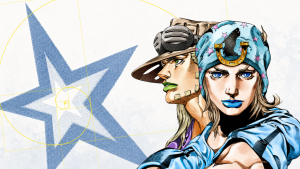
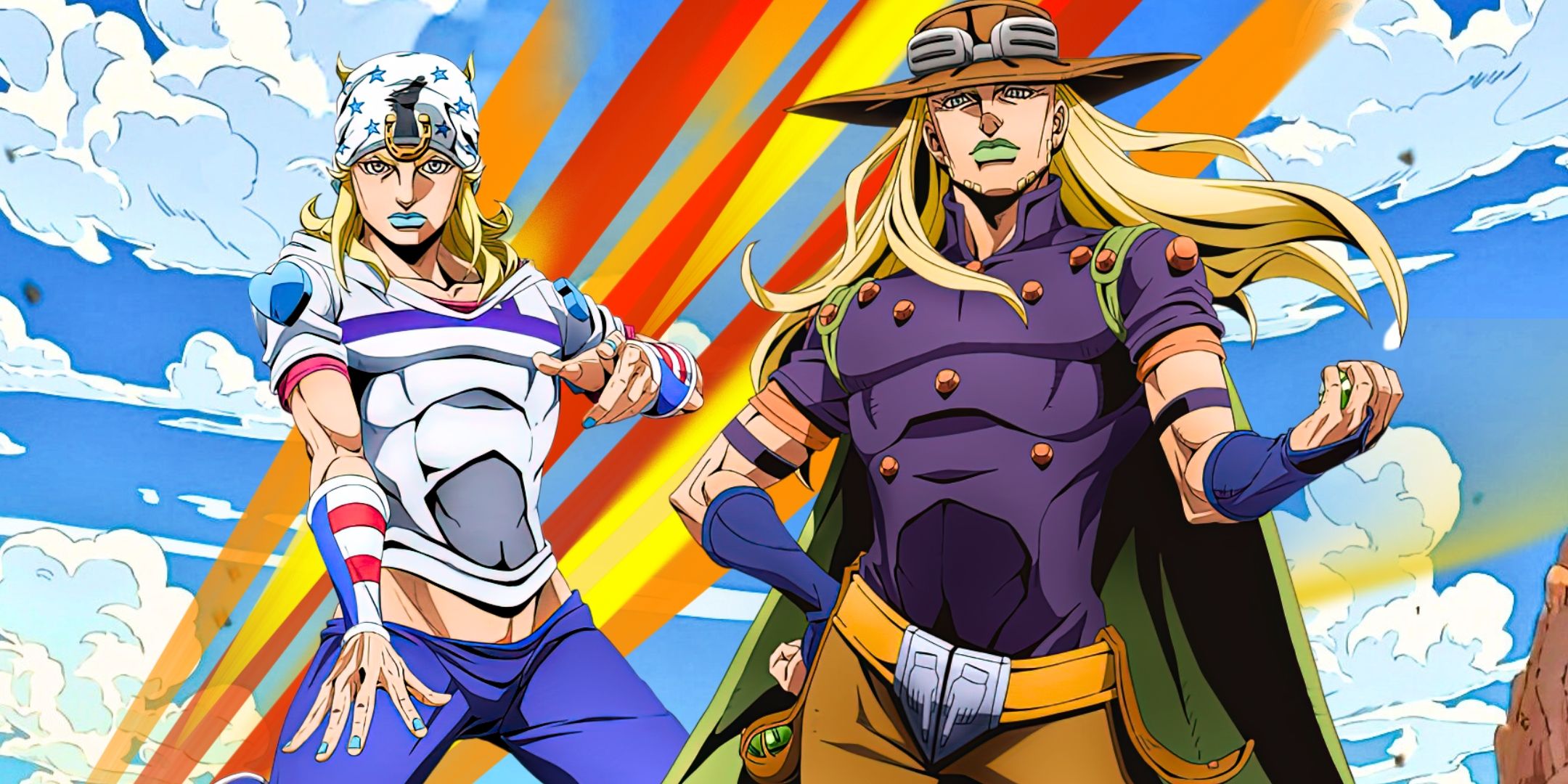
At the beating heart of this grand American odyssey is the dynamic between Johnny Joestar and Gyro Zeppeli, arguably the most fully realized partnership in modern comic history. Unlike the instantly heroic Jonathan or the swaggering, infallible Jotaro, Johnny Joestar begins his journey as an unlikable, fallen prodigy. Crippled by a hubristic mistake that severed his spine and derailed his equestrian career, Johnny is bitter, selfish, and desperate. His quest is not righteous; it is entirely self-interested. He joins the race not for glory or patriotism, but because a momentary encounter with Gyro’s mysterious kinetic technology allows him to move his legs for a split second.
The Flame of “Dark Determination”
Araki paints Johnny with an unnerving psychological nuance. Throughout the manga, Johnny exhibits what Araki famously terms shikkoku no ishi—a “dark determination.” It is a vacant, terrifying glint in his eyes signaling a willingness to kill without hesitation to reclaim his humanity. Contrasting Johnny’s brooding existential dread is Gyro Zeppeli, a disgraced Neapolitan executioner’s son armed with twin revolving steel spheres, an absurd repertoire of terrible dad jokes, and an unyielding personal code of honor. Gyro rides not for himself, but to win amnesty for an innocent child condemned to death back in Italy.
Their camaraderie does not evolve through trite declarations of friendship, but through shared suffering, tactical synergy, and the quiet intimacy of nights spent huddled around campfires beneath cold desert skies. David Production’s voice casting and sound design team will face the daunting task of capturing this fragile, sacred chemistry—a bond that transitions from skeptical transactional mentorship to an unbreakable spiritual brotherhood.
The Metaphysics of the Spin: Beyond Traditional Stands
While Stands naturally return as the narrative progresses, Steel Ball Run enriches the franchise’s combat meta by introducing The Spin. Grounded in the mathematical aesthetic of the Golden Ratio and Fibonacci sequences, the Spin functions as a spiritual successor to Part 1 and 2’s Hamon, reimagined through advanced spatial physics and anatomical mastery.
The visual execution of the Spin in anime form will require an extraordinary level of stylized kinetic flair. Gyro’s steel spheres warp the flesh, skin, and spatial awareness of his targets, acting as precision conduits of rotational energy. Simultaneously, Johnny’s evolving Stand, Tusk, bridges the gap between stand abilities and the Spin. As Johnny’s psychological resolve matures across four distinct “Acts,” his Stand transforms from a bizarre, rudimentary finger-nail projectile launcher into an interdimensional, reality-shattering juggernaut. Translating these intricate geometric concepts and surreal body-horror shifts into movement demands an animation philosophy that honors Araki’s high-fashion illustrative linework while maintaining clarity during blinding, supersonic combat.
The Equestrian Dilemma: The Nightmare of Animating Part 7
For all the narrative brilliance of Steel Ball Run, there remains a terrifying, unignorable challenge: horses. Within the animation industry, quadrupeds—and horses in particular—are notoriously considered an animator’s graveyard. The complex muscular anatomy of a galloping stallion, the rhythmic shifting of hooves, and the physics of reins, saddles, and riders in constant, high-speed motion make drawn equestrian animation staggeringly expensive and labor-intensive.
CGI vs. 2D: The David Production Balancing Act
Unlike Stardust Crusaders or Golden Wind, where characters largely stood stationary while their Stands traded rapid-fire punches, Steel Ball Run features hundreds of consecutive chapters set atop galloping mounts across diverse terrain. The creative team at David Production faces a monumental technical crossroads:
Do they deploy heavily shaded 3D CGI models for the horses—akin to the modern hybrid pipelines seen in Studio Orange’s works or Wit Studio’s early seasons of Attack on Titan? Or do they risk catastrophic production burnout by attempting traditional 2D keyframing? Fans have watched the divisive aesthetic of Stone Ocean‘s batch release closely. For Steel Ball Run to claim the cultural crown it deserves, David Production cannot rely on cost-cutting shortcuts. It will require an expanded production cycle, unrivaled compositing artistry, and likely a partnership with a world-class 3D CG studio capable of matching the gritty, tactile weight of Araki’s inked crosshatching.
The Modern Political Allegory: Funny Valentine and the Saint’s Corpse
An appraisal of Steel Ball Run’s anime prospects is incomplete without examining its antagonist: the 23rd President of the United States, Funny Valentine. Armed with the multiverse-hopping Stand Dirty Deeds Done Dirt Cheap (D4C), Valentine is widely regarded as Araki’s most multifaceted antagonist. Valentine is not driven by psychopathic megalomania like Dio, nor obsessive introversion like Yoshikage Kira. He is consumed by extreme, uncompromising patriotism.
His quest to gather the scattered remnants of a sacred, holy mummy—heavily implied to be Jesus Christ—to grant the United States eternal prosperity at the literal expense of the rest of the world makes him a chillingly relevant political archetype. The inevitable animated collision between Valentine’s twisted utilitarian doctrine and Johnny’s selfish, raw fight for survival promises to deliver some of the most philosophically layered, tension-drenched television of the decade.
The Starting Pistol Awaits
The road to adapting JoJo’s Bizarre Adventure: Steel Ball Run is paved with logistical hurdles, sky-high expectations, and the daunting shadow of Araki’s finest work. Yet, that very adversity is what makes the prospect so intoxicating. If David Production can harness the patience, resources, and uncompromised artistic ambition that defined the heights of Rohan Kishibe and Golden Wind, Part 7 has the latent potential to transcend the seasonal anime landscape and establish itself as an all-time classic of modern animation.
The horses are pacing behind the starting gate. The tension in the air is palpable, and the track ahead is vast and unforgiving. The only question that remains is: when the starting pistol fires, will David Production be ready to ride?
What do you think of the challenges facing a Steel Ball Run adaptation? Should David Production embrace high-end 3D CGI for the race sequences, or stick strictly to traditional 2D? Drop your thoughts in the comments below!