JoJo’s Bizarre Adventure: Steel Ball Run — The Most Anticipated Anime Adaptation of a Generation Is Finally on the Horizon
For over a decade, the words “Steel Ball Run anime” have functioned as a kind of sacred incantation within the JoJo fandom — whispered in comment sections, emblazoned across fan art, and debated endlessly on Reddit threads that stretch longer than the fictional race at the story’s center. Now, with David Production having triumphantly carried the animated JoJo saga through Stone Ocean‘s universe-resetting finale, the studio stands at the threshold of what many consider the single most ambitious adaptation challenge in modern anime. Steel Ball Run isn’t just the next JoJo part. It’s Hirohiko Araki’s magnum opus — a genre-defying western epic that fuses Cormac McCarthy’s desolate Americana with metaphysical Stand battles, disability narrative, and one of the most emotionally devastating bromances in manga history. The question isn’t whether it deserves a world-class adaptation. The question is whether any studio on Earth can do it justice.
The Weight of Part 7: Why Steel Ball Run Is Araki’s Definitive Statement
Published in Ultra Jump from 2004 to 2011, Steel Ball Run marked a radical reinvention of the JoJo franchise. Set in an alternate 1890 America, it follows the Steel Ball Run race — a grueling, cross-continental horseback competition stretching from San Diego to New York City, with a $50 million purse that attracts cowboys, assassins, government agents, and the spiritually broken alike. But beneath the surface-level spectacle of a transcontinental horse race lies Araki’s most thematically sophisticated work: a meditation on faith, the will to stand, the nature of gravity, and whether redemption is something earned or bestowed.
What separates Part 7 from its predecessors isn’t just the setting — it’s the narrative architecture. Unlike the episodic villain-of-the-week structure that defined earlier parts, Steel Ball Run operates as a tightly woven novel. Every stage of the race feeds into a larger conspiracy involving the corpse parts of a holy figure, President Funny Valentine’s nationalist ambitions, and the metaphysical concept of “gravity” that Araki had been building toward since Stone Ocean. It is, without exaggeration, the most critically acclaimed part of JoJo — consistently topping fan polls and earning comparisons to literary westerns far outside the manga sphere.
A New Universe, A New Kind of JoJo
Part 7’s position as the first entry in the “SBR Universe” — a continuity reset from Parts 1–6 — gives it a unique narrative freedom. New viewers won’t need six seasons of context. This is both a creative blessing and a marketing goldmine for David Production and whatever streaming platform secures distribution rights. Steel Ball Run is, paradoxically, the most accessible JoJo story and the most complex one simultaneously — a perfect entry point wrapped in layers that reward deep franchise knowledge.
Johnny Joestar and Gyro Zeppeli: The Broken Hero and the Golden Mentor
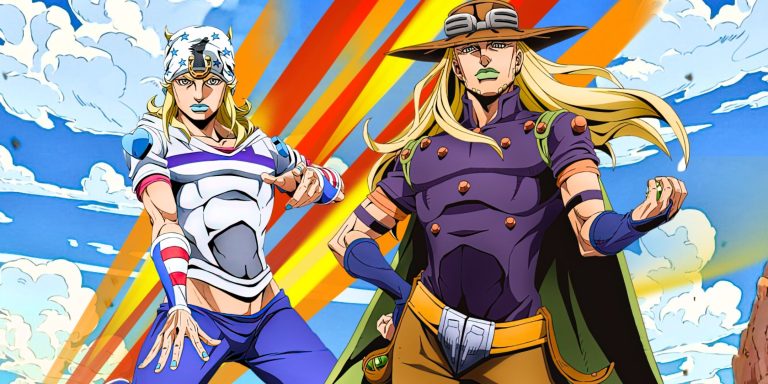
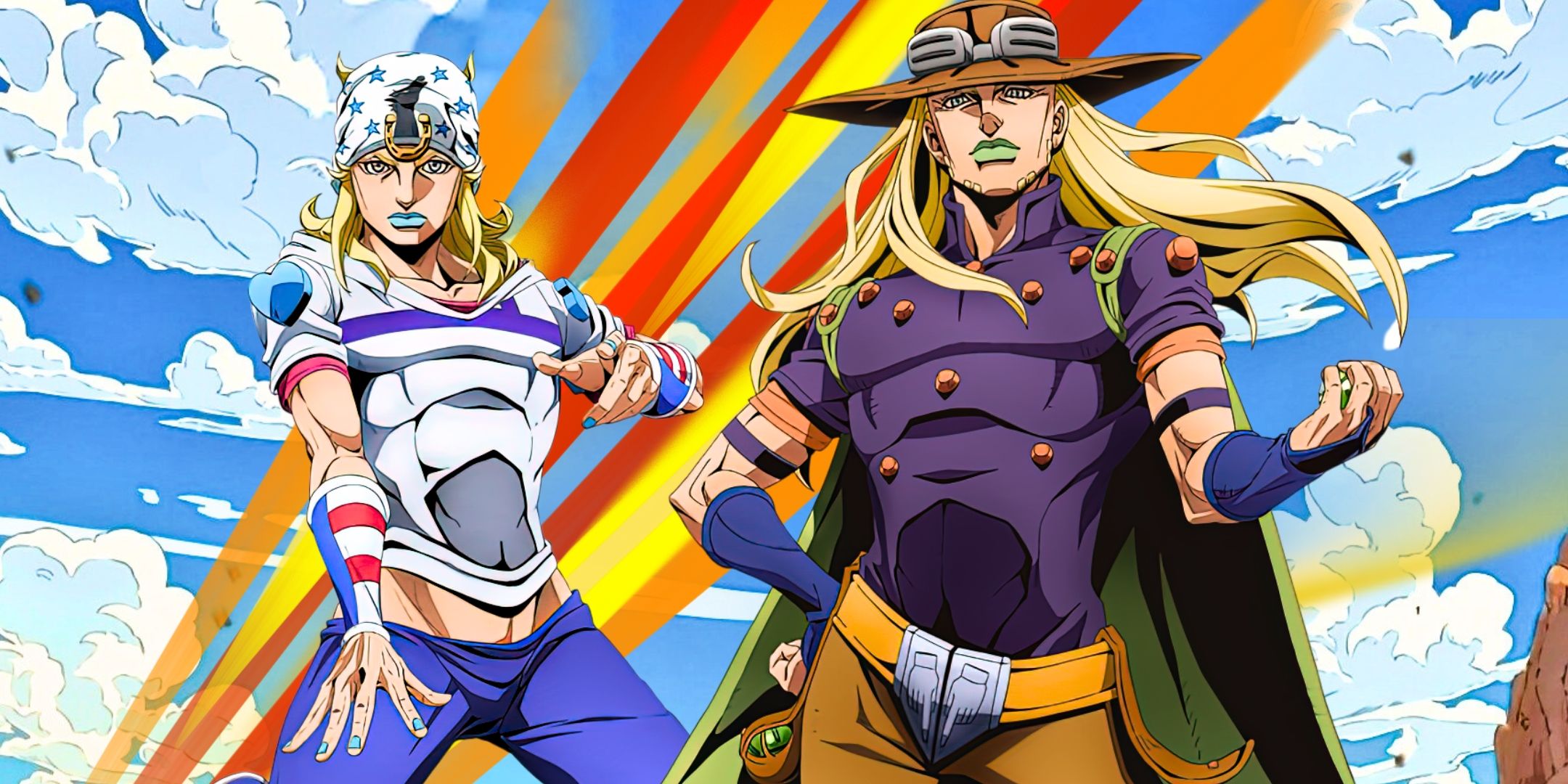
At the heart of Steel Ball Run is one of manga’s greatest character duos. Johnny Joestar — the alternate-universe counterpart of Jonathan Joestar — is a former horse-racing prodigy left paraplegic after a shooting incident born from his own arrogance. He is, by design, the most unheroic JoJo protagonist Araki ever created: bitter, self-serving, and driven not by justice but by a desperate, almost feral need to reclaim the ability to walk. His character arc from selfish desperation to something approaching grace is one of the most nuanced disability narratives in shōnen history — one that never sanitizes his pain or reduces his wheelchair to a simple metaphor.
Then there’s Gyro Zeppeli, the Neapolitan executioner’s son who enters the race to win a pardon for a condemned child — a man whose flamboyant exterior (the grills, the teddy-bear-studded hat, the relentless pizza mozzarella jokes) masks a profound moral seriousness. Gyro is the deuteragonist who arguably is the protagonist in terms of thematic weight. His mastery of the Spin — the SBR universe’s answer to Hamon and Stands — becomes the story’s central visual and philosophical motif. The Golden Rectangle, the Fibonacci sequence, the infinite rotation: Araki transforms mathematics into mythology, and Gyro is its high priest.
Their relationship — mentor and student, cynic and idealist, two broken men teaching each other how to move forward — is the emotional engine that makes Steel Ball Run transcend its genre. Voice casting for these two roles will be among the most scrutinized decisions in anime history. The fandom has opinions. Strong opinions.
David Production’s Greatest Technical Challenge: Horses, Dust, and the Infinite Spin
Let’s address the elephant — or rather, the horse — in the room. Steel Ball Run is, fundamentally, a story about people on horseback. Constantly. For 24 volumes. And animating horses convincingly is one of the most notoriously difficult tasks in the medium. Equine locomotion involves complex, multi-joint biomechanics that look immediately wrong when simplified. Studios have historically avoided extended horseback sequences for exactly this reason. David Production isn’t being asked to animate a cavalry charge scene — they’re being asked to build an entire series around it.
The expectation is that CG integration will play a significant role, and the studio’s track record here is mixed. Stone Ocean showed improvement in blending 2D and 3D elements, but the leap required for SBR is exponential. We’re talking about dynamic racing sequences across deserts, mountains, forests, and urban landscapes — often while Stand battles rage simultaneously. The Spin itself presents another visual puzzle: how do you animate a steel ball rotating at infinite speed along the Golden Rectangle in a way that feels visceral rather than abstract? Araki’s manga panels use intricate linework and mathematical diagrams to convey the Spin’s power. Translating that kinetic energy to motion will require genuine creative innovation.
The Western Aesthetic and Araki’s Cinematic DNA
Beyond the technical hurdles, there’s the question of atmosphere. Steel Ball Run is drenched in the visual language of Sergio Leone spaghetti westerns, John Ford’s Monument Valley compositions, and the sun-bleached desolation of Sam Peckinpah. Araki has cited Clint Eastwood films as direct inspirations. The color design, the vast negative space of the American frontier, the dust-choked sunsets — these aren’t decorative choices. They’re structural to the storytelling. David Production’s art direction team will need to channel a cinematic grammar that anime rarely attempts at this scale. If they nail it, SBR could redefine what anime landscapes look like. If they don’t, the story’s soul will feel hollow regardless of how well the fights are choreographed.
Funny Valentine and the Politics of Villainy
President Funny Valentine deserves his own discussion because he represents Araki’s most philosophically challenging antagonist. A patriot who genuinely believes that redirecting all misfortune away from America (and onto the rest of the world) constitutes moral governance, Valentine isn’t a cackling megalomaniac — he’s a compelling nationalist with an internally consistent ethical framework. His Stand, Dirty Deeds Done Dirt Cheap (D4C), which allows him to travel between parallel dimensions, is both a narrative Swiss Army knife and a thematic mirror for American exceptionalism: the idea that one nation can simply export its suffering elsewhere.
Adapting Valentine will require the anime to sit in moral ambiguity without flinching. His famous napkin monologue — about how societal order is determined not by justice but by who “takes the napkin first” — is one of the most quoted villain speeches in manga. Getting that scene right could produce an iconic anime moment on par with any in the medium’s history.
Community Pulse: A Fandom Holding Its Breath
The JoJo community is in a peculiar state of ecstatic anxiety. Every David Production staff interview is dissected for subtext. Animation reels are analyzed frame by frame. Fan animators have already produced stunning proof-of-concept SBR sequences on YouTube, simultaneously raising the bar and demonstrating the raw hunger for this adaptation. The discourse around potential episode count (fans are pushing hard for a multi-cour, 40+ episode commitment), pacing decisions, and whether the anime will retain the manga’s more graphic moments of violence and body horror remains fervent.
There’s also the streaming question. With Stone Ocean‘s Netflix batch-release model drawing significant criticism for fracturing weekly community engagement, fans are vocally hoping SBR returns to a simulcast weekly format — the kind that lets collective hype build organically, episode by episode, meme by meme.
The Road Ahead: Why Steel Ball Run Could Define the Next Era of Anime
If David Production delivers on the promise of Steel Ball Run, we won’t just be looking at another great JoJo season. We’ll be looking at a potential watershed moment for anime as a storytelling medium — proof that the industry can adapt dense, literary, visually experimental manga without compromise. The ingredients are all there: a narrative universally regarded as a masterpiece, a studio with deep institutional knowledge of the franchise, and a global fanbase ready to evangelize every frame.
But the margin for error is razor-thin. Steel Ball Run demands more than competence. It demands artistry.
Stay locked in with Wibux.com for every casting announcement, trailer breakdown, and production update as the Steel Ball Run adaptation takes shape. Drop your dream voice cast picks and animation studio wishlists in the comments below — because this conversation is just getting started, and the race is about to begin.