Ever since the melancholic, bittersweet notes of Duffy’s “Distant Dreamer” faded over the climax of Stone Ocean, a profound, anticipatory quiet has settled over the anime landscape. For over a decade, David Production pulled off what was once deemed impossible: translating Hirohiko Araki’s notoriously eccentric, anatomically fluid, and genre-defying generational saga into a modern animated benchmark. Yet, as the original Joestar bloodline reached its definitive, universe-resetting punctuation mark, every gaze turned West. Specifically, toward the wind-battered shores of 1890 San Diego, where thousands of equestrians line up to embark on an unforgiving transcontinental dash. We have officially entered the era of the Steel Ball Run vigil.
To call Part 7: Steel Ball Run merely “anticipated” is an understatement of colossal proportions. On cataloging platforms like MyAnimeList, Araki’s seventh chapter has long reigned as the second highest-rated manga in history, resting shoulder-to-shoulder with Kentaro Miura’s Berserk. It is universally lauded not merely as a high-water mark for the franchise, but as Araki’s transcendent magnum opus. Yet, between whispered production leaks and rampant internet speculation, a vital question remains: how will David Production tackle a masterwork that is as technically terrifying to animate as it is narratively sublime?
The Great American Rebirth: Resetting the Lore and the Seinen Evolution
To comprehend the sheer cultural gravity surrounding Steel Ball Run, one must understand its historic break from convention. Serialized initially in Weekly Shonen Jump before migrating to the monthly, mature pages of Ultra Jump in 2005, Steel Ball Run granted Araki total creative emancipation. The breathless, weekly grind gave way to expansive, meticulously researched paneling, cinematic wide-angle vistas, and a dramatic elevation of thematic complexity. This was no longer just a bizarre adventure; it was a gritty, tragic, revisionist Western epic steeped in Americana, supernatural dread, and political maneuvering.
A Clean Slate with Historical Stakes
By hitting the cosmic reset button, Araki liberated himself from the generational baggage of the preceding six parts. Set against the backdrop of an exorbitant, cross-country horse race spanning from San Diego to New York City, the narrative centers on an eccentric cast vying for a $50 million grand prize. Beneath the spectacle of the race, however, lies an occult conspiracy: the search for the scattered, mummified relics of a divine figure known simply as the Saint’s Corpse. This narrative pivot traded the urban scuffles of Morioh and the prison-yard brawls of Green Dolphin Street for the sprawling, lethal isolation of the American frontier.
Johnny Joestar and Gyro Zeppeli: Deconstructing the JoJo Archetype
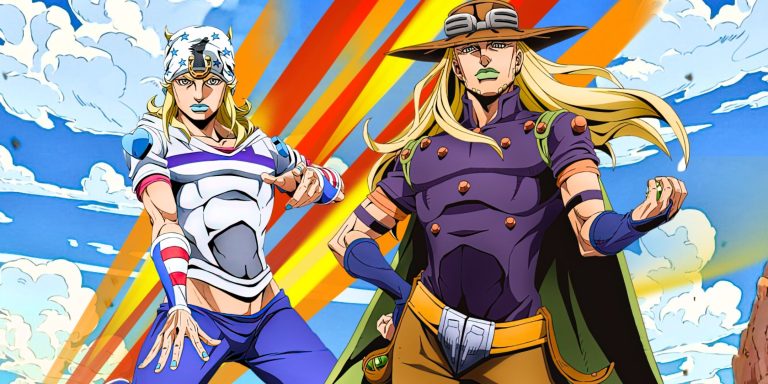
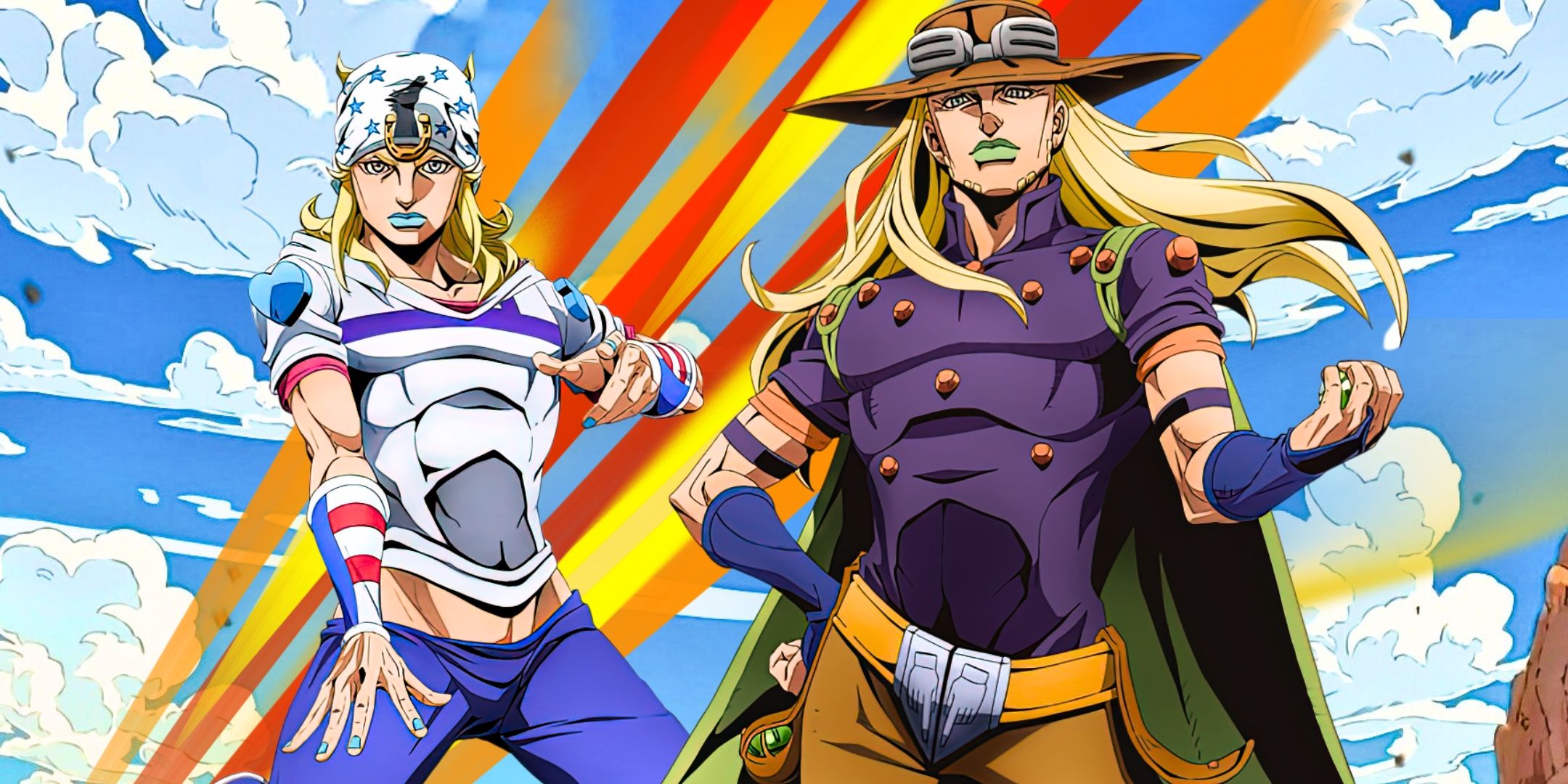
At the beating heart of this frontier epic lies the most profound, emotionally resonant partnership Araki has ever penned: the fraught, symbiotic camaraderie between Johnny Joestar and Gyro Zeppeli. In an industry saturated with idealized, morally unyielding protagonists, Johnny stands as a stark, unapologetically flawed anomaly.
The Pariah’s Dark Determination
Unlike Jonathan Joestar’s noble chivalry or Jotaro Kujo’s stoic righteousness, Johnny begins his odyssey as an outcast. A former prodigy jockey struck down in his prime by his own hubris, Johnny is a paraplegic stripped of his prestige, family, and dignity. He is bitter, cynical, and marked by what Araki explicitly terms “Dark Determination”—a ruthless, pitch-black moral flexibility that borders on villainous when his survival or goal is threatened. Johnny does not join the race to save the world; he mounts a horse simply to regain sensation in his legs and discover how to “start from zero, rather than negative.”
The Executioner and the Golden Spin
Balancing Johnny’s corrosive trauma is Gyro Zeppeli, a disgraced officer from the Kingdom of Naples brandishing steel spheres and an absurd, golden-toothed grin. Serving as Johnny’s reluctant mentor, Gyro injects the journey with existential philosophy and dark comedic levity. Their bond transcends standard shonen dynamics; it is an agonizing, beautiful study of two broken men navigating grief, redemption, and identity.
Furthermore, Gyro introduces the Spin—Araki’s ingenious thematic successor to Hamon (Ripple). Rooted in the biological and mathematical perfection of the Golden Ratio and Fibonacci sequence, the Spin transforms kinetic energy into a metaphysical weapon. Watching this dynamic geometric power evolve alongside Johnny’s Stand, Tusk, from brittle fingernail projectiles to multi-dimensional realities represents some of the most conceptually daring storytelling ever committed to sequential art.
The Elephant in the Stable: David Production’s Equestrian Nightmare
If the narrative pedigree of Steel Ball Run is ironclad, its path to animation is a logistical minefield. Within the anime industry, there is an infamous, universally recognized axiom: animating horses is suicide for production schedules.
The Technical Hurdles of Quadruped Anatomy
Equine anatomy is notoriously complex. Unlike human bipedal motion, drawing a horse requires an acute understanding of shifting bone structures, undulating muscle mass, weight distribution, and galloping gaits. Now, multiply that difficulty by dozens of racers colliding across dust-choked deserts, traversing icy mountain passes, and dueling at full gallop with reality-bending Stands. Industry insiders have long cited this monumental barrier as the primary reason an adaptation has taken so long to materialize.
David Production stands at a pivotal technological crossroads. The studio has three primary avenues:
First, an overwhelming reliance on 2D animation, which risks melting animator hands, delaying episodes, and burning through unprecedented budgets. Second, pure 3D CGI integration, a route that runs the severe risk of triggering the uncanny-valley backlash that famously doomed series like 2016’s Berserk. The third—and most likely—approach is an ambitious hybrid pipeline. By pairing high-end, cell-shaded 3D assets for distance races with hand-drawn, rotoscoped 2D close-ups for intimate duels, the studio could mirror the stylistic triumph that Orange achieved with Trigun Stampede or MAPPA’s intricate hybrid work.
Funny Valentine and the Moral Landscape of Patriotism
An appraisal of Steel Ball Run remains fundamentally incomplete without addressing its primary antagonist: the 23rd President of the United States, Funny Valentine. Armed with an immovable, utilitarian philosophy and the dimensional-hopping Stand known as D4C (Dirty Deeds Done Dirt Cheap), Valentine elevates the narrative into high-stakes political intrigue.
Valentine is not a mustache-twirling cartoon despot. He is driven by pure, unadulterated patriotism, viewing the acquisition of the Saint’s Corpse as a sacred imperative to secure eternal prosperity for his nation—even if it means displacing disaster and misery onto the rest of the world. In the climactic confrontations, Araki blurs the line between protagonist and antagonist so radically that the reader is forced to confront uncomfortable truths regarding nationalism, sacrifice, and the morality of absolute conviction. Translating Valentine’s dimension-folding battles onto the screen will test David Production’s cinematic direction to its absolute limit.
The Starting Line Awaits
The cultural buzz surrounding the Steel Ball Run anime is more than simple fandom impatience; it is the collective yearning for a transformative milestone in the medium. It represents the convergence of Araki’s peak literary ambitions with an animation studio that has spent a decade honing its voice, color theory, and audio design to near-mythic heights.
When that starting pistol finally fires and the race across the American continent begins, the anime sphere will witness a spectacle unlike anything before: a sprawling, violent, emotionally devastating Western that challenges our concepts of heroism, fate, and the indomitable human spirit. The road ahead is undeniably steep, but in the immortal words that whisper through the Zeppeli lineage: the shortest route has always been a detour.
Are you holding out hope for a purely 2D adaptation, or do you think David Production should lean into cutting-edge CGI for the horses? Who is your dream voice cast for Johnny and Gyro? Sound off in the comments below, and keep your browsers locked to Wibux.com for all incoming JoJo updates!