Ever since the melancholic notes of “Distant Dreamer” faded over the rebooted sunset of Stone Ocean, the international anime collective has existed in a state of suspended animation. For over a decade, David Production pulled off what critics once considered impossible: transforming Hirohiko Araki’s wildly eccentric, anatomy-defying manga into a generation-defining anime powerhouse. Yet, throughout every multi-hued color palette shift and bass-boosted Stand cry, an unspoken truth lingered in the wings of anime conventions and forum threads alike. Everything—from Jonathan Joestar’s gentlemanly Hamon to Jolyne Cujoh’s prison break—was merely a prologue to the grandest ambition on the horizon: JoJo’s Bizarre Adventure: Steel Ball Run.
Widely revered by manga literati as Araki’s undisputed magnum opus, Part 7 represents a tectonic shift in both narrative maturity and aesthetic precision. Sitting comfortably near the apex of MyAnimeList’s top-rated manga of all time, the sheer anticipation behind this project rivals the fever pitch seen before Chainsaw Man or Bleach: Thousand-Year Blood War. But bringing Steel Ball Run to the small screen is not merely a matter of greenlighting another cour; it is David Production’s ultimate frontier, a gauntlet demanding unprecedented technical prowess, thematic sophistication, and stylistic reinvention.
The Trans-American Odyssey: Why Steel Ball Run is Araki’s Magnum Opus
To grasp why Steel Ball Run carries such monumental gravity, one must examine the watershed era in which it was forged. When serialization kicked off in early 2004 under the banner of Weekly Shonen Jump, it began as an apparent standalone period piece before pivoting to the seinen-oriented pages of Ultra Jump in 2005. That editorial migration changed everything. Unshackled from the demographic boundaries and weekly turnaround pressure of standard teenage battle manga, Araki blossomed.
Set against the sprawling, sun-bleached expanse of late-nineteenth-century America, Steel Ball Run transforms a grueling coast-to-coast equestrian race—from San Diego Beach to New York City—into an existential psychological battlefield. Araki fused classic spaghetti western tropes with cosmic dread and historical reimagining. The five-million-dollar purse is an illusion; the true catalyst is the hunt for the scattered mummified Relics of an unnamed Saint, capable of altering the geopolitical destiny of nations. It is a work of breathtaking ambition, boasting cinematic page layouts, panoramic cross-hatching, and an uncompromising, gritty visual style that makes its predecessors look like rehearsal runs.
Johnny Joestar and Gyro Zeppeli: Flawed Humanity and The Golden Ratio
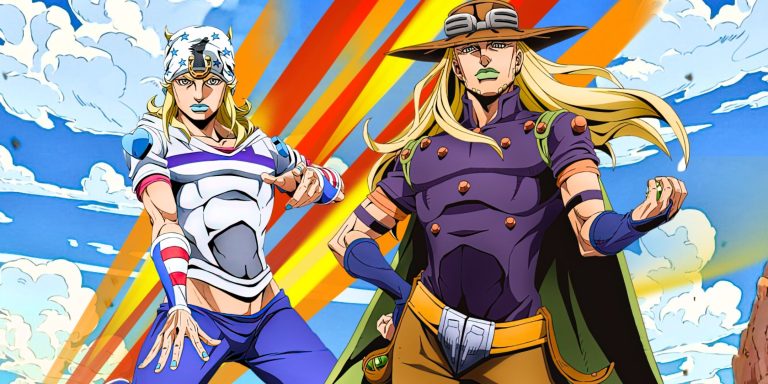
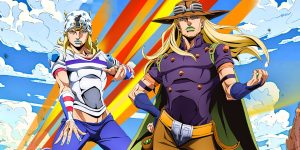
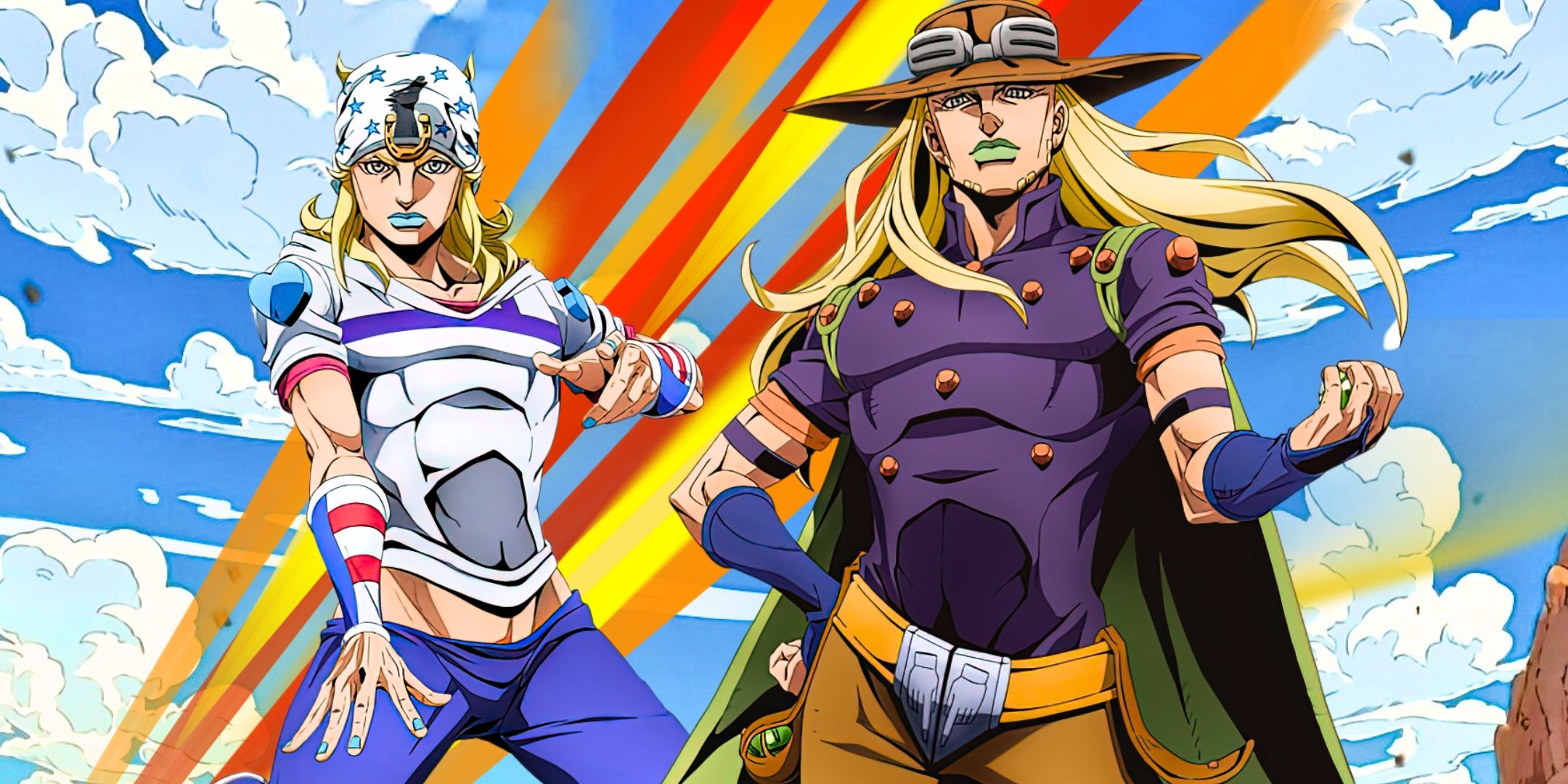
At the beating heart of this sprawling dust storm lies the most complex, profoundly compelling dual-protagonist dynamic in modern sequential art: Johnny Joestar and Gyro Zeppeli.
The Anti-Hero with Dark Determination
Johnny Joestar is an absolute departure from every JoJo that came before him. A former prodigy jockey whose hubris cost him his family, his fame, and the use of his legs, Johnny begins his odyssey not out of righteous benevolence, but out of desperate, bitter self-interest. He possesses what Araki chillingly labels “dark determination”—the pitch-black glint in a person’s eyes when they are willing to kill or sacrifice their own soul to reclaim what was lost. His Stand, Tusk, mirrors this harrowing psychological journey, evolving from a frail, nail-shooting cherub into a hulking, dimensional-shattering juggernaut as Johnny reconciles with his trauma.
Gyro Zeppeli and the Legacy of the Spin
Contrasting Johnny’s brooding gloom is Gyro Zeppeli, a disgraced executioner from the Kingdom of Naples whose absurd eccentricity—immortalized in gold-plated teeth and terrible jokes about mozzarella cheese—masks profound familial guilt and a noble moral spine. Gyro acts as Johnny’s mentor, companion, and philosophical anchor. Through Gyro, Araki introduced the Spin, a supernatural martial art rooted in the mathematics of the Golden Rectangle. Unlike the raw biological energy of Hamon or the psychic projections of Stands, the Spin is a cosmic science of rotation, momentum, and sacred geometry. The organic give-and-take between Johnny and Gyro forms an emotional bedrock unprecedented in the franchise, ensuring that the stakes feel intimate even when the fate of reality itself hangs in the balance.
The Equestrian Gauntlet: David Production’s Monumental Production Hurdle
If Steel Ball Run is universally heralded as a masterpiece, why hasn’t an anime adaptation sprinted out of the gates? The answer lies within the brutal reality of the animation industry: horses.
Ask any seasoned sakuga veteran or production animator, and they will tell you that four-legged quadrupeds—specifically horses in dynamic motion—are the absolute bane of 2D animation pipelines. Capturing the intricate skeletal mechanics, shifting muscle mass, and thunderous hooves of dozens of stallions galloping side-by-side through varied terrain requires an exorbitant amount of time, budget, and elite draftsmanship. In an era where production crunches routinely decimate animation schedules across top-tier studios, animating hundreds of consecutive episodes heavily featuring equestrian warfare is a logistical nightmare.
David Production stands at a critical technological crossroads. To execute Steel Ball Run without driving its workforce into ruin, the studio will inevitably need to rely on a sophisticated hybrid approach:
- Next-Gen 3D CGI Integration: Much like Studio Orange’s masterclasses in Trigun Stampede or the complex 3D maneuvers utilized in modern historical epics, David Pro must develop hyper-stylized 3D horse models that seamlessly blend with hand-drawn character profiles.
- Camera Rigging & Speed Illusion: Utilizing dynamic kinetic framing and perspective warping to emphasize velocity, compensating for frames where full anatomical breakdown would otherwise bottleneck the episode’s pipeline.
- Dedicated Prestige Pacing: Rumors and industry speculation suggest that unlike the marathon 39-episode runs of prior parts, Steel Ball Run could demand a seasonal or split-cour release schedule to preserve the breathtaking artistic fidelity Araki delivered in Ultra Jump.
The Saint’s Corpse and Funny Valentine: The Ultimate Antagonist
An adaptation of Part 7 cannot succeed on technical horsepower alone; it requires an unflinching approach to its socio-political narrative. Enter Funny Valentine, the 23rd President of the United States and undeniably Araki’s most layered, chillingly charismatic antagonist.
Armed with Dirty Deeds Done Dirt Cheap (D4C)—a terrifying Stand granting him passage across parallel dimensions—Valentine does not lust for chaotic evil or personal tyranny in the vein of Dio Brando or Yoshikage Kira. Instead, Valentine is propelled by an absolute, zealous belief in American exceptionalism. He pursues the Saint’s Corpse to anchor global prosperity exclusively within his country’s borders, deliberately deflecting all suffering, disease, and tragedy onto the rest of the planet. Adapting this storyline will require David Production to handle sensitive geopolitical themes and visceral, psychological body horror with the utmost narrative precision.
The Final Stretch: When Can Fans Expect the Green Flag?
While David Production and Warner Bros. Japan remain tight-lipped, dropping mere breadcrumbs and focusing recent resources on spin-offs like Thus Spoke Kishibe Rohan, the momentum surrounding Steel Ball Run is undeniable. Historically, the gap between Golden Wind and Stone Ocean demonstrated that the studio is more than willing to take its time to assemble the right creative staff. As milestone franchise anniversaries approach and the global streaming appetite for prestige anime reaches an all-time high, the gears behind the curtain are undoubtedly turning.
When the signal flare finally fires and the race across the American frontier begins, it won’t just be another season of television—it will mark the monumental reimagining of anime’s most daring reinvention. The saddles are strapped, the Golden Ratio is calculated, and the fandom is holding its collective breath.
How do you think David Production should tackle the legendary horse race—pure 2D sakuga or stylized 3D hybrid? Drop your theories and favorite Gyro moments in the comments below, and stay tuned to Wibux.com for all breaking JoJo’s Bizarre Adventure updates!