

After an unprecedented theatrical run that raked in over $100 million worldwide and ignited packed, screaming multiplexes from Shinjuku to Los Angeles, Haikyu!! The Dumpster Battle has finally arrived on global streaming services. For sports anime enthusiasts and manga loyalists, this is not merely another high-profile digital drop; it is the realization of a decade-long narrative promise. The fabled “Battle at the Garbage Dump” between Karasuno High and Nekoma High is the beating heart of Haruichi Furudate’s masterpiece. Now accessible to viewers worldwide from the comfort of their homes, the film confirms what many of us suspected during its theatrical debut: this eighty-five-minute kinetic hurricane represents the pinnacle of modern sports storytelling.
The Bloodline of a Rivalry: Decades in the Making
What separates Karasuno versus Nekoma from standard tournament matchups across the shonen landscape is the sheer weight of its heritage. Most sports rivalries are manufactured through proximity, petty grievances, or bracket seeding. The feud between the Crows and the Cats, however, is an inherited grudge that spans generations. Originating with the fiery rivalry between former head coaches Ikkei Ukai and Yasufumi Nekomata, the two historic powerhouses chased an official national showdown for decades, only to consistently miss one another on the grandest stage.
Throughout the television anime’s four preceding seasons, Nekoma served as Karasuno’s mirror and ultimate training partner. They traded hundreds of sets in anonymous, humid Tokyo gymnasiums during summer training camps. Yet, the stakes here are fundamentally different. As the players perpetually remind themselves throughout the film, this is a match where the phrase “one more set” does not exist. There are no do-overs on the orange court of Tokyo Metropolitan Gymnasium. Once the ball hits the hardwood for the final time, the high school careers of their beloved third-years end forever.
The Architect vs. The Monster: Kenma’s Cage for Hinata
Rather than framing this epic encounter solely as a clash of team philosophies—Karasuno’s dynamic, airborne aggression versus Nekoma’s ironclad defensive circulation—director Susumu Mitsunaka zeroes in on the intimate psychological chess match between Kenma Kozume and Shoyo Hinata.
Suffocating the Sun: Kenma’s Algorithmic Trap
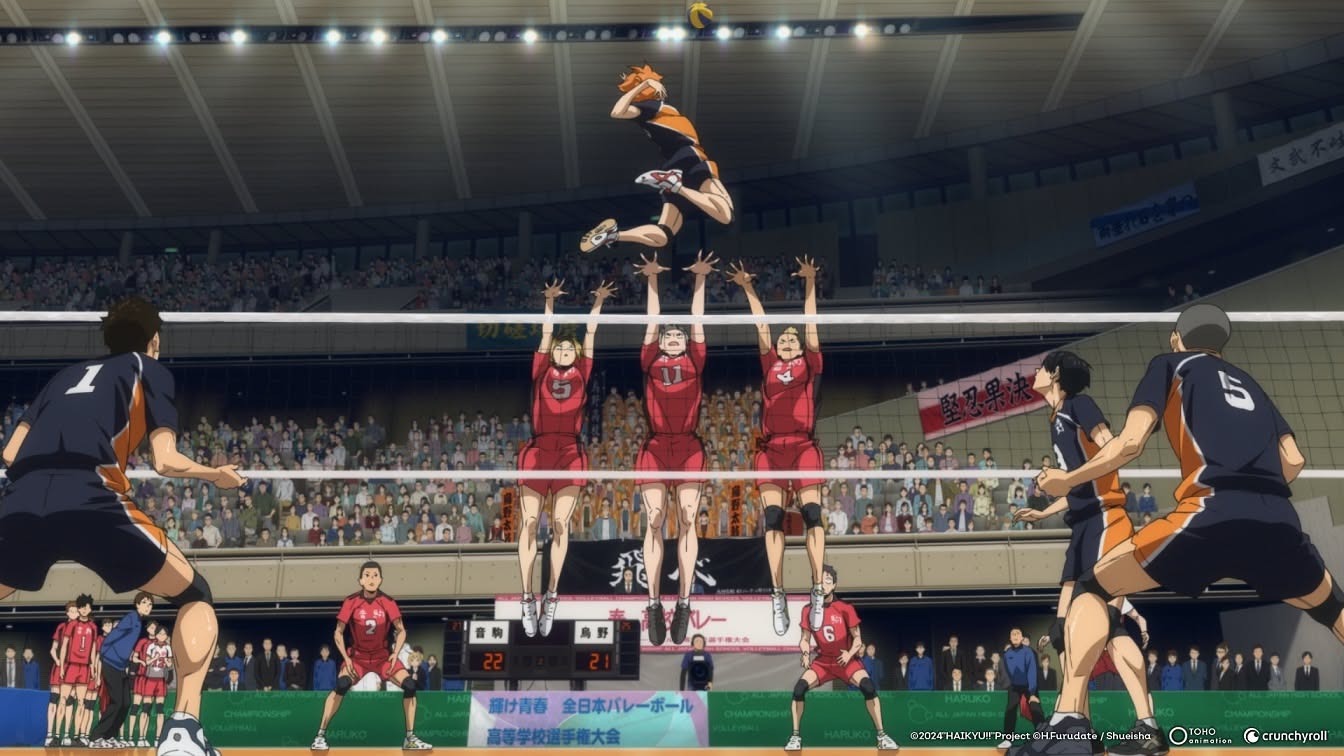
Kenma is the antithesis of the traditional sports anime protagonist. He is introverted, chronically fatigued, and driven purely by cold calculation rather than visceral passion. In Hinata, Kenma sees an unpredictable, radiant force of nature—an anomaly that threatens to disrupt Nekoma’s systemic equilibrium. The film excels brilliantly in visualizing Kenma’s strategic mind at work. As Nekoma manipulates ball placement to deny Hinata his necessary four-step approach run, the camera physically contracts. Mitsunaka frames Hinata within tighter, claustrophobic angles, literally illustrating the invisible cage Kenma has built around the “Crows’ greatest decoy.”
Breaking the Horizon: Evolution Through Fundamentals
What makes this tactical battle exhilarating is that Karasuno does not rely on a sudden, unrealistic supernatural power-up to escape Kenma’s stranglehold. When Hinata finally breaks free, it is through the quiet maturation of his technical fundamentals: an ultra-high open spike set by Tobio Kageyama that gives Hinata the time and vertical clearance to soar above Nekoma’s suffocating triple-block. The sudden silence that blankets the arena before Hinata leaps stands as one of the most chilling, beautifully directed pauses in sports anime history.
Production I.G’s Kinetic Masterclass: Directing Sweat, Gravity, and Perspective
Condensing an entire multi-volume manga match into an eighty-five-minute feature film drew skepticism from fans during pre-production. Yet, Production I.G transforms that structural compression into an asset. The pacing of The Dumpster Battle is relentless, mirroring the actual exhaustion of playing against a team that simply refuses to let the ball touch the floor.
The film’s technical crowning jewel is undeniably its climactic, extended first-person point-of-view sequence. As the match dissolves into a war of attrition in the third set, the camera slips behind Kenma Kozume’s sweat-streaked eyes. We hear his ragged, shallow breathing; we watch the court blur with motion-sickness intensity as the ball is dug, set, and spiked across the net in real time. By abandoning objective coverage for subjective, disorienting visceral realism, Production I.G pays homage to the legendary direction of Takahiro Kishida and Susumu Mitsunaka, delivering an animation flex that rivals the ground-level realism of Takehiko Inoue’s The First Slam Dunk.
The Existential Breakthrough: When the Game Becomes “Fun”
For all its tactical intricacy and visual spectacle, the true soul of The Dumpster Battle is emotional reconciliation. Throughout his entire life, Kenma has treated volleyball merely as a task to complete—a game to finish because his childhood friend, Tetsuro Kuroo, asked him to play. He famously avoids effort, shuns sweating, and treats intense athletic passion with distant bewilderment.
Yet, pushed to the absolute edge of his physiological capacity by Karasuno’s unyielding offense, the ice breaks. In the match’s dying moments, after an exhausting rally that feels more like an emotional purge than a contest, Kenma looks up at Kuroo through a curtain of drenched hair and mutters four simple words: “Kuroo. Thanks for teaching me volleyball. It’s fun.”
In that singular sentence, Haikyu!! deconstructs the foundational trope of shonen sports narratives. There are no villains here. There is no moral crusade to defend. There are only two groups of adolescents who love a sport so profoundly that the final whistle feels like an existential tragedy. The ending of the match—where a sweat-soaked ball slips harmlessly from Kenma’s exhausted fingertips—is an anti-climactic masterstroke. It reminds the audience that sports are defined as much by human frailty and friction as they are by triumphant, soaring spikes.
Setting the Gold Standard for Modern Sports Anime
Now that Haikyu!! The Dumpster Battle is streaming across international living rooms, its broader legacy can be properly contextualized. In an era where sports anime often leans heavily into battle-shonen archetypes, magical flourishes, or hyper-stylized ego clashes, Haikyu!! remains radically dedicated to the purity of athletic realism, team synergy, and profound empathy for every single athlete on the roster.
This film is not a disposable bridge leading into the upcoming clash against Kamomedai and the legendary “Little Giant” showdown; it is the thematic summit of the entire franchise. It justifies the cinematic format by presenting an unbroken, suffocating symphony of volleyball that demands your undivided attention from serve to match point.
Have you streamed Haikyu!! The Dumpster Battle yet? Did Kenma’s emotional confession bring a tear to your eye, or did Karasuno’s relentless offense steal the show? Drop your thoughts, favorite rallies, and Kamomedai predictions in the comments below!