
When the bittersweet melancholy of Stone Ocean’s reset universe faded into the credits of Episode 38 in late 2022, a deafening silence settled over the anime landscape. For over a decade, David Production maintained an almost sacred pact with the global anime fandom, adapting Hirohiko Araki’s generational chronicle with bespoke aesthetic fidelity, neon-drenched soundscapes, and iconic musical stingers. Yet, the moment Irene drove into the rain-slicked horizon, an inescapable phantom took root in the cultural consciousness: JoJo’s Bizarre Adventure: Steel Ball Run. Long hailed as Araki’s undisputed magnum opus and perpetually perched at the upper echelons of critical rankings like MyAnimeList, Part 7 is far more than another episodic cour. It represents an ontological reboot, a tonal renaissance, and the most harrowing production challenge modern Japanese television animation has dared to confront in the digital age.
The Trans-American Odyssey: Araki’s Masterpiece of Grit and Rebirth
To understand the unprecedented buzz surrounding a potential Steel Ball Run anime, one must first recognize the dramatic metamorphosis Hirohiko Araki underwent between 2004 and 2011. Mid-way through Steel Ball Run‘s serialization, the series shifted from the frenetic, youth-oriented confines of Weekly Shōnen Jump to the monthly, creator-friendly pages of Ultra Jump. The change in demographic was seismic. Suddenly unshackled from weekly editorial panics and censorial constraints, Araki transitioned from hyper-stylized brawls to an expansive, existential Western epic spanning the 1890 American frontier.
The premise itself is breathtaking in scope: thousands of international competitors gather on the sands of San Diego Beach to partake in a grueling, 6,000-kilometer cross-country horseback race with a $50 million grand prize. Yet, beneath the veneer of Manifest Destiny and ruthless sportsmanship lies a sinister geopolitical conspiracy involving the dismembered relics of a holy corpse. It is a work of historical magical realism, high-octane vehicular survival, and moral ambiguity that completely deconstructed the formulaic tropes of the franchise up to that point.
Johnny Joestar and Gyro Zeppeli: Dual Protagonism and the Metaphysics of the Spin
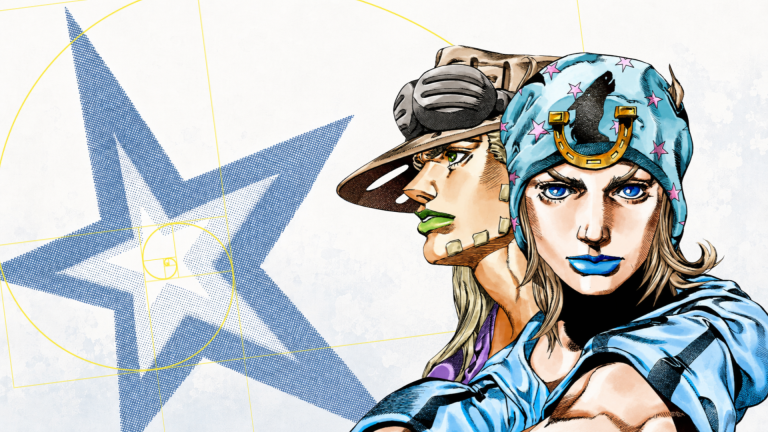
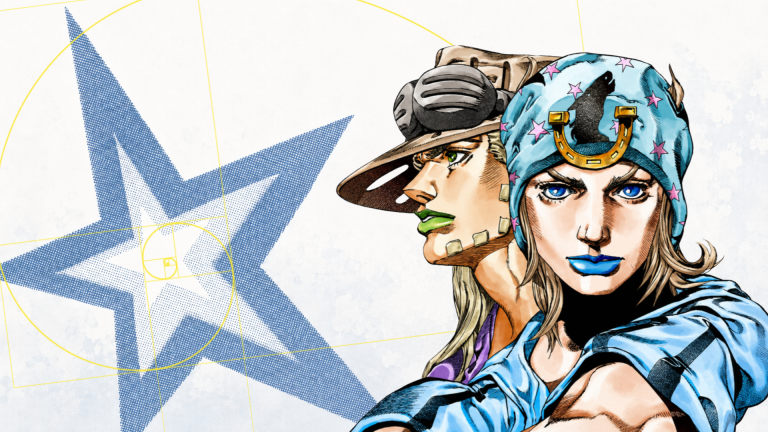
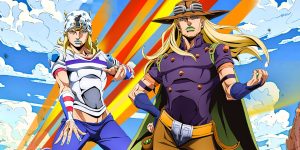
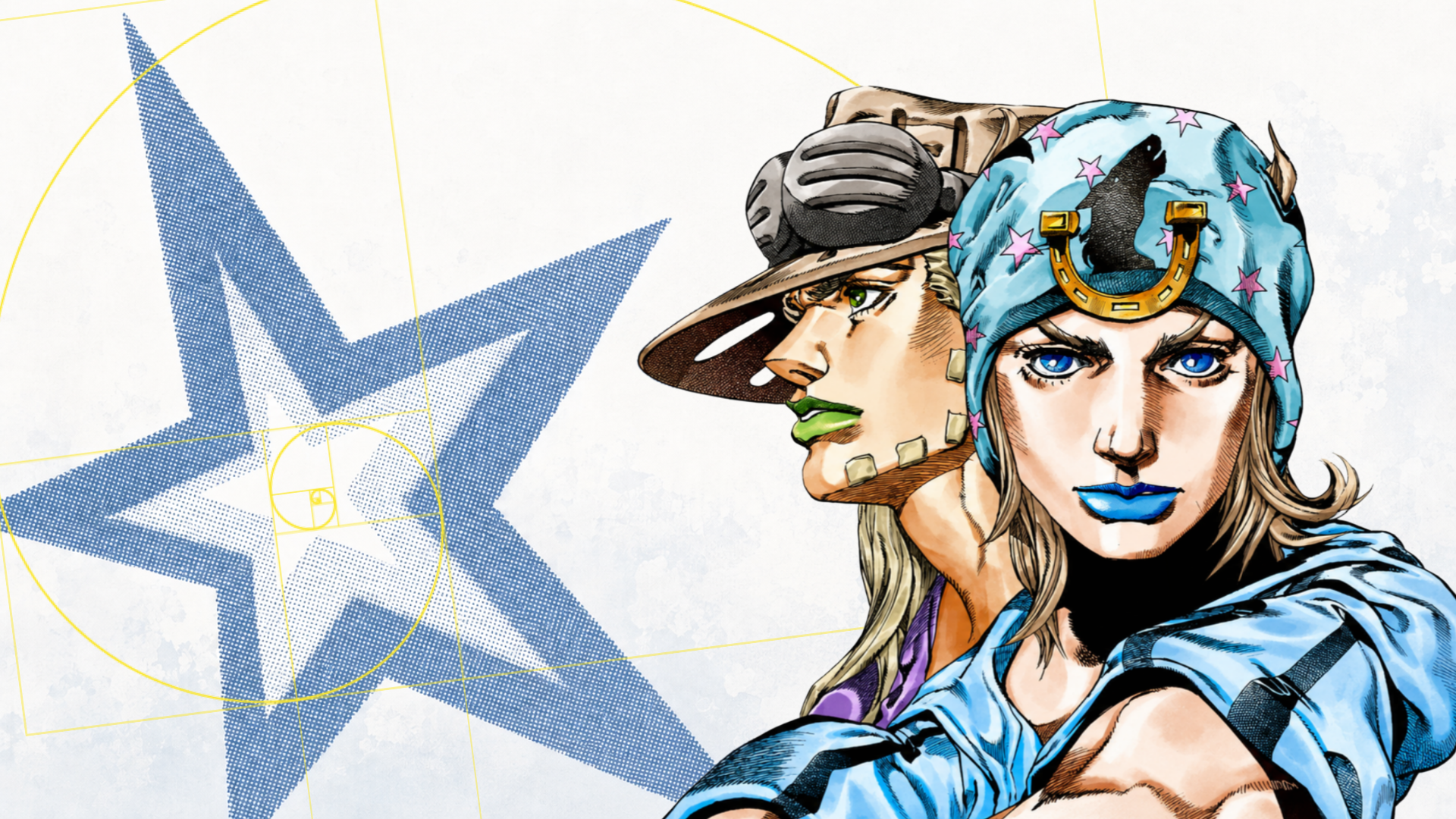
At the beating heart of Steel Ball Run is the most intricately layered central dynamic Araki has ever penned. Rather than presenting another virtuous, towering powerhouse in the mold of Jonathan or Jotaro, Part 7 introduces us to Johnny Joestar: a former prodigy jockey whose juvenile arrogance ended in a tragic gunshot wound that left him paraplegic. Johnny does not enter the Steel Ball Run to save the world, preserve family honor, or claim wealth. He is propelled by a visceral, self-centered desperation—a yearning to move from “negative to zero” after witnessing a peculiar kinetic energy temporarily restore sensation to his legs.
The Moral Decay of Johnny Joestar
Johnny represents a radical departure from traditional heroics. Throughout the grueling stages—from the suffocating salt flats of the Arizona Desert to the freezing sleet of Philadelphia—Johnny’s eyes frequently burn with what the text overtly terms “dark determination.” He is vindictive, relentlessly pragmatic, and willing to sacrifice collateral lives to reclaim his humanity. The psychological journey of watching Johnny evolve alongside his Stand, Tusk, as it physically molts across four successive Acts, provides an emotional anchor unprecedented in previous JoJo parts.
Gyro Zeppeli and the Miracle of the Golden Rectangle
Contrasting Johnny’s brooding pessimism is Gyro Zeppeli, a disgraced Neapolitan executioner possessing an irreverent exterior lined with grilled-gold teeth and absurd sight gags, concealing a devastating internal burden of duty. Through Gyro, Araki introduced the Spin—a mathematical martial art rooted in Renaissance anatomical observation and the Fibonacci sequence. The Spin replaces the respiratory mystique of Hamon and elevates the spatial puzzles of Stands, turning thrown steel spheres and spatial trajectories into an intoxicating blend of theoretical geometry and kinetic violence. Their evolving mentorship, built over quiet campfire reflections and lethal duels against rival racers, serves as the emotional soul of the entire saga.
The CGI Mare in the Room: David Production’s Technical Bottleneck
If the thematic and narrative appetite for Steel Ball Run is white-hot, the industry-wide hesitation is rooted in cold, logistical reality. In the world of commercial animation, there is a pervasive, terrifying maxim: horses ruin studios. Quadrupedal locomotion—with its intricate muscle groups, undulating shoulder blades, precise hoof landings, and volumetric consistency—is notoriously labor-intensive to animate cleanly in traditional 2D hand-drawn frames.
In Steel Ball Run, horses are not secondary background dressing; they are primary vehicles, physical characters, and extensions of Stand combat. Animating a single stampede through dynamic camera orbits over dynamic sand dunes poses an astronomical budget and timeline hurdle. Fans and industry analysts remain locked in intense debate regarding how David Production will conquer this creative precipice:
- The Full Hybrid 3D Pipeline: David Production could lean heavily on cel-shaded 3D CGI models for the mounts, similar to the approach pioneered by Studio Orange (Beastars, Trigun Stampede) or Kamikaze Douga’s historic, jaw-dropping opening sequences for JoJo Parts 1 through 3.
- The Selective 2D/3D Blend: Utilizing high-detail 3D models for chaotic herd sequences and wide shots, seamlessly composited with hand-drawn, artisanal close-ups for intimate duels, facial expressions, and high-impact Stand beatdowns.
- Schedule and Pre-Production Expansion: David Production’s recent diversions—handling major productions like Urusei Yatsura and Undead Unluck—strongly suggest the studio has intentionally been clearing its slate, perhaps allowing an extended multi-year incubation period specifically dedicated to building custom animation assets for SBR.
Funny Valentine, D4C, and the Cultural Phenomenon of the Corpse
An adaptation of Steel Ball Run is incomplete without addressing its overarching ideological collision. Enter the 23rd President of the United States, Funny Valentine. Operating under an unyielding, radicalized conviction of national prosperity, Valentine does not view himself as an antagonist; he views his quest to secure the Saint’s Corpse as an existential duty to ensure America “takes the first napkin.”
His Stand, Dirty Deeds Done Dirt Cheap (D4C), introduces hyper-complex dimensional jumping that will challenge the visual grammar of television anime in dazzling ways. Characters will be torn between parallel planes, identical paradoxes will collide and annihilate, and the boundary between patriotic sacrifice and monstrous megalomania will blur. Add in beloved adversarial wildcards like the velociraptor-shifting Diego Brando, Hot Pants, and the stoic, honor-bound Ringo Roadagain (“Welcome to the True Man’s World”), and the narrative density easily rivals modern prestige television.
The Horizon: When Will the Starting Pistol Fire?
Historically, the temporal gap between David Production’s JoJo announcements spans anywhere from 18 to 24 months post-conclusion of previous seasons. While Warner Bros. Japan has maintained strict radio silence, trademark renewals, event panels, and subtle voice-actor speculations keep community hype at a fever pitch. Enthusiasts are already theorizing whether game alumni like Yūki Kaji (who voiced Johnny in All Star Battle) will be recast to preserve vocal continuity or if fresh talents will take up the saddle.
One undeniable truth stands clear across the global anime community: Steel Ball Run is the ultimate test of pedigree. If executed with the artistic bravery, stylistic palette transitions, and kinetic swagger that define the franchise, it has the cultural inertia to transcend anime subculture entirely and emerge as a generational cinematic triumph.
Are you prepared to enter the race across the American frontier, or do you think the animation challenges of Steel Ball Run will demand an entirely new creative approach? Drop your theories, dream voice cast picks, and favorite Stand battles in the comments below, and stay locked to Wibux.com for breaking updates on the next frontier of JoJo’s Bizarre Adventure.