

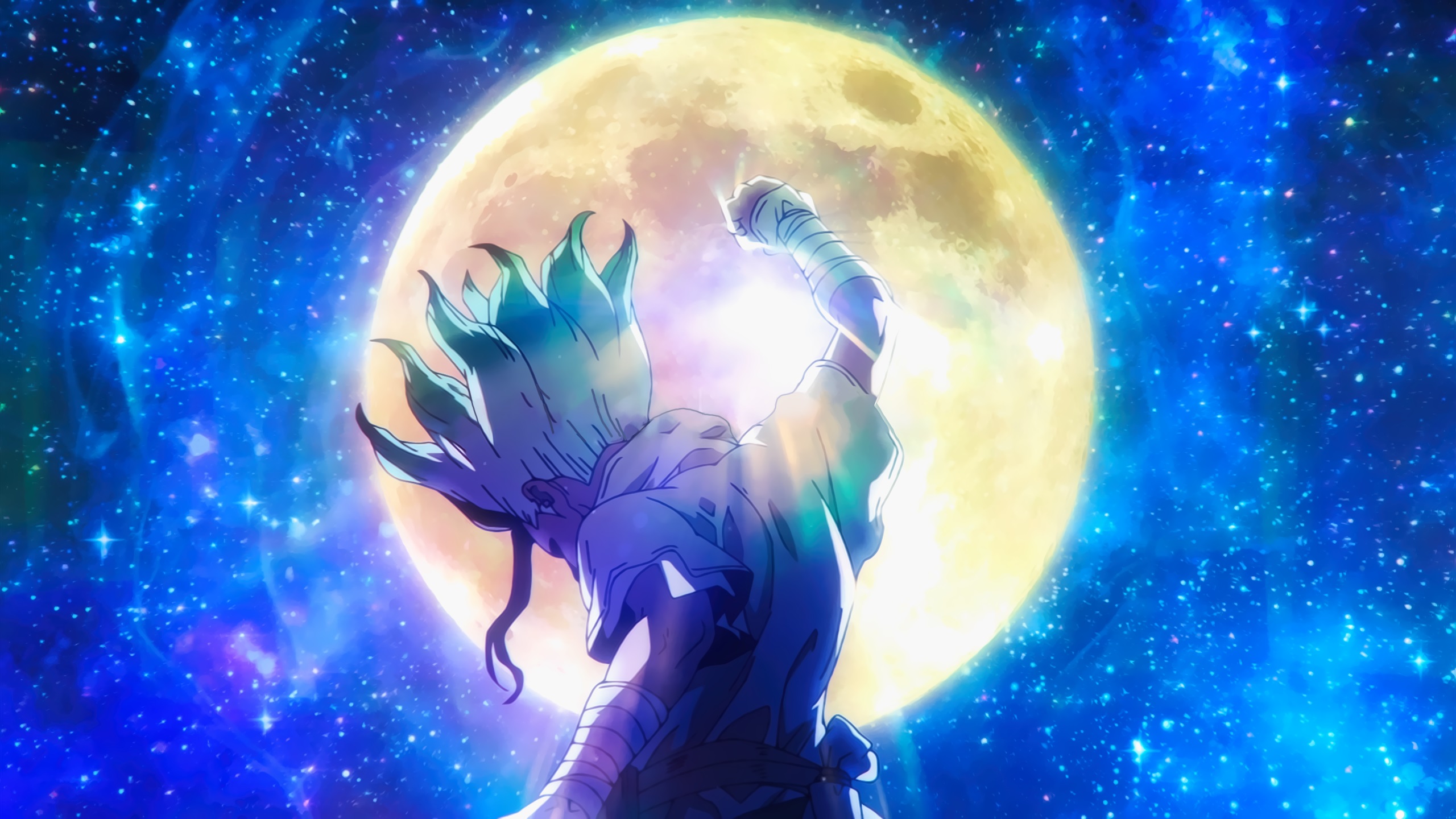
When Senku Ishigami cracked out of his stone sarcophagus in the year 5738 AD, clad in nothing but determination and armed with a baseline understanding of elementary chemistry, the notion of spaceflight seemed beyond absurd—it was an impossibility bordering on madness. Yet, as the curtain rises on Dr. STONE: Science Future, TMS Entertainment’s grand multi-cour final season, that once-ludicrous horizon has become the focal point of humanity’s survival. The Kingdom of Science is not just rebuilding civilization; they are constructing a Saturn V-class rocket from scratch to mount an expedition to the Moon. In doing so, this landmark adaptation is preparing to deliver one of the most mechanically rigorous, emotionally resonant, and conceptually ambitious finales in modern shonen history.
For four seasons, Riichiro Inagaki and Boichi’s creation has stood as a defiant anomaly within the pages of Weekly Shonen Jump. Where its contemporaries leaned heavily into cursed energy, demon slayers, and grimdark deconstructions of violence, Dr. STONE anchored its stakes in the radical, unyielding optimism of the human intellect. Now, the overarching narrative is converging on its ultimate mystery: the petrification phenomenon, the lunar entity known only as “Why-Man,” and the closure of a 3,700-year-old generational promise. The stakes could not be higher, and the road to get here has redefined what educational sci-fi can achieve in the anime medium.
From Earthenware Kilns to Cape Canaveral: The Insane Logistical Odyssey
The fundamental brilliance of Dr. STONE has always resided in its compounding tech tree. The series never took narrative shortcuts; Senku did not merely discover electricity, he worked his fingers raw winding copper coils around hand-carved wooden cylinders. In Science Future, this methodical progression reaches its zenith. To reach the Moon, the Kingdom of Science was forced to transform from a regional tribe in Ishigami Village into a fully mobilized global industrial network.
The build-up to this mission demands sheer geological and metallurgical mastery. Viewers have watched Senku’s coalition circle the globe—harvesting corn for alcohol fuel in the Americas, tapping rubber in Southeast Asia, mining rare-earth metals for micro-circuitry, and constructing a functional core memory computer using hand-soldered ferrite rings. By the time the chassis of their launch vehicle begins to take shape, the viewer feels the authentic, crushing weight of every single screw and bolt. This isn’t cartoon science; it is a painstakingly researched love letter to the Apollo program, filtered through the hyper-stylized lens of shonen pacing.
The final season handles this transition from earthbound survivalism to aerospace engineering with breathtaking scale. The logistical puzzle shifts from “how do we survive winter?” to “how do we refine hundreds of tons of liquid oxygen and construct multi-stage propellant tanks without a modern industrial base?” The narrative treats these engineering bottlenecks as visceral, pulse-pounding boss battles, turning the formulation of heat-resistant ablative shielding into a high-stakes dramatic thrill ride.
The Phantom in the Static: Deconstructing the Why-Man Enigma
Every legendary journey requires a shadow, and Dr. STONE introduced its definitive antagonist not as a towering warlord, but as a chilling, metallic voice interrupting their fledgling radio tests: a synthetic signal asking, over and over in unyielding Morse code, “WHY?”
The Chilling Semantic Shift of “12,800,000 Meters, One Second”
The Why-Man phenomenon transformed Dr. STONE overnight, injecting existential cosmic dread into what had largely been an uplifting romp of discovery. When the signal evolved from passive transmissions to weaponized attempts to trigger the Petrification Devices—broadcasting the exact diameter of the Earth alongside a time activation—the true scope of the battlefield was revealed. Why-Man is not hiding in the shadows of the restored cities or lurking deep within the Mariana Trench; this intelligence sits dead center on the lunar surface, watching humanity’s every technological leap through the lens of a celestial executioner.
This dynamic sets up a fascinating philosophical clash for Science Future. Why-Man is the conceptual antithesis to Senku Ishigami. Where Senku views science as the ultimate tool for universal liberation and preservation of life, Why-Man views the petrification beam through an alien, calculating logic of biological stagnation and control. The lunar showdown is fundamentally an ideological debate played out in the vacuum of space: Is humanity’s chaotic drive to expand, explore, and invent an infection to be cured, or the universe’s most magnificent achievement?
The Apollo 11 of the Post-Apocalypse: Character Psychology and the Lunar Crew
A mission to the Moon in a freshly rebooted civilization is inherently suicidal. Even with Ryusui Nanami’s navigational instincts, Chrome’s out-of-the-box primitive ingenuity, and Senku’s encyclopedic mind, the reality of a zero-margin-for-error mission looms heavily over the narrative. The selection of the lunar crew serves as a thematic microcosm of everything the series has built. It demands the ultimate synthesis of mental acuity, physical combat prowess, and emotional resolve.
Beyond the logistical terror, the psychological undertones are deeply personal for Senku. The lunar mission represents the closing of a cosmic circle initiated by his adoptive father, Byakuya Ishigami. When the petrification light first enveloped the globe, Byakuya and the crew of the International Space Station watched helplessly from orbit, ultimately choosing to return to Earth and leave behind the foundational seeds—the hundred tales, the platinum, the cultural breadcrumbs—that would one day allow Senku to stand up and reclaim the planet.
Now, decades later in physical time and thousands of years later in historical time, the son takes to the sky to gaze back at the cradle his father fought so desperately to repopulate. The emotional gravity underpinning the launch sequences in Science Future strips away Senku’s stoic, “ten billion percent logical” exterior, exposing the beating, vulnerable human heart of a boy driven by generational devotion and filial love.
TMS Entertainment’s Production Gambit: The Visual Blueprint for Deep Space
Adapting the final stretch of Boichi’s manga is an intimidating prospect for any animation studio. Boichi’s backgrounds during this arc are monuments of technical illustration—hyper-dense cross-hatching, photo-realistic mechanical renders of gantry towers, telemetry readouts, and the stark, cratered vistas of the lunar surface. TMS Entertainment, which has maintained an astonishing level of consistency across previous seasons, faces its most demanding visual hurdle yet.
Early glimpses and production choices for Science Future indicate that the team has leaned heavily into dynamic lighting and digital composition to sell the transition into space. The shift from lush, green post-petrification foliage to the harsh, high-contrast, black-and-white void of the lunar regolith requires a total realignment of the show’s artistic palette. Furthermore, the decision to produce this final season as a split-cour project demonstrates a commitment to pacing over speed. Rather than condensing hundreds of chapters into an unceremonious sprint, the studio is giving the engineering trials, the orbital dynamics, and the psychological isolation of deep space the breathing room they demand.
A Counter-Cultural Masterpiece in Shonen’s Modern Era
As Dr. STONE: Science Future approaches its grand finale, it is impossible not to reflect on its cultural footprint. In an entertainment landscape saturated with bleak apocalypses and power-scaling power fantasies, Senku Ishigami’s world offered something fundamentally distinct: the radical premise that humanity is fundamentally worth saving, and that our greatest superpower is not genetic destiny or supernatural blessing, but the slow, methodical accumulation of peer-reviewed truth.
When the rocket engines ignite and the plumes of smoke envelop the launchpad, Dr. STONE will not just be concluding an anime arc—it will be planting a flag for the endurance of human curiosity. Senku’s trek to the Moon proves that even if the world falls to dust, so long as one person is willing to ask “how?” and “why?”, the stars will always remain within our reach.
Are you prepared for the final countdown? How do you think TMS Entertainment will adapt the mind-bending revelations surrounding Why-Man’s true identity? Sound off in the comments below, and let us know which Kingdom of Science invention has been your favorite across the entire series!