
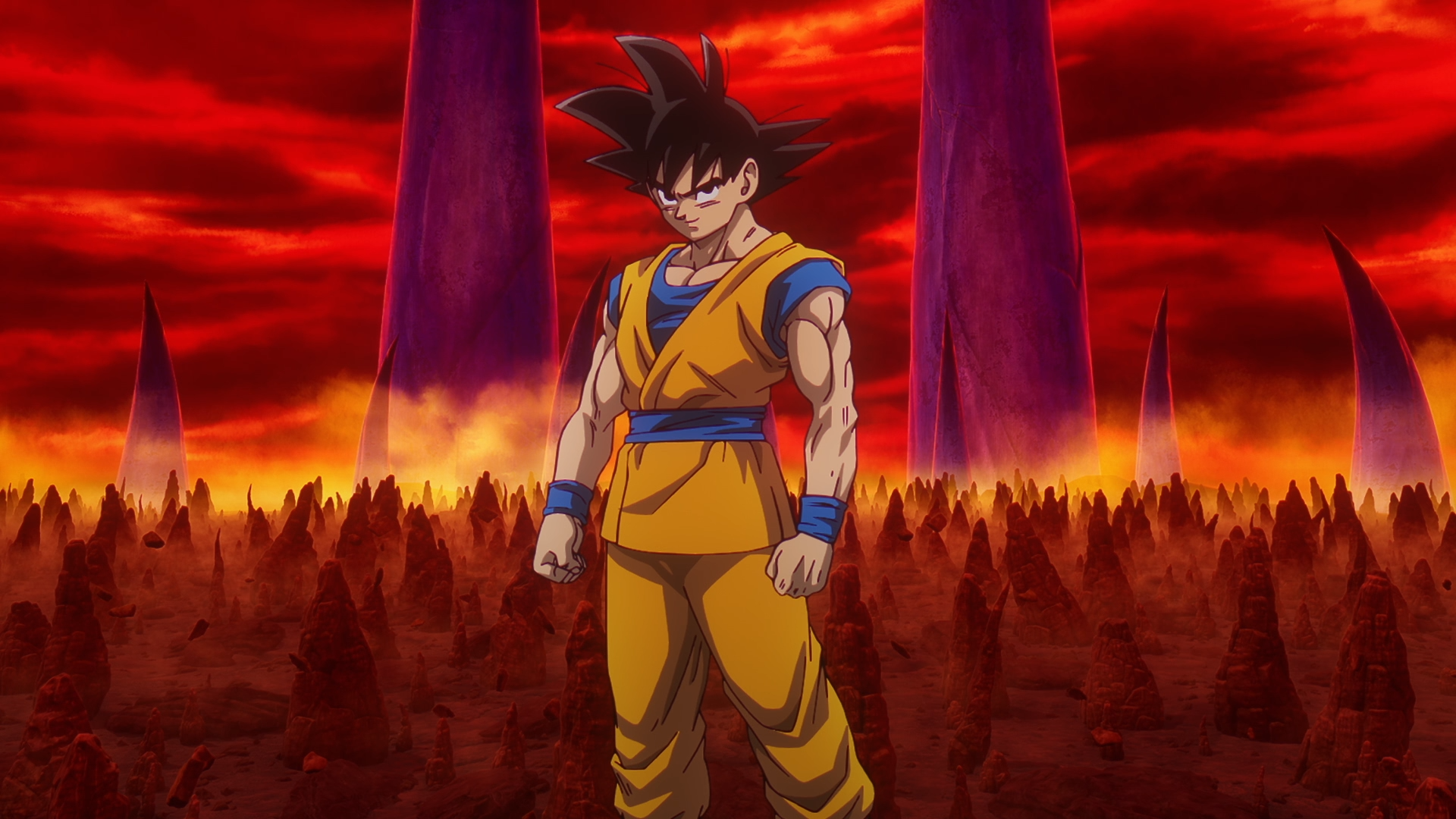
When the opening chords of “Jaka Jaan” ring out across the screen, an undeniable wave of emotion crashes over the global anime community. Dragon Ball Daima arrives not merely as another seasonal tentpole or a calculated milestone for the franchise’s 40th anniversary; it stands as the final, fully realized creative vision of the late Akira Toriyama. Following the visionary creator’s shocking passing in March 2024, every frame of this new anime series carries an immense cultural weight. Yet, far from a solemn, retrospective memorial, Daima explodes onto our screens with vibrant color, boundless childlike whimsy, and an unmistakable creative vitality. Rather than continuing the relentless cosmic power escalation of Dragon Ball Super, Toriyama turned the wheel completely, taking Goku back to the roots of pure adventure and pulling back the curtain on one of the franchise’s greatest untapped enigmas: the Demon Realm.
A Deep Dive into the Demon Realm: Toriyama Expands the Makai Mythos
For decades, the Demon Realm (Makai) existed as an tantalizing footnote within the broader Dragon Ball macrocosm. Beyond Dabura’s tragic servitude to Babidi in the Majin Buu Saga and fringe lore explored in non-canon video games like Dragon Ball Heroes and Xenoverse, fans knew remarkably little about this shadowy dimensional underbelly. In the premiere of Daima, Toriyama decisively reclaimed this territory, delivering an exquisite world-building masterclass that immediately expands canonical lore.
The narrative wastes no time establishing the political fallout of Majin Buu’s defeat. Deep within the Demon Realm, Dabura’s sudden demise has left an unexpected power vacuum, swiftly seized by King Gomah, a diminutive, paranoid ruler flanked by his scheming adviser Degesu—the estranged younger brother of the Supreme Kai—and the mysterious Dr. Arinsu. Watching archived footage of Earth’s greatest warriors annihilating Buu, Gomah understands that the Z-Fighters are living existential threats to his fledgling hegemony. His proactive countermeasure? Gathering Earth’s Dragon Balls to curse the heroes into harmless, pint-sized versions of themselves before retreating behind the dimensional barrier.
King Gomah, Degesu, and the Ancient Tamagami
What makes this world-building instantly captivating is the introduction of the Tamagami—ancient, colossal demonic guardians created to protect the Demon Realm’s localized set of Dragon Balls. By establishing a separate Dragon Ball ecosystem and hinting at a tripartite cosmological hierarchy divided into three distinct Demon Worlds, Toriyama pivots the franchise away from sterile, omnipotent deities like Grand Zeno. In their place, he installs a tactile, folklore-infused occult kingdom steeped in arcane rules, regional conflicts, and untapped secrets.
The “Mini” Phenomenon: Stripping God Ki for Classic Kinetic Choreography
When Toei Animation first announced that Goku, Vegeta, Piccolo, and the rest of the gang would be reduced to diminutive children, skeptical corners of the fandom braced for a lukewarm rehash of Dragon Ball GT. Those anxieties evaporate within minutes of Daima‘s opening act. The transformation of the cast into “Mini” forms is neither a cheap gimmick nor a simple nostalgia trap; it functions as a deliberate mechanical reset that fundamentally restores dramatic tension to the franchise.
By shrinking Goku’s center of gravity and altering the physical proportions of the Z-Fighters, Daima effectively takes Ultra Instinct, God Ki, and planet-shattering ki blasts off the immediate tactical table. Goku can no longer rely on unbridled, god-like brute force to overpower his adversaries. Instead, he is forced back into the scrappy, resource-driven martial artist persona that made the original run of Dragon Ball an enduring global classic. The celebrated return of the Nyoibo (Power Pole) is not mere aesthetic fan service; it is an organic narrative tool that re-establishes environmental spacing, reach, and weaponized kinetic physics in combat, breathing fresh life into Goku’s battle choreography.
Elite Craftsmanship: How Toei Animation Honored the Master’s Brush
From an aesthetic and visual standpoint, Dragon Ball Daima operates in an entirely different stratosphere compared to the turbulent, rushed television beginnings of Dragon Ball Super in 2015. Under the joint directorship of Yoshitaka Yashima and Aya Komaki, with veteran animator Katsuyoshi Nakatsuru supervising the character designs, the production reflects an uncompromised standard of craftsmanship that Toei Animation typically reserves for cinematic theatrical releases.
The character animation abandons the hyper-glossy, plastic textures of the 2010s in favor of fluid, expressive line work that lovingly evokes Toriyama’s legendary 1990s peak. Nakatsuru captures the maestro’s rounded, idiosyncratic curves, rendering mechanical ships, alien flora, and comedic background expressions with infectious charm. During the premiere’s explosive hand-to-hand skirmishes, the camera pivots dynamically with the weight of each blow. Weight, momentum, and follow-through take precedence over flashing aura effects and looped animation cycles, providing a visceral, tactile punch that honors Toriyama’s roots as a martial arts cinema devotee.
The 40-Year Journey: Why Daima is Toriyama’s Purest Swansong
As Dragon Ball celebrates its monumental 40th anniversary, Daima serves as a poignant reminder of Akira Toriyama’s creative philosophy. Throughout his legendary career, Toriyama was famously resistant to grim, overly self-serious melodrama. At his core, he was a gag manga artist who stumbled into revolutionizing the global shonen landscape through lighthearted escapism, razor-sharp visual humor, and the joy of spontaneous adventure.
Daima perfectly bridges the whimsical, folklore-inspired journey to the west found in early Dragon Ball with the high-stakes, lore-dense universe built during the late chapters of Dragon Ball Z. It honors the hero’s journey without taking itself too seriously, finding wonder in strange alien snacks, peculiar demonic dialects, and Goku’s unquenchable, cheerful curiosity. In giving us a Goku who is once again an intrepid explorer wandering through unknown lands rather than an unreachable cosmic titan, Toriyama left behind a parting gift that encapsulates everything that made the world fall in love with his universe in 1984.
Final Verdict: A Flawless Launch into the Unknown
The premiere of Dragon Ball Daima accomplishes the seemingly impossible: it delivers a fresh, mechanically compelling jumping-off point for an iconic four-decade-old franchise while functioning as an emotional, beautifully crafted tribute to the greatest mangaka who ever lived. Packed with dazzling kinetic action, richly woven mythological depth, and Toriyama’s unmistakable warmth, the series sets a gold standard for what modern anime revivals ought to aspire to.
As Goku and the mysterious wanderer Glorio board their craft and journey deeper into the sprawling expanse of the Demon Realm, one thing is abundantly clear—the adventure of Dragon Ball is far from over, and Akira Toriyama’s imaginative spark burns as brightly as ever.
What did you think of the Dragon Ball Daima premiere? Do you prefer this grounded, martial arts-focused approach over Dragon Ball Super’s cosmic scale? Drop your thoughts, theories on the Demon Realm, and tribute messages in the comments below!