When the final credits rolled on David Production’s adaptation of Stone Ocean in late 2022, a collective hush fell over the global anime fandom. The bittersweet melancholia of Jolyne Cujoh’s journey didn’t just conclude a generational struggle against the lingering shadow of DIO—it severed the original timeline completely. For casual viewers, it felt like an ending. But for die-hard manga acolytes and anime historians alike, it was the necessary clearing of the board for what comes next: JoJo’s Bizarre Adventure: Steel Ball Run.
Widely regarded not just as Hirohiko Araki’s magnum opus, but as one of the greatest manga runs in the history of the medium—perennially locked in battle with Kentaro Miura’s Berserk for the top spot on aggregated fan ratings worldwide—Steel Ball Run (SBR) represents a gargantuan paradigm shift. It is a grand reinvention of the JoJo mythos, a sun-drenched, dust-caked Western odyssey where supernatural weird fiction clashes with late-19th-century Americana. Yet, as rumors churn across Tokyo production circles and fan fervor reaches a boiling point, an inescapable tension looms: can David Production actually pull this off?
The Seinen Evolution: Why Steel Ball Run Stands as Araki’s Masterpiece
To understand the near-mythic reverence surrounding Steel Ball Run, one must look at the circumstances of its creation. Serialized initially in Weekly Shonen Jump before transitioning to the monthly seinen publication Ultra Jump in 2005, Part 7 unshackled Araki from the punishing weekly release schedule and the demographic constraints of teen-focused manga. The results were instantaneous and transformative.
With monthly breathing room, Araki’s artwork transcended comic illustration and morphed into fine art. The anatomical precision deepened, character designs adopted runway-model silhouettes battered by frontier grit, and the pacing acquired an expansive, cinematic weight. Set in 1890, the narrative chronicles the titular Steel Ball Run race—a grueling, 6,000-kilometer cross-country equestrian rally spanning from San Diego Beach to New York City, bankrolled by a $50 million grand prize. Beneath the sporting spectacle, however, lies an occult battle royale: the racers are unwittingly participating in a scavenger hunt for the mummified, miraculous relics of Jesus Christ, scattered across the harsh American frontier.
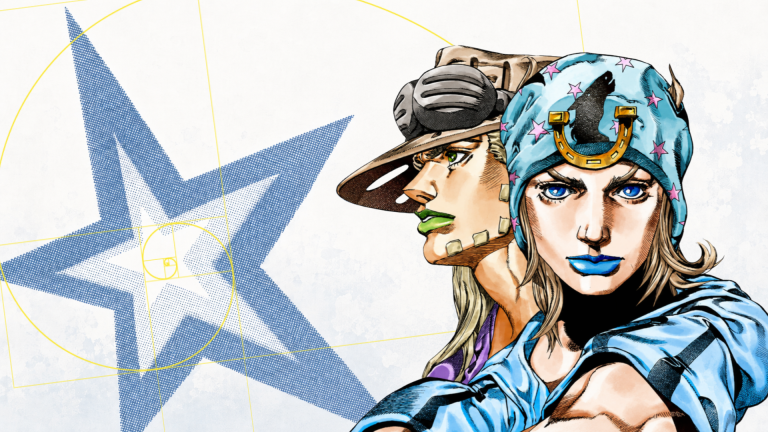
Flawed Humanity and the Golden Ratio: Johnny Joestar and Gyro Zeppeli
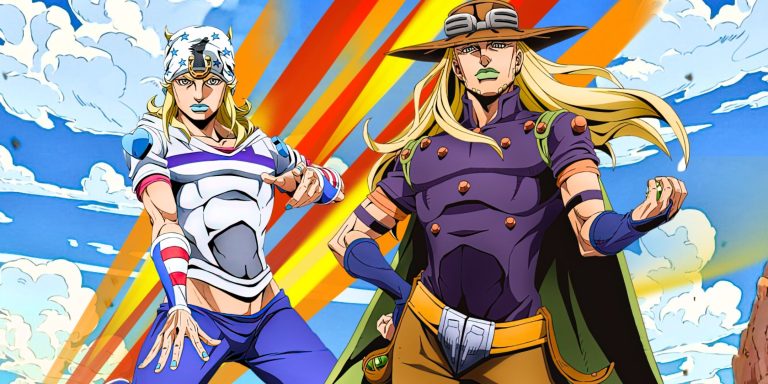
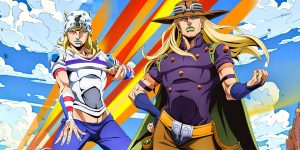
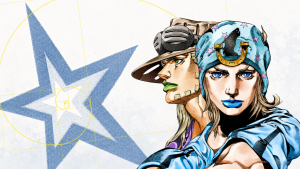
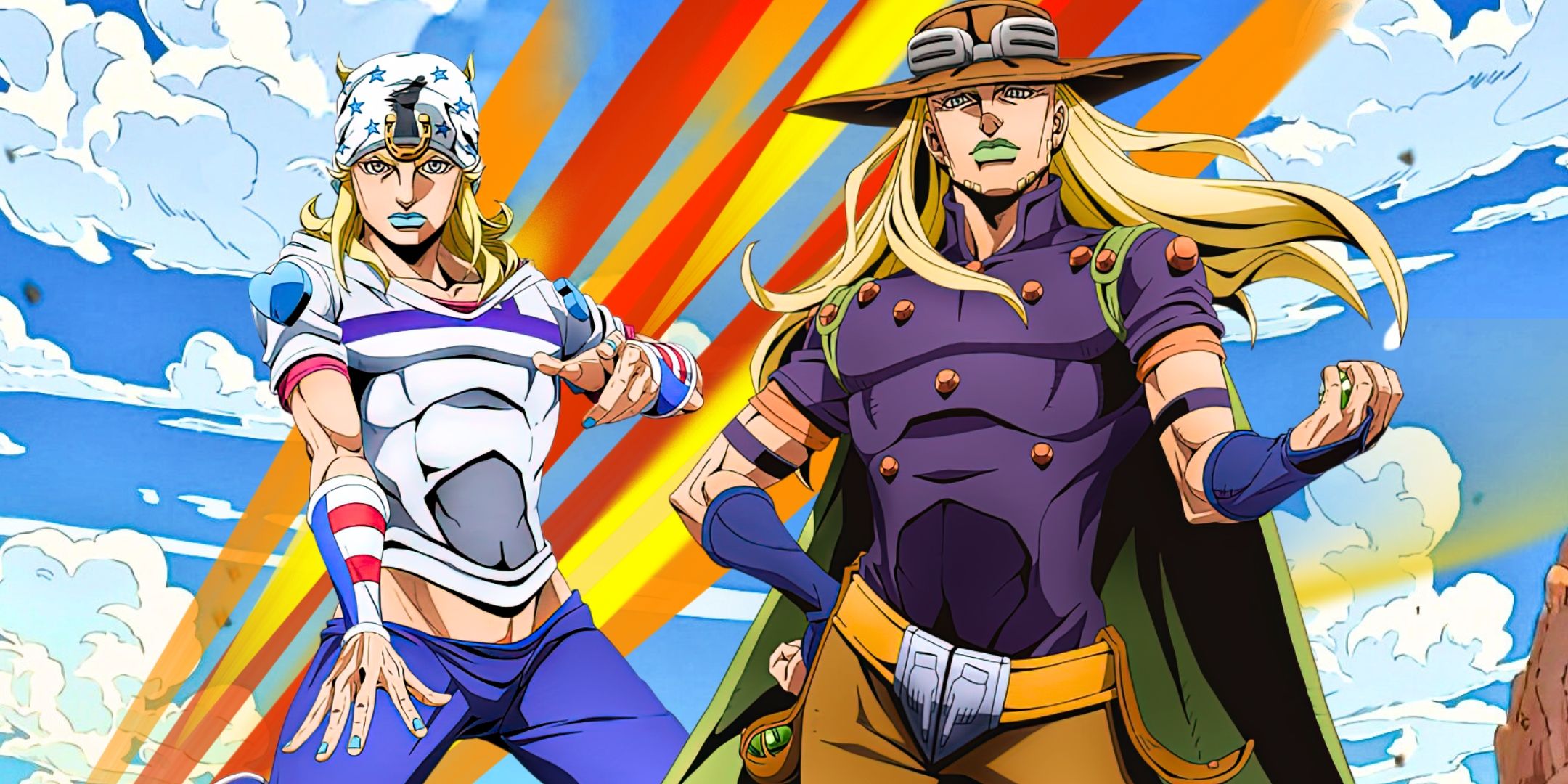
At the center of this bloodstained expedition is the most complex, compelling duo Araki has ever penned: Johnny Joestar and Gyro Zeppeli. Their dynamic is the beating heart of the series, trading the chivalrous heroism of Jonathan or the cool-guy stoicism of Jotaro for raw vulnerability, dark ambition, and comedic intimacy.
Johnny Joestar: The Anti-Hero Driven by “Dark Determination”
Unlike his heroic forebears, Johnny Joestar begins his journey not as a savior, but as a broken, cynical outcast. Once a prodigal jockey blinded by vanity and privilege, an act of sheer arrogance leaves him paralyzed from the waist down, stripped of his glory, his family, and his will to live. Johnny is arguably the most morally ambiguous protagonist in JoJo history; Araki frequently draws attention to the “dark flame” in Johnny’s eyes—a willingness to commit murder, sabotage, and morally reprehensible acts if it means reclaiming his ability to stand. His Stand, Tusk, evolves through distinct “Acts,” mirroring his excruciating psychological rehabilitation and gradual climb toward self-forgiveness.
Gyro Zeppeli: The Spin and the Burden of Duty
Counterbalancing Johnny’s brooding desperation is Gyro Zeppeli, a disgraced Neapolitan royal executioner whose flamboyant exterior—complete with steel grillz reading “GO! GO! ZEPPELI”—masks a profound ethical crisis. Gyro enters the race not for personal riches, but to win amnesty for a young, innocent boy condemned to death in his homeland. In place of Hamon, Gyro introduces the Spin, an ancient, pseudo-scientific martial art based on the Fibonacci Sequence and the Golden Ratio. By throwing perfectly balanced steel balls to create rotational energy, Gyro manipulates anatomy, terrain, and even the fabric of space-time. The interplay between Johnny’s desperate disciple status and Gyro’s eccentric mentorship forms an emotional core that completely outshines the episodic “Stand user of the week” formula of earlier parts.
The Production Dilemma: The Nightmare of Equestrian Animation
If Steel Ball Run is a thematic triumph, it is also a technical minefield for any studio audacious enough to tackle it. There is an open secret within the Japanese animation industry: horses are the ultimate animator killer. Drawing four-legged animals in complex, rapid, perspective-shifting motion has broken production schedules across the industry for decades.
Unlike Stone Ocean or Golden Wind, where fights occurred in confined rooms, city streets, or prison courtyards, Steel Ball Run is fundamentally an equestrian anime. Hundreds of race sequences take place at breakneck speeds across open plains, muddy swamps, and treacherous mountain ranges. Characters don’t simply ride; they leap from stirrup to stirrup, fire projectiles from the saddle, and clash in hand-to-hand combat while their steeds sprint at 40 miles per hour.
Industry insiders have long cited this equestrian hurdle as the primary reason David Production did not immediately greenlight Part 7 post-Stone Ocean. To bring this to life without losing the iconic, high-contrast, pop-art soul of the series, the studio faces a treacherous balancing act:
- The CGI Question: Can David Production develop a bespoke 3D cel-shaded pipeline for the horses—similar to the stunning vehicular and mech animation seen in modern studio showcases—without triggering the uncanny-valley backlash that plagued shows like Berserk (2016) or the mixed reactions to MAPPA’s early Attack on Titan CG horses?
- Sakuga Preservation: The emotional climaxes, Stand manifestations, and visceral impacts must remain hand-drawn sakuga spectacles. Blending seamless 2D character models onto dynamically animated 3D mounts running across painterly, sepia-toned Western landscapes will require unprecedented financial investment and pre-production lead time.
Funny Valentine, D4C, and the Subversion of Morality
No dissection of Steel Ball Run is complete without addressing its antagonist: Funny Valentine, the 23rd President of the United States. Valentine is a masterclass in villainous design, eschewing the raw sadism of DIO or the neurotic serial-killer tendencies of Yoshikage Kira in favor of fervent, single-minded utilitarian patriotism.
Valentine’s Stand, Dirty Deeds Done Dirt Cheap (D4C), allows him to travel between parallel dimensions by sandwiching himself between two surfaces. His ultimate goal—to secure the Holy Relics to ensure the United States permanently absorbs all the world’s fortune while deflecting its misery onto other nations—is pursued with a charismatic, horrifyingly rational sincerity. The philosophical clashes between Johnny Joestar’s selfish survivalism and Funny Valentine’s absolute, self-sacrificing nationalism flip traditional narrative morality on its head, culminating in what many consider the single greatest climax in modern comic history.
The Verdict: The Next Great Frontier for Anime
David Production has proven time and again that their reverence for Hirohiko Araki’s life work borders on religious devotion. From their iconic visual sound-effect kanji to their unyielding dedication to musical homage, they have turned an eccentric, non-traditional manga series into a worldwide pop-culture juggernaut. Currently balancing high-profile projects like Urusei Yatsura and Fire Force, the studio is understandably taking its time with Part 7.
Make no mistake: Steel Ball Run is coming. The cultural demand is too colossal, the source material too revered, and the commercial upside too lucrative to remain locked on the page forever. When that starting gun finally echoes across San Diego Beach, and Johnny Joestar and Gyro Zeppeli burst onto our screens, it will not just be the continuation of an anime franchise—it will mark the dawn of the medium’s next defining masterpiece.
Are you ready to embrace the Spin? Do you think David Production should rely on advanced CG for the horses or stick to traditional hand-drawn animation? Drop your theories, favorite Stand predictions, and dream voice casts in the comments below!