

When the world lost Akira Toriyama in March 2024, the collective grief that swept across the globe wasn’t merely mourning an iconic mangaka; it was the realization that the primary architect of modern shonen anime had put down his pen for good. Yet, before his untimely passing, Toriyama left behind one final, deeply personal gift: Dragon Ball Daima. Arriving precisely on the 40th anniversary of the franchise’s inception in Weekly Shonen Jump, the premiere of Daima carries an almost unbearable emotional weight. But rather than collapsing under the expectations of a legacy brand or relying on sterile nostalgia bait, the premiere episode delivers something unexpected: an exuberant, lore-dense, and beautifully crafted adventure that reminds us why Toriyama fell in love with this sandbox in the first place.
The Bittersweet Swan Song: Toriyama’s Hands-On Creative Imprint
For decades, Toriyama’s involvement in televised Dragon Ball projects swung between detached supervision and broad outline submissions. Series like Dragon Ball GT saw him contribute little more than initial concept sketches and the title, while Dragon Ball Super operated primarily on his narrative checkpoints, leaving the heavy lifting to Toyotarou and Toei Animation’s scriptwriters. Dragon Ball Daima is an entirely different beast. Here, Toriyama was deeply involved in the structural mechanics of the story, dialogue beats, vehicle mechanics, and the granular rules governing a forgotten corner of his universe.
That personal investment radiates through every frame of the premiere. The premiere spends a generous amount of its runtime grounding itself in the aftermath of the Majin Buu saga, rewriting and reframing pivotal lore through the vantage point of newly introduced watchers. Toriyama’s unmistakable voice—characterized by his signature blend of whimsical character designs, peculiar gastronomic gags, and understated menace—permeates the script. It feels less like a corporate mandate to generate quarterly merchandise and more like an auteur taking his toys out of the chest one last time to tell a bedtime story on his own idiosyncratic terms.
Beyond the De-Aging Gimmick: Unpacking the “Mini” Phenomenon
When Toei first announced that Goku and the Z-Fighters would be transformed into children—officially designated as their “Mini” states—the community’s collective knee-jerk reaction was a defensive recoil. Memories of Dragon Ball GT’s polarizing opening arc immediately resurfaced. However, Daima executes this transformation through a vastly different thematic lens, treating the de-aging not as a cheap reset button, but as a deliberate narrative recalibration.
Stripping Down the Power Escalation
In Dragon Ball Super, power scaling reached a point of absolute absurdity: multiversal tournaments, literal Gods of Destruction, and angelic techniques that transformed Goku into a white-haired, detached deity. By contrast, the premiere of Daima deliberately severs that runaway escalation. When King Gomah and his sycophantic advisor Degesu use the Earth’s Dragon Balls to shrink the warriors of Earth, they don’t just reduce their stature; they alter their physical weight, center of gravity, and reach.
This dynamic breathes instant life back into Goku’s character psychology. Instead of brooding over his compromised strength, Goku’s reaction to his shrunken form is pure, unadulterated joy—a kinetic problem to be solved through training. The triumphant return of the Nyoibo (Power Pole) is not mere fan-service; it is a mechanical necessity. Goku can no longer rely purely on planetary-scale Ki blasts or instantaneous blitzing. He must fight as a true martial artist again, using spatial awareness, leverage, and martial implements to bridge the physical gap.
Mapping the Demon Realm: Forty Years of Lore Finally Explored
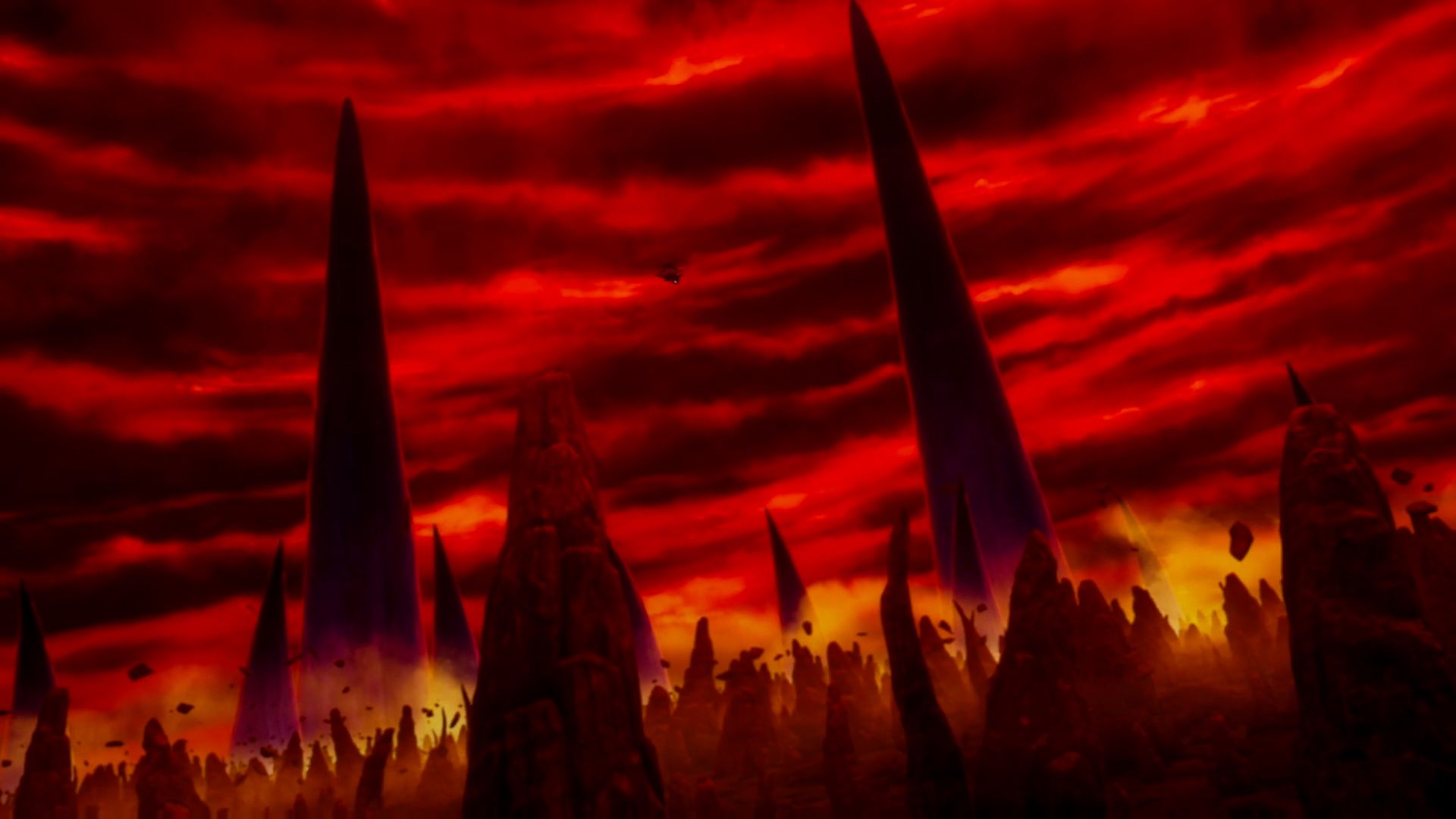
Perhaps the most exhilarating aspect of Dragon Ball Daima‘s opening salvo is its unprecedented commitment to world-building. For forty years, the Demon Realm (Makai) existed in the periphery of canon, occasionally hinted at via Dabura or relegated to non-canon spinoffs like Dragon Ball Heroes. Daima tears the veil off this shadowy dimension, establishing it as an intricate, bureaucratic, and socially layered civilization divided into distinct realms.
Through the eyes of King Gomah, the newly crowned ruler scrambling to secure his throne following Dabura’s demise, Toriyama expands the cosmology of the cosmos in ways that retroactively enrich the Majin Buu saga. The premiere introduces fans to the Tamagami—the imposing demonic guardians of the Demon Realm’s native Dragon Balls—and recontextualizes the origins of the Namekians through characters like the enigmatic Neva. The visual design of the Demon Realm is classic Toriyama: a vibrant fusion of European folklore, insectoid fauna, and dieselpunk technology. It abandons the sterile, cosmic voids of recent arcs in favor of tactile environments packed with dust, strange cuisine, and peculiar socio-political squabbles.
Toei’s Technical Renaissance: Animation Pedigree and Martial Precision
A script this warm deserves visual execution to match, and Toei Animation assembled a veritable dream team to ensure Daima honors its creator’s visual legacy. Under the co-direction of Yoshitaka Yashima and Aya Komaki, with character designs adapted by Chikashi Kubota (famed for his stellar contributions to Dragon Ball Super: Broly and One-Punch Man), the premiere achieves an aesthetic benchmark rarely seen in weekly television anime.
The visual philosophy here shifts dramatically away from the hyper-saturated, plastic sheen that plagued early Dragon Ball Super. Instead, Daima employs softer linework, rich background textures, and expressive squash-and-stretch animation that honors the curved, chunky sensibilities of late-80s and early-90s anime. The premiere features breathtaking frame economy, effortlessly switching from comedic character acting to jaw-dropping kinetic displays.
Even the recap sequences—revisiting Goku’s battles with Frieza, Cell, and Buu—are freshly re-animated with a cinematic grandeur that recontextualizes the sheer brutality and grace of Toriyama’s fight choreography. The impact frames carry genuine mass; punches land with resounding acoustic depth, and the staging emphasizes spatial continuity over rapid-fire camera cuts. It is an emphatic demonstration that modern digital production can channel the tactile soul of cel animation when steered by passionate directors.
The Verdict: A Master’s Final, Joyful Statement
The early fandom discourse surrounding Dragon Ball Daima has shifted from cautious skepticism to widespread, emotional celebration. Fans aren’t just satisfied with the show’s staggering production value; they are moved by its unabashed sincerity. In an era where modern shonen often defaults to relentless trauma and hyper-convoluted magic systems, Daima reminds us of the power of whimsical exploration and kinetic wonder.
Akira Toriyama did not spend his final days obsessing over power levels, divine transformations, or grimdark stakes. He spent them laughing at short-limbed brawlers, designing funky space cruisers, and chronicling the boundless resilience of a country bumpkin with an insatiable appetite and a heart of pure gold. Dragon Ball Daima is a masterclass in tone, a visual spectacle, and above all, a deeply moving monument to a storyteller whose work shaped generations of imaginations across the stars.
What did you think of Dragon Ball Daima’s premiere? Did the return to martial arts and the Demon Realm live up to Toriyama’s monumental legacy, or are you missing the divine power-scaling of Super? Let us know your theories in the comments below, and stay tuned to Wibux.com for full weekly episode breakdowns!