Few franchises in the contemporary anime ecosystem carry the sheer cultural gravity and volatile anticipation of One-Punch Man. What began as a crudely drawn, sharply written webcomic by the elusive creator ONE evolved into a visual benchmark for the entire medium when Yusuke Murata lent his hyper-detailed, kinetically transcendent art to the serialized manga. Now, as the industry gears up for One-Punch Man Season 3, the anime stands on the precipice of its most ambitious, structurally chaotic, and cosmically unhinged chapter yet: the subterranean war against the Monster Association and the apocalyptic clash between Saitama and Garou.
This is not merely another battle shonen tournament or rescue mission. The Monster Association Arc represents a complete paradigm shift for the franchise. It strips away the comforting parody of the early chapters, dragging its colorful ensemble of narcissists, prodigies, and freaks into a brutal crucible that redefines the lore, introduces eldritch divine entities, and tests the very philosophical foundation of Saitama’s existence.
The Underworld Incursion: Dissecting the Monster Association Raid
The structural spine of Season 3 rests on the raid beneath the ruins of Z-City. Where Season 2 suffered from a fragmented narrative that struggled to balance martial arts tournaments with scattered monster ambushes, the assault on the Monster Association headquarters offers a hyper-focused, pressure-cooker dynamic. The Hero Association is forced to throw its dysfunctional apex predators—the S-Class—into an environment specifically engineered to neutralize them.
What makes this sequence legendary among manga readers is Murata and ONE’s subversion of conventional team-up tropes. Rather than fighting as a unified vanguard, the S-Class fractures along the lines of individual ego. We witness visceral, prolonged duels that dismantle the heroic mystique:
- Superalloy Darkshine confronting the fragile vanity of muscles built for aesthetics rather than genuine survival against Garou.
- Flashy Flash demonstrating peerless spatial speed against former ninja village comrades Hellfire Flame and Gale Wind.
- Tatsumaki (Tornado of Terror) unleashing psychic cataclysms that fundamentally reshape the planetary crust, peeling back the subterranean fortress like a tin can.
The raid operates on a staggering scale. The introduction of monsters like the subterranean monarch Orochi, the parasitic Psykos, and the cadre of “Dragon-level” threats forces the S-Class to reckon with their mortality. This is the moment One-Punch Man pivots from a dry satire of cape comics to a genuinely harrowing military engagement where the collateral damage is planetary.
The Human Monster Unshackled: Garou, God, and Breaking the Limiter
At the beating heart of Season 3’s narrative engine is Garou, a character who transcended typical shonen antagonist status to become one of modern manga’s most complex anti-villains. Garou is not motivated by nihilism or greed; he is motivated by a warped pursuit of moral equity. As a boy who identified with the ostracized, defeated monsters of children’s television, Garou seeks to become “Absolute Evil”—a universal boogeyman so terrifying that humanity must unite in terror, achieving world peace through mutual fear.
The Agony of Monsterization
Unlike Saitama, who removed his limiter through an absurdly mundane training regimen of push-ups, squats, and running, Garou’s evolution is a horrific biological nightmare. He endures near-fatal trauma repeatedly, his flesh fusing with his clothes, his hair matting into demonic horns, and his bone structure twisting under the unbearable pressure of forced evolution. This concept of the “Limiter”—first theorized by Dr. Genus in Season 1—becomes the thematic Rosetta Stone of the series. Garou is the mirror image of Saitama: a man scraping his fingernails against the celestial ceiling of human potential, paying for every inch of power in arterial blood.
The Cosmic Horror of “God”
Season 3 also formalizes the looming meta-threat of the series: the enigmatic, celestial entity known simply as God. Whispering from the craters of the moon and through cryptic, fleshy cubes, this cosmic parasite offers forbidden power to desperate souls. Garou’s eventual brush with this entity transforms him from a terrifying martial artist into an avatar of universal entropy, changing the stakes of the series from street-level brawling to cosmic horror.
Beyond a Mere Brawl: Saitama vs. Cosmic Garou
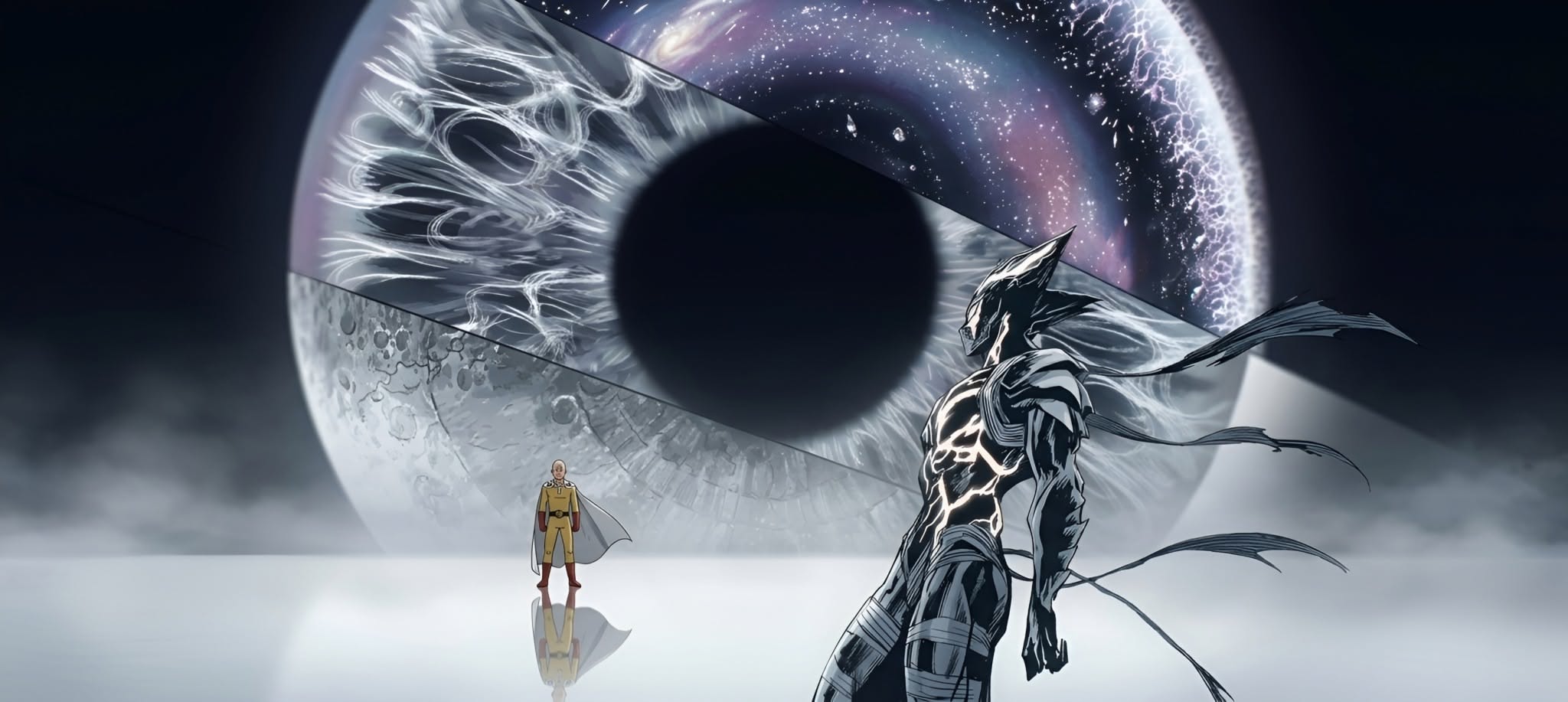
When Saitama and Garou finally lock horns in their absolute states, the narrative leaves Earth behind—both literally and figuratively. This climactic confrontation represents the emotional and ideological zenith of ONE and Murata’s collaboration. For years, the core joke of One-Punch Man was that Saitama is a max-level character in a starting-zone world, chronically depressed by the absence of challenge.
In Garou, Saitama finds an opponent who can survive a punch. But the tragic irony is that by the time Garou reaches a state capable of pushing the Caped Baldy—achieving the dreaded Cosmic Fear mode and mimicking Saitama’s own techniques—the cost has rendered the fight utterly devoid of joy. Triggered by a heart-wrenching assault on Saitama’s closest companion, the mood shifts from deadpan levity to pitch-black, suffocating wrath.
The sheer staging of this fight demands unprecedented scale: shockwaves blowing away the atmosphere of Jupiter, martial arts colliding across IO’s desolate surface, and the conceptual “Serious Punch Squared” threatening the fabric of local space-time. Yet underneath the spectacle lies a profound character study. Garou realizes the horrifying truth that Saitama isn’t an impassioned protector of justice; he is an immovable, incomprehensible wall. Saitama’s growth rate simply outpaces infinity, exposing Garou’s cosmic pretensions as the desperate tantrums of a wounded child.
The Murata Paradigm: Replicating Impossible Art on Screen
You cannot discuss Season 3 without addressing the elephant in the studio: the visual execution. The legacy of Season 1, orchestrated by director Shingo Natsume and a historic dream-team of freelance animators at Madhouse, remains a high-water mark for the television anime industry. Conversely, Season 2, helmed by J.C. Staff, drew fierce critique from the fandom for its inconsistent composites, metallic gradient textures, and compressed sound design.
Season 3 faces an artistic hurdle that dwarfs both previous outings. Yusuke Murata’s artwork throughout the Monster Association and Garou climax represents some of the most intricate, double-page splash-heavy linework in comic history. Adapting sequences like the Tatsumaki vs. Psykos-Orochi beam clashes, Garou’s evolving monstrous silhouettes, and the vastness of the Jovian battlefields requires top-tier compositing, dynamic 3D background animation, and animators who understand the physics of kinetic momentum.
Industry insiders and fans alike are watching closely. The return of key animators like Kenichiro Aoki—a beacon of passion who carried Season 2’s most memorable choreography—provides hope. But for Season 3 to achieve legendary status, the production must honor Murata’s spatial ambition without sacrificing the expressive character animation that makes ONE’s writing sing.
The Verdict: An Era-Defining Arc in the Making
The Monster Association War is the defining crucible of One-Punch Man. It is the moment the series graduated from a beloved, witty deconstruction of superhero archetypes into a towering titan of the battle shonen canon. It brings cosmic scale, tragic character writing, and a philosophical interrogation of strength to the forefront, delivering an experience that leaves the status quo forever shattered.
If the animation team can capture even a fraction of the raw, unadulterated madness penned in the manga, Season 3 will not just break the internet—it will redefine what a climactic anime season can be.
What part of the Monster Association Arc are you most desperate to see animated? Can any studio do Yusuke Murata’s art true justice, or is the manga simply unmatchable? Drop your takes, theories, and dream animation staff picks in the comments below!