For more than twenty-seven years, Eiichiro Oda has operated less like a traditional weekly mangaka and more like an obsessive mythological architect. Every geopolitical tremor, discarded historical footnote, and folklore echo across the Grand Line has steadily funneled toward one definitive destination: Elbaf, the legendary realm of war, honor, and colossal shadows. Following the apocalyptic paradigm shifts of the Egghead Island Arc—where Dr. Vegapunk peeled back the veil on the world’s sinking topography and Joy Boy’s ancient war—the Straw Hat Pirates now find themselves traversing the roots of Yggdrasil itself. Yet, as the manga marches toward the historic milestone of Chapter 1200, the fandom’s collective gaze has shifted downward into the uncharted subterranean darkness beneath the giant kingdom. The prevailing theory dominating the global community posits an unforgettable turning point: the unearthing of Void Century war relics buried in Elbaf’s deep crust, directly catalyzed by the unshackling of Prince Loki and his long-repressed divine wrath.
The Sacred Milestone: Why Chapter 1200 Demands an Earth-Shattering Shift
In the intricate rhythm of Oda’s serialization, centenary chapters are never treated as mere calendar dates; they are structural keystones. Chapter 100 gave us “The Legend Begins” as the crew entered the Grand Line; Chapter 500 introduced Silvers Rayleigh and the dark reality of Mary Geoise’s slave trade; Chapter 1000 immortalized “Straw Hat Luffy” redefining the peak of piratical power atop Onigashima; and Chapter 1100 shattered emotional defenses with Bartholomew Kuma’s tragic pact. By the time Oda pens the final pages of Chapter 1200, the narrative demands an event that fundamentally recalibrates the final saga’s balance of power.
Egghead established the existential stakes—the world is actively submerging under rising tides engineered by the Mother Flame and the Ancient Weapons. Elbaf is structurally positioned not just as an idyllic Viking haven, but as the fortress that survived that original cataclysm eight centuries ago. Chapter 1200 sits at the exact mathematical juncture where the exposition of Elbaf’s fractured royal family must violently collide with the overarching mythology of the Void Century, pivoting the Straw Hats from wide-eyed adventurers into soldiers standing on ground zero of the final war.
Yggdrasil’s Underworld: The Relics of the 800-Year War Beneath Elbaf
To understand the secrets lurking beneath Elbaf, one must examine Oda’s meticulous botanical and geographical symbolism. For decades, theorists have fixated on the relationship between the colossal arbor vitae of the One Piece cosmos: the Sun Tree Eve, which channels sunlight thousands of meters down to Fishman Island beneath the Red Line, and the Treasure Tree Adam, renowned as the strongest timber in existence, from which both the Thousand Sunny and the Oro Jackson were hewn.
The Planetary Axis: The Roots of Adam and Eve
It is increasingly evident that Elbaf is the physical home of Treasure Tree Adam. If Eve sits beneath the throne of the Celestial Dragons at Mary Geoise, absorbing light, then Adam serves as the physical anchor of the opposite side of the world, rooted deep into the tectonic mantle. The theory suggests that the Underworld of Elbaf—a vast subterranean labyrinth running beneath the roots of the colossal central tree—is not simply an execution ground or a prison for rogue giants, but a petrified graveyard of the Void Century.
During the Great War, the ancient Kingdom did not fall overnight. If Joy Boy commanded the Iron Giant Emet and held alliances with the ancient Kozuki, the Lunarians, and the Fishman royalty, the ancient giants of Elbaf were unquestionably his frontline siege engines. The caverns beneath Elbaf likely conceal the auxiliary engines of that bygone era: ancient sea-stone armaments, prototypes of technological weaponry exceeding modern Vegapunk designs, and perhaps the dormant hulls of warships manufactured to survive the first global flood. These are the “Forbidden Relics” that the World Government has historically feared, explaining why Mary Geoise has constantly attempted—via Mother Carmel and illicit gigantification experiments—to cultivate, infiltrate, or subjugate giant-kind.
Loki Unbound: The Accursed Prince and the Mythos of Divine Wrath
Central to this tectonic threshold is the enigmatic figure of Prince Loki, the self-proclaimed “Sun God” who was introduced bound in colossal chains of Seastone, blindfolded, and reviled as a parricide who murdered his own father, King Harald, for a legendary Devil Fruit. Oda’s character design choices rarely exist in a vacuum; Loki’s visual framing heavily evokes the Norse myth of Fenrir bound by the magical ribbon Gleipnir, as well as Loki himself bound beneath the earth until the arrival of Ragnarök.
The Anatomy of Parricide: Monstrous Villain or Tragic Sentinel?
The standard World Government propaganda machine, mirrored in Elbaf’s own internal dogmas, brands Loki as a purely destructive sociopath. However, veteran readers recognize Oda’s signature narrative misdirection—a device previously deployed with characters like Oden, Kuma, and Mont Blanc Noland. Loki’s declaration that he will “destroy the world” resonates less like the megalomania of an Enel and more like the tragic burden of someone who knows the true shape of the planet’s doomed destiny.
What if King Harald did not fall out of malice, but out of necessity? If Elbaf’s previous royalty sought appeasement with the World Government—perhaps bargaining away the land’s ancient historical neutrality—Loki’s violent coup may have been a desperate measure to prevent the subterranean relics from falling into the hands of the Five Elders. Chaining Loki may have been the only compromise the warrior nation could stomach to delay an internal civil war. The legendary Devil Fruit Loki consumed, long shrouded in secrecy, is hypothesized to be a Mythical Zoan directly tied to the unbridled forces of cataclysm—a power capable of interacting with the biomechanical remnants sleeping beneath the roots of Adam.
The Ragnarök Protocol: What Happens When the Chains Snap?
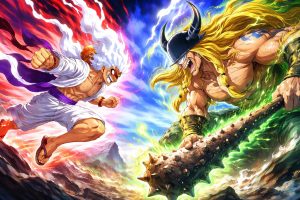
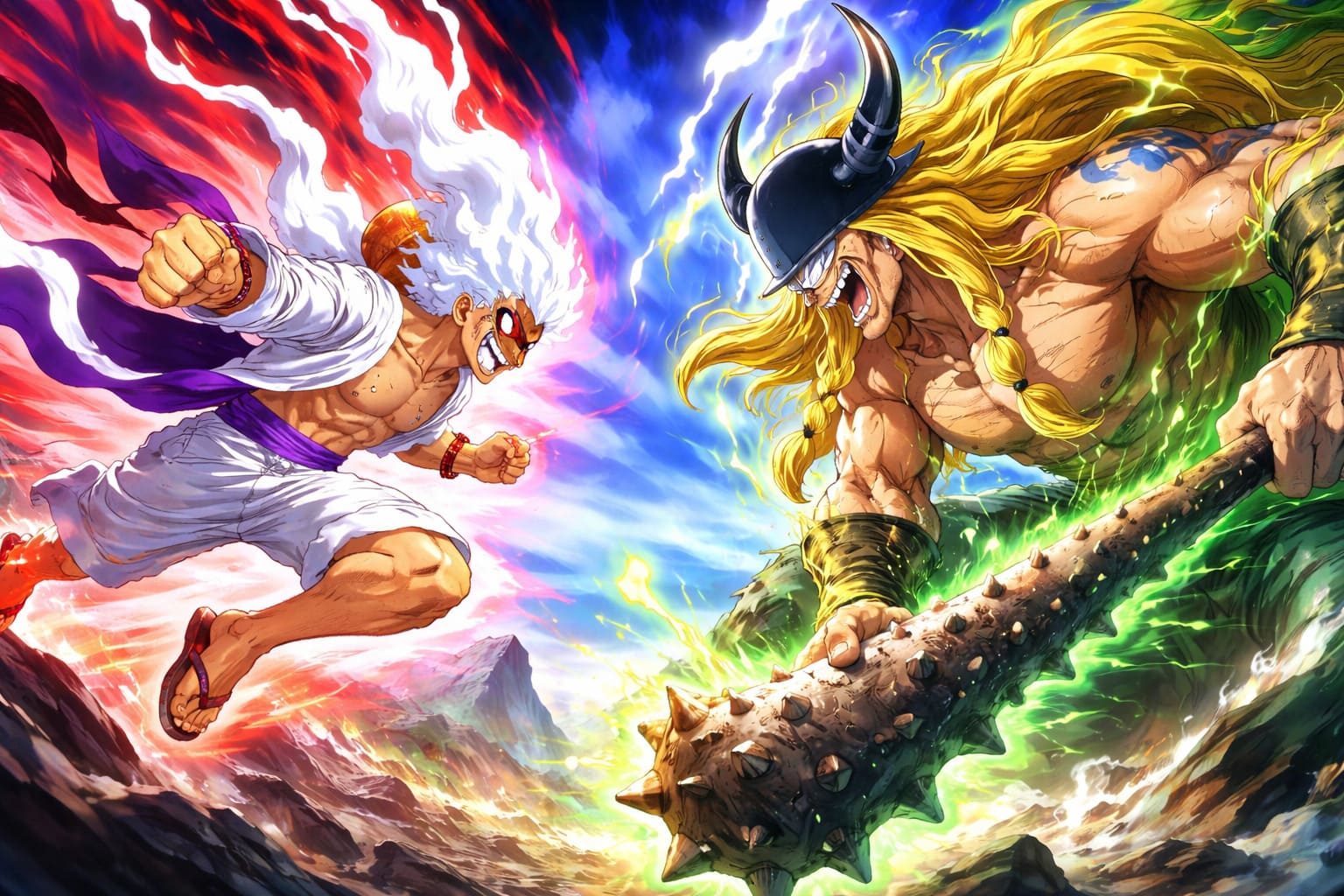
When Luffy encounters Loki, the thematic resonance is electric: Luffy, the true embodiment of the liberating Sun God Nika, stands face-to-face with a man condemned for donning the same divine mantle in darkness. Chapter 1200 offers the ideal dramatic canvas for Loki’s inevitable release. Whether unchained by Luffy’s reckless curiosity, Zoro’s blade, or an external assault by encroaching imperial agents, the unshackling of Prince Loki will unleash a divine wrath that physically tears through Elbaf’s surface crust. This will not merely be an internal display of Conqueror’s Haki; it will be the structural cracking of the continent, exposing the ancient technology entombed below and sounding the horn of the narrative’s long-promised Ragnarök.
The Convergence: God’s Knights, Shanks, and the Final Battleground
The implications of Elbaf’s subterranean arsenal extend far beyond the Straw Hats and the giant clans. The world is converging on this isolated northern stronghold at terrifying velocity. Figarland Garling’s elevation to the Gorosei and the mobilization of the Holy Knights (God’s Knights) signal that the World Government can no longer afford to leave Elbaf unmonitored. With Red-Haired Shanks having recently departed the shores after obliterating the Kid Pirates, Elbaf currently stands in a precarious power vacuum—one ripe for invasion.
Should Chapter 1200 expose the Void Century warmachines beneath Adam’s roots, it will validate why Shanks lingered in Elbaf for so long: not as a conqueror, but as an impassive gatekeeper safeguarding the final threshold until Joy Boy’s return. The unsealing of the Underworld would trigger an immediate red alert across the Grand Line, forcing the Holy Knights to deploy their ultimate enforcers directly to the giant homeland, sparking a multi-front clash between imperial inquisitors, ancient giant warriors, and the Straw Hat Grand Fleet.
The Twilight of the Gods Beckons
As the serialization barrels toward Chapter 1200, the narrative kineticism of One Piece is operating at an all-time zenith. What began in 1999 as a whimsical fable about a rubber boy setting out in a barrel has evolved into an apocalyptic epic where botanical megastructures, forgotten techno-warfare, and suppressed pantheons dictate the fate of human civilization. Elbaf is no longer a quaint pastoral retreat for Usopp to find his courage; it is the powder keg of the final era.
If the subterranean relics beneath Treasure Tree Adam are brought to light by the shattering of Prince Loki’s bindings, the myth of the Great Kingdom will finally cease to be a phantom of the past. It will become the terrifying artillery of the present. As the roots of Yggdrasil begin to groan under the weight of destiny, only one question remains: when the chains of the Accursed Prince shatter, will the dawn finally break, or will the world drown in the flames of the Gods’ Twilight?
What are your predictions for Chapter 1200? Is Loki a misunderstood tragic hero, or does he truly harbor the flames of global ruin? Let your theories run wild in the comments below!