
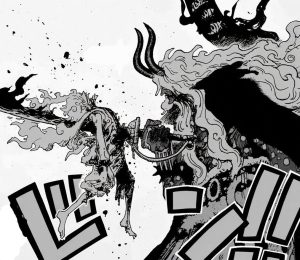
In the grand architecture of serialized manga, few creators wield the monumental weight of milestone chapters with the mythic precision of Eiichiro Oda. Ever since Chapter 100 (“The Legend Begins”) charted the Straw Hats toward the Grand Line, Chapter 500 pulled back the curtain on Silvers Rayleigh, and Chapter 1000 immortalized Luffy’s “Red Roc” against Kaido, the community has learned an unspoken rule: when Oda drops a double- or triple-zero chapter, the tectonic plates of the world shift. Now, with the story deep into the long-awaited shores of Elbaf, all eyes are locked on the horizon of Chapter 1200.
This isn’t merely another pit stop on the final lap toward Laugh Tale. Elbaf has been gestating in the cultural consciousness of the fandom since Little Garden in the early 2000s. With Prince Loki introduced in chains, the ghosts of the Void Century lingering across the giant kingdom’s sprawling landscapes, and the lingering threat of the World Government’s Holy Knights, Chapter 1200 promises to be the flashpoint where ancient history violently collides with modern revolution.
The Crypts of Yggdrasil: Treasure Tree Adam and the Void Century Graveyard
To understand the powder keg awaiting detonation, one must look downward. Elbaf’s geography is overwhelmingly vertical, dominated by the colossal crown of what appears to be the legendary Treasure Tree Adam. While maritime history in One Piece reveres Adam for yielding timber resilient enough to withstand cannon fire—crafting both the Pirate King’s Oro Jackson and Franky’s masterwork, the Thousand Sunny—its systemic counterpart, the Sun Tree Eve, hints at a far more esoteric reality.
Eve channels light down 10,000 meters to illuminate Fish-Man Island; Adam, conversely, anchors itself deep into the subterranean bedrock of Elbaf. If Eve represents illumination and sanctuary, Adam historically represents conflict, endurance, and the blood-soaked soil of perpetual war. Theorists across the community are converging on a startling proposition: the true foundation of Elbaf is not mere rock, but a catacomb of Void Century war relics.
The Iron Giants’ Ancestral Forge
Following the emotional sacrifice of the Ancient Iron Giant, Emet, on Egghead Island, we know that Joy Boy’s coalition was powered by impossible, lost technology. The giants of 800 years ago were not mere observers; they were Joy Boy’s heavy vanguard. Beneath Elbaf lies the primary graveyard of this ancient war—defunct mechanical colossi, energy cores humming with dormant Mother Flame prototypes, and unexploded weaponry that the World Government spent eight centuries attempting to erase. Chapter 1200 may peel back the roots of Adam to reveal that Elbaf sits directly atop the physical armory that nearly toppled the Twenty First-Century Kings.
Loki’s Unshackled Divine Wrath: The Ragnarok Parable
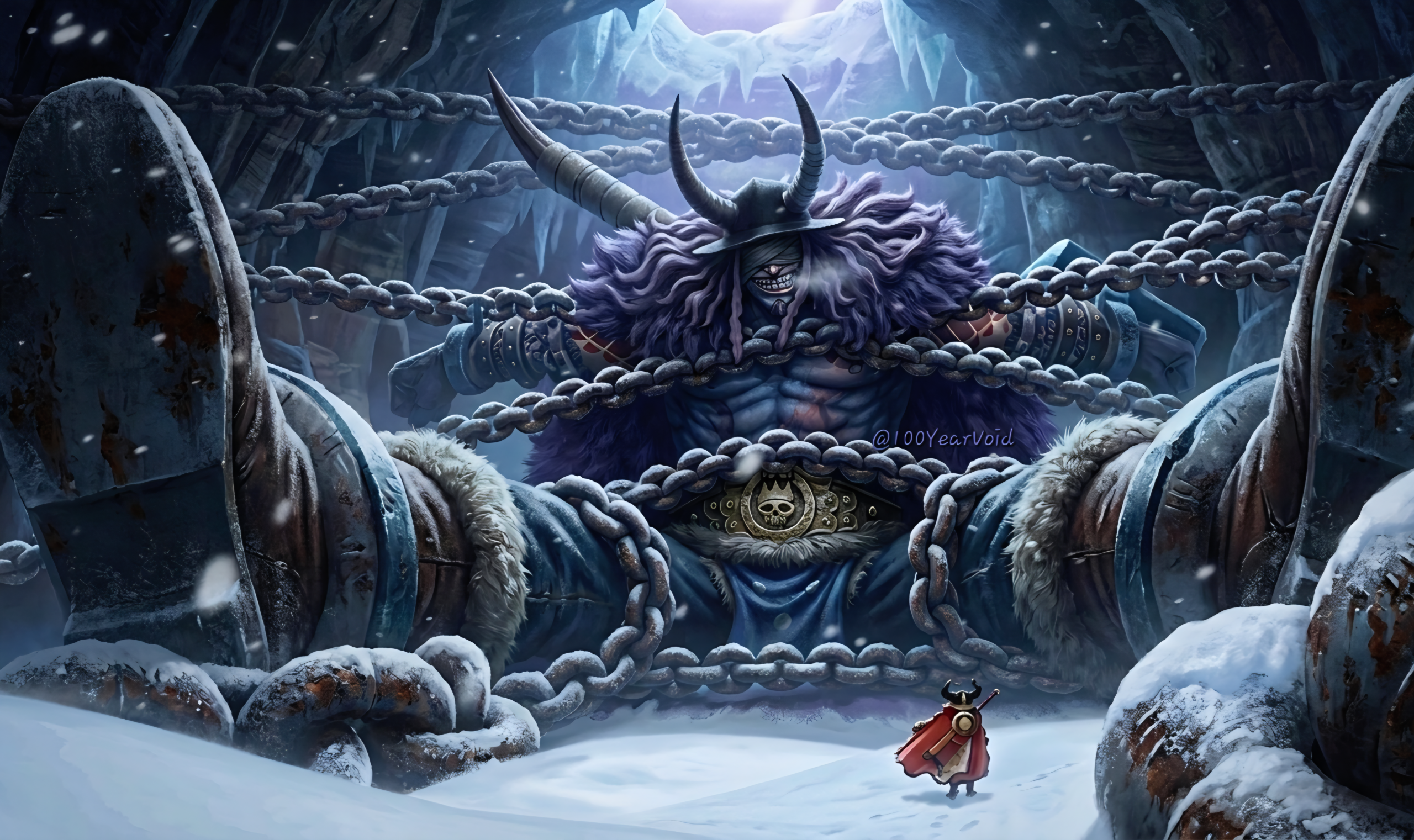
No character embodies Elbaf’s volatile duality quite like Prince Loki. Introduced not as a dignified sovereign, but as a blindfolded, heavily chained pariah pinned to the base of the world, Loki radiates an aura of mythic menace. Oda’s deliberate homage to Norse mythology casts Loki not merely as a trickster, but as the harbinger of Ragnarok—the apocalyptic twilight of the gods.
The narrative tension surrounding Loki’s “cursed” Devil Fruit has reached a boiling point. The Giants speak of his power with pure dread, having sacrificed their kingdom’s pride to keep him subdued under colossal sea-prism shackles. But what fruit warrants such existential terror?
- The Mythical Zoan Inversion: While Luffy carries the mandate of Nika—the Sun God who liberates through joy and unconstrained laughter—Loki likely harbors a power rooted in pure, catastrophic collapse. Speculation points toward a Mythical Zoan tied to primeval destruction: perhaps the Hito Hito no Mi, Model: Surtr, the black fire titan who burns the cosmos, or a calamity-class beast that directly counteracts the life-giving dawn of Nika.
- A Broken Mind, An Unbroken Will: Loki’s psychology is fundamentally scarred by rejection. Abandoned by Lola, demonized by his kin, and imprisoned by his own lineage, his release will not be a heroic triumph; it will be an unbridled expulsion of divine spite. If Chapter 1200 chronicles the snapping of those chains, we will witness a force that rejects both the World Government’s order and Joy Boy’s benevolent dawn.
The God’s Valley Parallel: The Holy Knights’ Descent
Eiichiro Oda rarely allows an isolated conflict to breathe without external systemic pressures tightening the noose. The ascension of Saint Figarland Garling to the Five Elders has fundamentally restructured the World Government’s offensive posture. The Holy Knights, long whispered of in Mariejois, are no longer a mythic secret police; they are an imperial clean-up crew.
The parallels between God’s Valley and the current trajectory of Elbaf are impossible to ignore. God’s Valley was an unaffiliated island holding treasures the World Government coveted, populated by races targeted for extermination. Elbaf stands as the final unconquered territory—a sovereign powerhouse boasting the world’s most terrifying standing military, yet lacking the protection of an Emperor’s formal flag, save for Shanks’ fleeting guardianship.
If the World Government learns that the war engines beneath Elbaf are awakening, the Holy Knights will not send an admiral; they will deploy an extermination fleet. Chapter 1200 presents the perfect staging ground for the Holy Knights to make planetfall, effectively trapping the Straw Hats, the Red Hair Pirates’ ideological territory, and Loki’s unleashed vengeance in a three-way apocalyptic crossfire.
The Ideological Crossroads: Sun God Nika vs. The Prince of Ruin
At the center of this storm stands Monkey D. Luffy. For years, readers have viewed the legacy of Joy Boy as an unblemished beacon of hope. Yet, Egghead exposed the tragic reality that Joy Boy failed. He was a flawed figure who lost, leaving his allies—like Emet and Zunesha—to bear centuries of unfathomable guilt and isolation.
Loki likely knows the unvarnished truth of Joy Boy’s original sin. His confrontation with Luffy in Chapter 1200 won’t simply be a battle of Conqueror’s Haki; it will be an ideological clash over the cost of freedom. Does liberation require the complete burning of the world tree, as Loki’s wrath demands, or can Nika’s rhythm breathe life back into the ashes?
The community sentiment surrounding this dynamic is electric. Discussions across forums and social channels indicate that fans are hungry for an antagonist who directly challenges the metaphysical premise of Nika’s cartoonish omniscience. Loki, armed with ancient relics and a millennia-old grudge, is uniquely positioned to wipe the grin off the Sun God’s face.
Editorial Horizon: The Precipice of the Final War
As we march relentlessly toward Chapter 1200, one truth becomes undeniable: Elbaf is not a pit stop. It is the crucible. By unearthing the relics beneath Adam’s roots and letting Prince Loki loose upon the global board, Oda is doing away with the safety rails. The World Government is fracturing from within, the Emperors are closing in on the final Road Poneglyph, and the weapons of the Void Century are finally waking up.
When those chains break, the world of One Piece will not simply advance—it will fundamentally fracture. Prepare yourselves. Chapter 1200 may very well be the moment the end of the world officially begins.
What do you think lies in the subterranean vaults of Elbaf? Is Prince Loki a misunderstood anti-hero or an irredeemable monster set to rival Marshall D. Teach? Drop your theories in the comments below, and don’t forget to bookmark Wibux.com for breaking manga analyses and weekly deep dives!
One thought on “One Piece Chapter 1200 Theory: The Void Century War Relics Beneath Elbaf and Loki’s Unshackled Divine Wrath”