

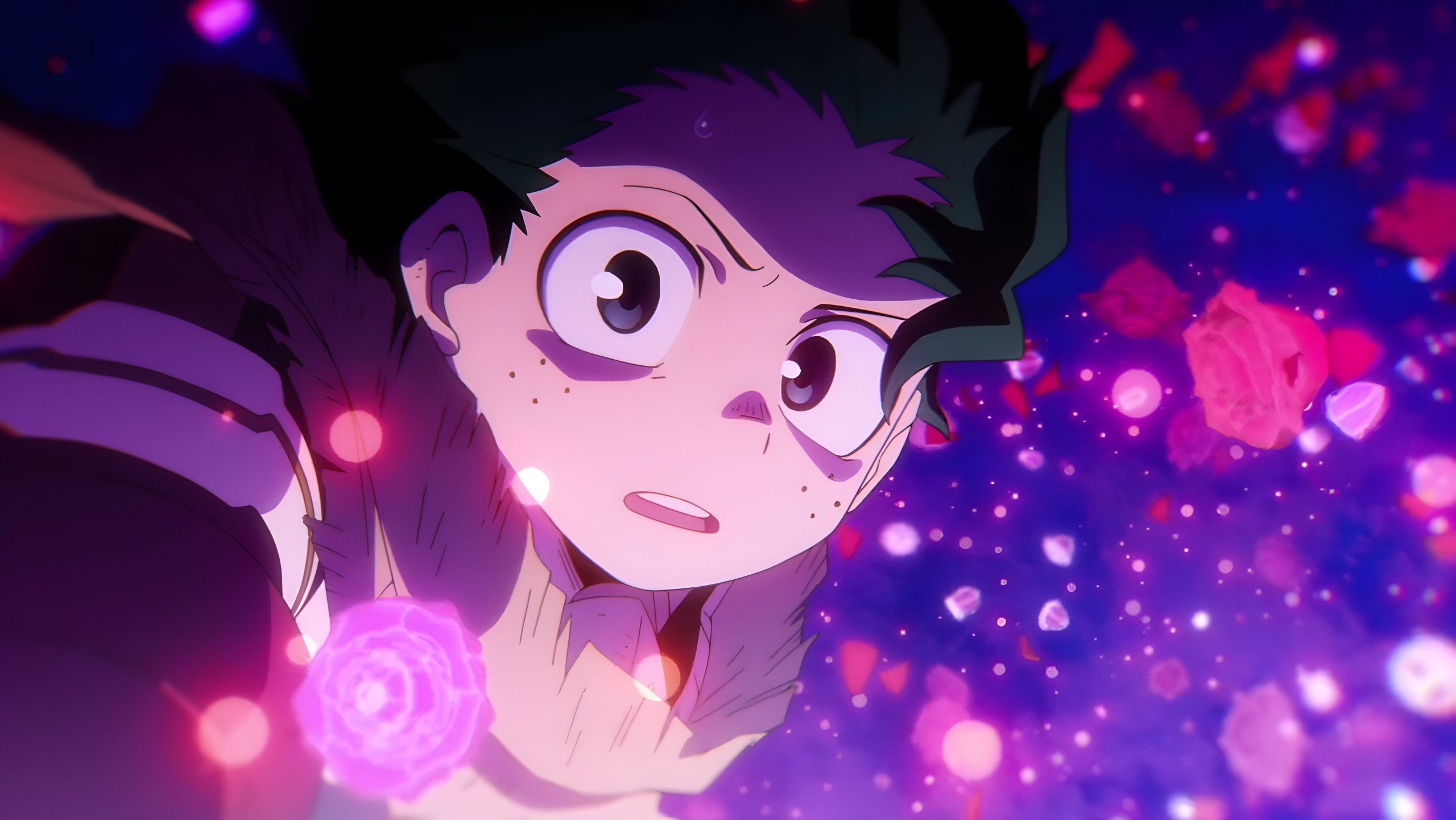
When Toshinori Yagi pointed his trembling, smoke-enshrouded finger toward the broadcast camera in the ruined crater of Kamino Ward and uttered the fateful words, “Next, it’s your turn,” he intended it as a quiet baton pass to a green-haired boy weeping in the crowd. He could never have anticipated that across the globe, an egomaniacal crime boss would interpret those very syllables as a divine mandate to construct an autocratic empire in his image. That chilling premise lies at the beating heart of My Hero Academia: You’re Next, the franchise’s fourth—and arguably most thematically complex—cinematic offering.
Arriving at a pivotal historical junction for Kohei Horikoshi’s juggernaut franchise, right as the manga crossed its finish line and the television adaptation braced for its apocalyptic final confrontation, You’re Next operates as far more than just a seasonal side-quest. It serves as a psychological inquest into the vacuum left by the Symbol of Peace, anchored by Studio Bones operating at the absolute peak of its kinetic, sakuga-drenched powers. Between the horrific mockery that is Dark Might and Izuku Midoriya’s breathtaking deployment of a fully awakened One For All arsenal, the film unpacks what heroic succession actually means when the world is burning down around you.
The Grotesque Simulacrum: Dark Might and the Perversion of an Icon
The greatest strength of You’re Next does not lie merely in its budget-bursting battle sequences, but in its villainous core. Valdo Gorrini, the patriarch of the European criminal syndicate known as the Gorrini Family, does not want to dismantle hero society like Tomura Shigaraki, nor does he wish to cleanse it with ideological fire like Stain. Instead, Gorrini commits the ultimate blasphemy: he commodifies and weaponizes the memory of All Might, adopting the moniker Dark Might.
A Distorted Mirror of the Symbol
From an aesthetic and narrative standpoint, Dark Might is a haunting exercise in uncanny valley storytelling. He dons the golden age aesthetic—the signature swooping blond hair, the broad grin, the booming theatrical baritone—yet beneath the gilded exterior festers a megalomaniacal tyrant driven by his “Alchemy” Quirk. Where All Might smiled to shoulder the fears of the terrified masses, Dark Might’s perma-grin is a grimace of absolute subjugation. He views peace not as an environment where people can flourish without terror, but as an absolute zero state achieved through total ideological dominance.
This dynamic exposes the underlying fragility of the world Horikoshi built. By creating a society that leaned entirely on the back of a singular living god, All Might inadvertently engineered the blueprints for a divine dictatorship. Dark Might is the ideological manifestation of that systemic flaw: a monstrous testament to what happens when charismatic worship completely detaches from empathy, sacrifice, and human vulnerability.
Deku’s Zenith: The Symphony of a Fully Integrated One For All
Standing opposite this gold-plated nightmare is Izuku Midoriya, who enters You’re Next in an evolutionary stage that long-time fans have spent a decade waiting to witness on the silver screen. Chronologically nestled between the fallout of the Dark Hero arc and the harrowing setup of the Final War, this film catches Deku at the precipice of absolute Quirk mastery. Gone are the days when utilizing One For All meant shattering his own radius and ulna into chalk.
What the audience gets in You’re Next is a combat masterclass. Deku no longer operates as a scrappy underdog mimicking his mentor; he fights like an unpredictable, mid-air god of momentum. His movement is a fluid, breathtaking ecosystem where distinct ancestral Quirks fire in seamless succession:
- Gearshift manipulates inertia to bend the laws of basic physics, turning split-second feints into inescapable sonic booms.
- Fa Jin stores explosive kinetic energy from kinetic recoil, allowing him to match Dark Might’s skyscraper-level strikes without tearing his tendons.
- Blackwhip functions not just as a grappling hook, but as structural armor, directional propulsion, and crowd-control webbing.
- Float and Smokescreen serve as tactical spatial controllers, transforming open skies into tight, claustrophobic arenas designed to disorient his opponent.
Witnessing Deku systematically deconstruct Dark Might’s counterfeit “Detroit Smash” with his own variant moves is narratively satisfying on a cellular level. It proves visually what Horikoshi has argued in ink: Izuku’s strength never came from the raw megatons of OFA, but from his capacity to perceive heroism as an act of shared, collective human burden rather than lonely individual supremacy.
The Origin Trio’s Tactical Evolution: Bakugo and Todoroki as Anchors
While the marketing inevitably frames the narrative around Deku’s philosophical clash with Dark Might, You’re Next refuses to relegate Katsuki Bakugo and Shoto Todoroki to cheerleaders on the sidelines. The film demonstrates how much the core Class 1-A triad has evolved into an interconnected tactical unit.
Bakugo’s aerial maneuvers feel sharper, angrier, and yet infinitely more deliberate than in Heroes Rising. His cluster explosions are utilized with surgical precision, carving paths through the Gorrini vanguard without wasting a single joule of energy. Todoroki, meanwhile, demonstrates unprecedented mastery over his temperature equilibrium, shifting between Phosphor-adjacent thermal bursts and titanic ice glaciers that dictate the geography of the battlefield. Their interactions with the movie’s original characters—particularly the enigmatic butler Giulio Gandini and the reality-altering Anna Scervino—ground the high-flying spectacle in raw character urgency.
Studio Bones Unchained: The Pedigree of Modern Sakuga
It is impossible to analyze You’re Next without paying homage to the jaw-dropping technical prowess flexed by Studio Bones. Directed by franchise veteran Tensai Okamura (Darker than Black, Wolf’s Rain), the film breaks away from the conventional television series constraints with a visual language that feels wild, tactile, and fiercely dynamic.
The impact frames throughout the film’s third act feature unmistakable flourishes of top-tier industry animators, where line work dissolves into frenetic sketch-lines, and explosions ripple through the color spectrum with neon intensity. The camera direction refuses to stay stationary; it loops around collapsing fortresses, dives headfirst into spiraling fistfights, and tracks Blackwhip strands through volumetric debris with nauseating kinetic joy. Bones treats the film’s climax not just as an episode with a bigger budget, but as an exhibition of modern anime craftsmanship at its undisputed zenith.
A Bittersweet Milestone in the Final War Narrative
Perhaps what elevates My Hero Academia: You’re Next beyond its explosive popcorn thrills is the palpable air of finality that permeates every frame. Fans know the status quo of this world is on borrowed time. The idyllic UA dorm life is effectively dead, the public trust is fractured beyond repair, and the shadow of All For One looms over every sunset.
In this context, You’re Next feels like a defiant, golden celebration of an era that is drawing to a close. It is the ultimate counter-argument to cynicism: even when an impostor wraps himself in the sacred cloak of your childhood hero, the genuine spirit of self-sacrifice cannot be counterfeited. Deku’s victory here is not just about bringing down a rogue mafia don; it is about reclaiming his idol’s legacy from the jaws of corruption before stepping onto the grim battlefield of the manga’s grand finale.
For fans who have followed Izuku Midoriya from a quirkless, crying middle schooler to this towering apex predator of empathy, You’re Next is a triumphant, emotionally resonant victory lap. The film proves once and for all that while anyone can steal a catchphrase, only a true hero can bear the weight of what comes next.
What did you think of Dark Might’s sinister ideology, and where does Deku’s fight rank among Studio Bones’ greatest animated spectacles? Drop your thoughts, favorite sakuga moments, and theories in the comments below, and don’t forget to follow Wibux for our full breakdown of the My Hero Academia manga finale!