Ever since Emporio Alniño wiped away tears under the rain-swept sky in the bittersweet crescendo of Stone Ocean, the international anime sphere has been trapped in a state of suspended animation. The reset of the original Joestar universe was not merely a narrative conclusion; it was an ontological clearing of the table. For years, manga purists and anime-only converts alike have whispered the same four words with the reverent urgency of a secular gospel: Steel Ball Run. Long hailed as Hirohiko Araki’s uncontested magnum opus, Part 7 represents the zenith of the mangaka’s thematic maturity, artistic virtuosity, and bizarre ingenuity. Now, with industry whispers intensifying around David Production’s production pipeline, the prospect of an animated adaptation is shifting from a utopian daydream to an imminent, monumental reckoning.
A Clean Slate on an Open Frontier: The Reinvention of the JoJo Mythos
To understand the unprecedented buzz surrounding Steel Ball Run, one must grasp the magnitude of Araki’s reinvention. When serialization moved from the relentless weekly grind of Weekly Shonen Jump to the adult, expansive pages of Ultra Jump in the mid-2000s, the shackles came off. The narrative breathed deeper, darker, and vastly more deliberate air. Set against the sun-baked, dust-choked expanse of 1890s America, the story ditches the claustrophobic urban sprawls of Morioh or Cairo for a grueling 6,000-kilometer cross-country equestrian race spanning from San Diego Beach to the avenues of New York City.
With a staggering 50-million-dollar purse dangling as bait, the race attracts the world’s most eccentric outlaws, prodigies, and mercenaries. Yet, this picaresque sports epic is merely the stage dressing. Beneath the hooves and grit lies a harrowing supernatural conspiracy involving the pursuit of the mummified, sacred Saint’s Corpse—relics possessing reality-altering providence that attract the predatory attention of the chillingly patriotic 23rd President of the United States, Funny Valentine. It is an intoxicating convergence of revisionist American history, western iconography, cosmic horror, and political thriller, redefining what a battle-seinen property can accomplish.
Broken Idols and Golden Ratios: The Psychology of Johnny and Gyro
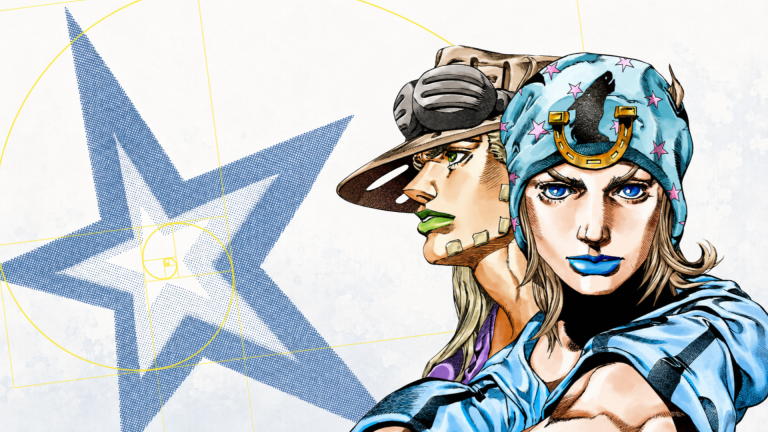
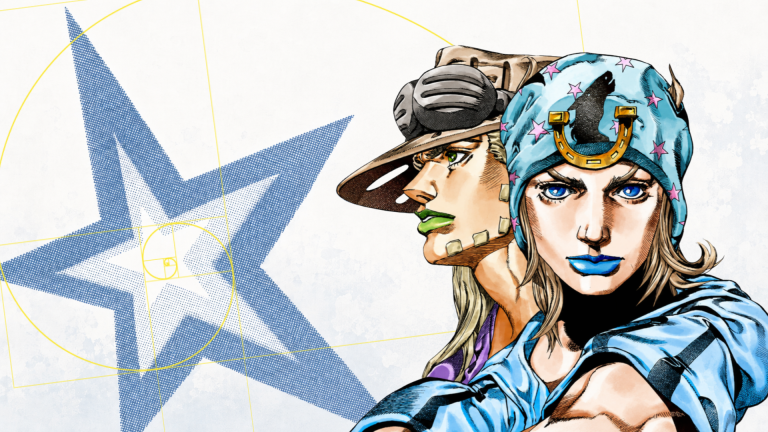
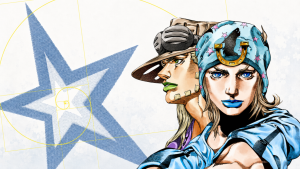
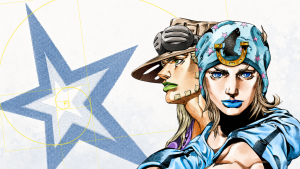
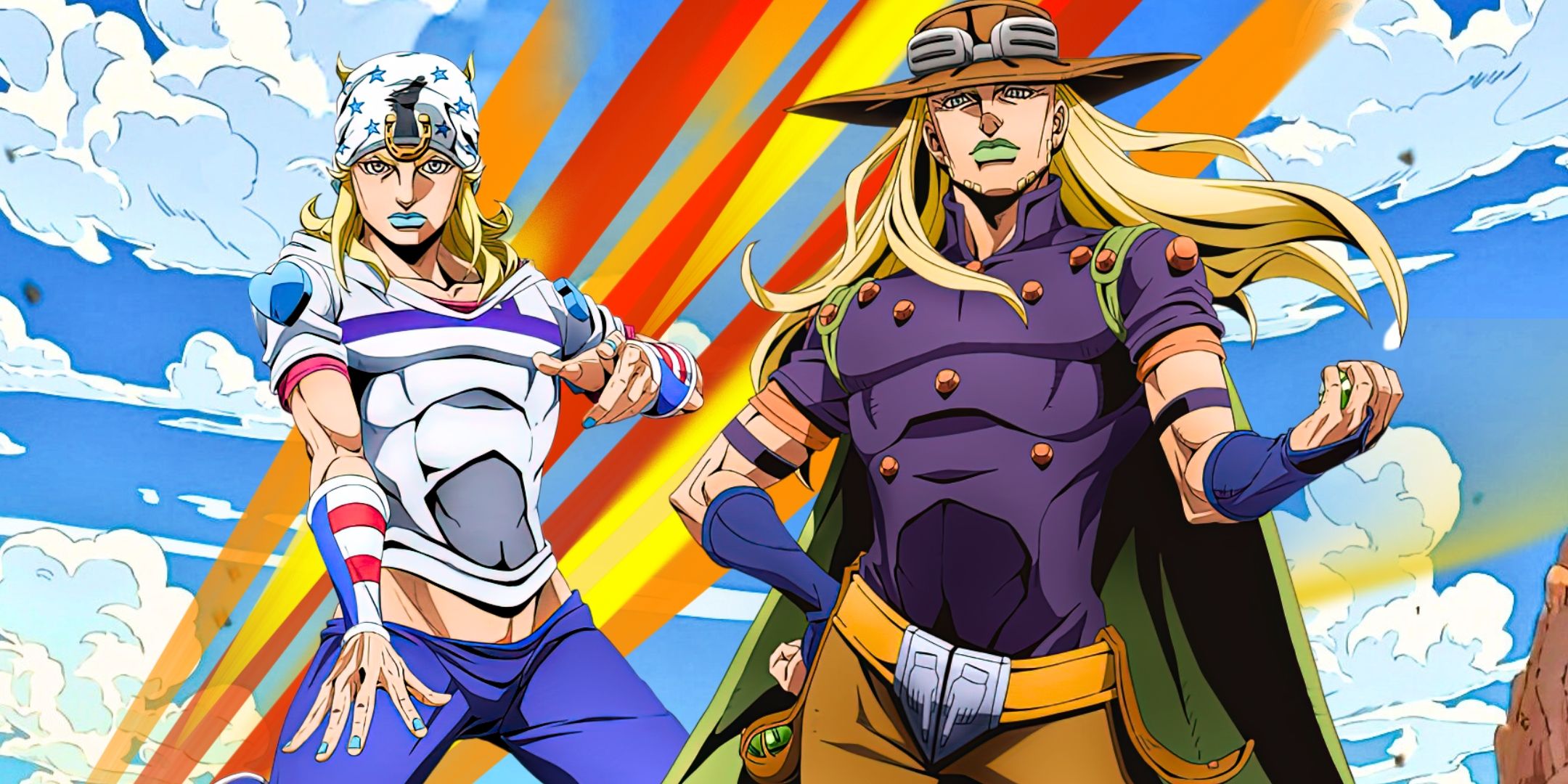
At the beating heart of this sprawling epic lies arguably the most layered and emotionally resonant dynamic in modern sequential art: Johnny Joestar and Gyro Zeppeli. Their pairing radically upends the archetypal “JoJo and Jobro” paradigm, presenting a study in contrasting existential traumas and mutual redemption.
Johnny Joestar and the Terrifying “Dark Determination”
Johnny is not Jonathan Joestar, nor is he meant to be loved immediately. A former horse-racing prodigy whose hubris, entitlement, and arrogance cost him the use of his legs, Johnny begins his odyssey as an embittered, morally compromised paraplegic. He does not embark on this grueling campaign out of heroism, altruism, or justice; his motivation is raw, desperate, and singularly selfish. He seeks only to restore his mobility, possessing what Araki explicitly labels shikkoku no ishi—a pitch-black determination devoid of hesitation to kill if an obstacle stands between him and his goal. Through Johnny, Araki explores disability, self-loathing, and spiritual resurrection with a jagged, uncompromising emotional honesty rarely glimpsed in mainstream serialized anime.
Gyro Zeppeli and the Legacy of the Executioner
In contrast stands Gyro Zeppeli: a charismatic, gold-toothed disgraced executioner from the Kingdom of Naples whose absurd humor and musical interludes about mozzarella cheese mask a soul crushed by dynastic duty and moral crisis. Rather than Stands dominating the initial proceedings, Gyro introduces the Spin (Kaiten)—a lineage-bound mystical technique rooted in spherical rotation and the aesthetic perfection of the Golden Ratio. Where traditional Hamon was divine solar energy, the Spin is relentless physical geometry elevated to an eldritch, dimensional science. The gradual symbiosis between Gyro’s wounded nobility and Johnny’s lethal pragmatism crafts an emotional foundation so watertight that it elevates every shootout and canyon duel into a profound philosophical contest.
The Equestrian Hurdle: David Production’s Technical Crucible
If Steel Ball Run is a transcendent work on paper, adapting it to screen is an animator’s waking nightmare. The elephant in the room—or rather, the thoroughbred—has always been the sheer mechanical terror of drawing horses. Equine anatomy is notoriously one of the most taxing challenges in visual arts: four-legged gait cycles, undulating muscular structures, shifting perspectives, and the sheer inertia of cavalry collisions demand inhuman frame rates and precise draftsmanship.
Industry insiders have long posited that David Production postponed Part 7 not out of ambivalence, but out of absolute technical preservation. Wit Studio famously hit operational limits animating horses in earlier seasons of Attack on Titan; animating dozens of dynamic mounts competing simultaneously across dynamic environments across 40-plus episodes presents an astronomical production risk. For David Production to honor Araki’s dense, photorealistic cross-hatching without dissolving into jarred, uncanny 3DCG models, the studio must forge an audacious hybrid workflow:
The studio must blend hyper-refined, stylized 3D base assets with painstakingly hand-drawn 2D corrective animation passes for close-up framing. Furthermore, maintaining the franchise’s signature pop-art palette shifts, hyper-stylized physical anatomy, and sonic brilliance—while sustaining the sheer cinematic scale of an unyielding dust-cloud tracking shot across Monument Valley—will necessitate the largest budget and production timeline David Production has ever allocated to an adaptation.
High Stakes and Sacred Ground: Managing the SBR Mythos
The anticipation surrounding Part 7 is further amplified by its legendary status in online culture. For over a decade, Steel Ball Run has reigned near the absolute summit of international aggregator lists, routinely trading blows with Kentaro Miura’s Berserk for the number-one spot on MyAnimeList. The fandom venerates this arc with an intensity that borders on religious fervor. From the viral ubiquity of Gyro’s offbeat humor to the breathless debate over Funny Valentine’s relativistic Stand, Dirty Deeds Done Dirt Cheap (D4C), audiences have built Part 7 into a mythic cultural obelisk.
However, this veneration comes paired with an acute demand for fidelity. Following the polarizing reception to Netflix’s fractured batch-release strategy during Stone Ocean—which many critics argue stunted the weekly community discourse that had previously propelled parts Stardust Crusaders and Golden Wind into viral sensations—fans are demanding a return to prestigious, weekly appointment television. If Steel Ball Run is to conquer the global anime market, it requires a rollout that matches its epic scope: uncompromising visual fidelity, a weekly broadcast cadence, and the space to let its slow-burn atmospheric tension fully flourish.
The Horizon Beckons: The Inevitability of the Run
Hirohiko Araki did not merely create another shonen chapter when he envisioned the dusty trails of 1890; he authored a singular, genre-defying masterpiece that permanently dismantled and reconstructed what comic narrative could achieve. As David Production works through its slate, the race is undeniably approaching the starting gate. Adapting Steel Ball Run will be the ultimate trial of the studio’s legacy—a crucible that could yield one of the most visually jaw-dropping and emotionally devastating anime productions of the 21st century.
The course is set, the Golden Spin has been calculated, and the prize is nothing short of immortality. How do you think David Production should tackle the daunting challenge of Part 7’s horse animation—high-end cell-shaded 3D or pure 2D sakuga? Drop your voice-cast predictions, production theories, and favorite moments in the comments below!