Ever since the cosmic strings of Pucci’s Made in Heaven unraveled and rewove reality at the bittersweet conclusion of Stone Ocean, the collective consciousness of the anime fandom has been tuned to a single, relentless frequency: the thundering gallop of hooves across the 19th-century American frontier. In the pantheon of modern manga, few arcs carry the mythic, untouchable prestige of Hirohiko Araki’s Steel Ball Run. Long hailed as Araki’s magnum opus, Part 7 is not merely the next linear entry in JoJo’s Bizarre Adventure; it represents a seismic artistic renaissance. It marked the moment Araki pivoted from the relentless shonen cadence of Weekly Shonen Jump to the textured, philosophically uncompromising pastures of Ultra Jump, gifting the world a narrative that feels less like a traditional battle-manga and more like an epic Cormac McCarthy novel punctuated by interdimensional gunfights and supernatural geometry.
Yet, alongside the feverish anticipation lies an acute sense of anxiety. Adapting Steel Ball Run into television anime is David Production’s undisputed Mount Everest. Between the technical terrors of rendering continuous equestrian motion and the thematic necessity of treating an intricate, morally ambivalent narrative with proper prestige, the industry stands breathless waiting for the official green light. As industry whispers continue to mount, it is time to dissect why Part 7 remains the ultimate frontier of modern anime adaptation.
The Seinen Paradigm Shift: Araki’s Unfiltered Frontier
To understand the immense pressure riding on an anime adaptation, one must comprehend how radical Steel Ball Run was on the printed page. Serialized beginning in 2004, the series originally debuted without the JoJo’s Bizarre Adventure prefix, a calculated obfuscation before cleanly migrating into the monthly seinen pages of Ultra Jump. Unshackled from weekly demographic constraints, Araki’s craft transformed dramatically. The paneling loosened, landscapes widened into painterly horizons, and the violence became visceral, grounded, and emotionally taxing.
Set in 1890, the narrative frames a grand trans-continental endurance race spanning 6,000 kilometers from San Diego Beach to New York City. The prize: a cool fifty million dollars. But the true race, hidden beneath the spectacle of galloping thoroughbreds and eccentric gunslingers, is a geopolitical pilgrimage for the scattered, petrified relics of a divine Holy Corpse. This premise alone completely rewrote the JoJo paradigm. The colorful pop-art metropolitan sets of Diamond is Unbreakable and Golden Wind give way to sweat, campfire smoke, rusted iron, and wind-scoured dust. For David Production, replicating this tonal shift requires fundamentally reimagining their auditory and visual identity, transitioning from brassy funk and disco-pop to haunting blues, acoustic slide guitars, and symphonic Americana.
The Broken Jockey and the Executioner’s Spin: A Masterclass in Character Psychology
Johnny Joestar: The Dark Determination of a Fallen Star
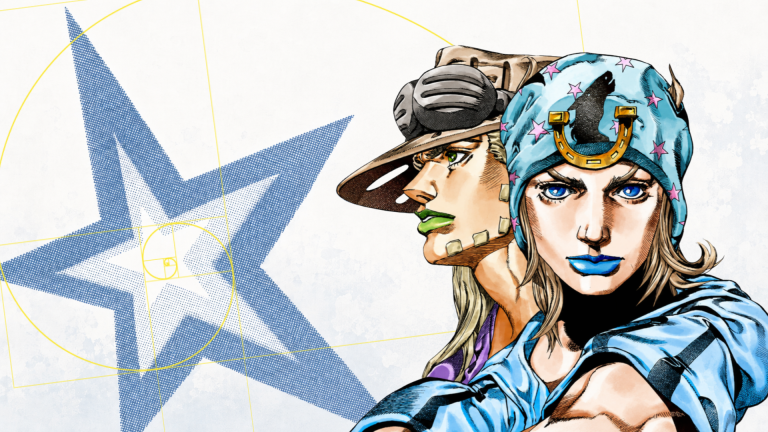
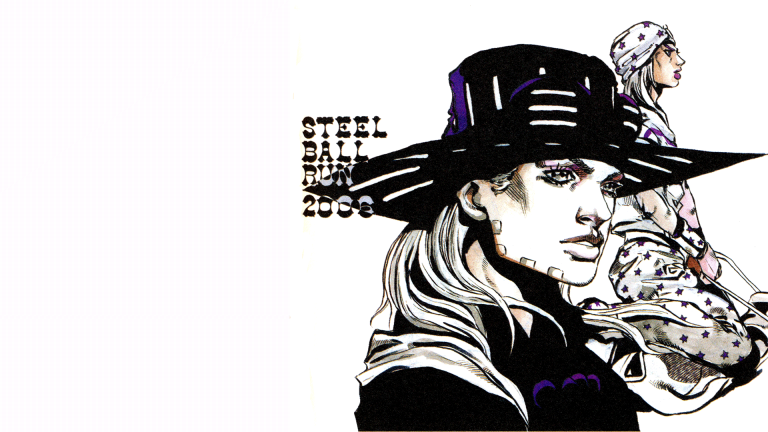
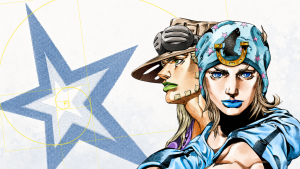
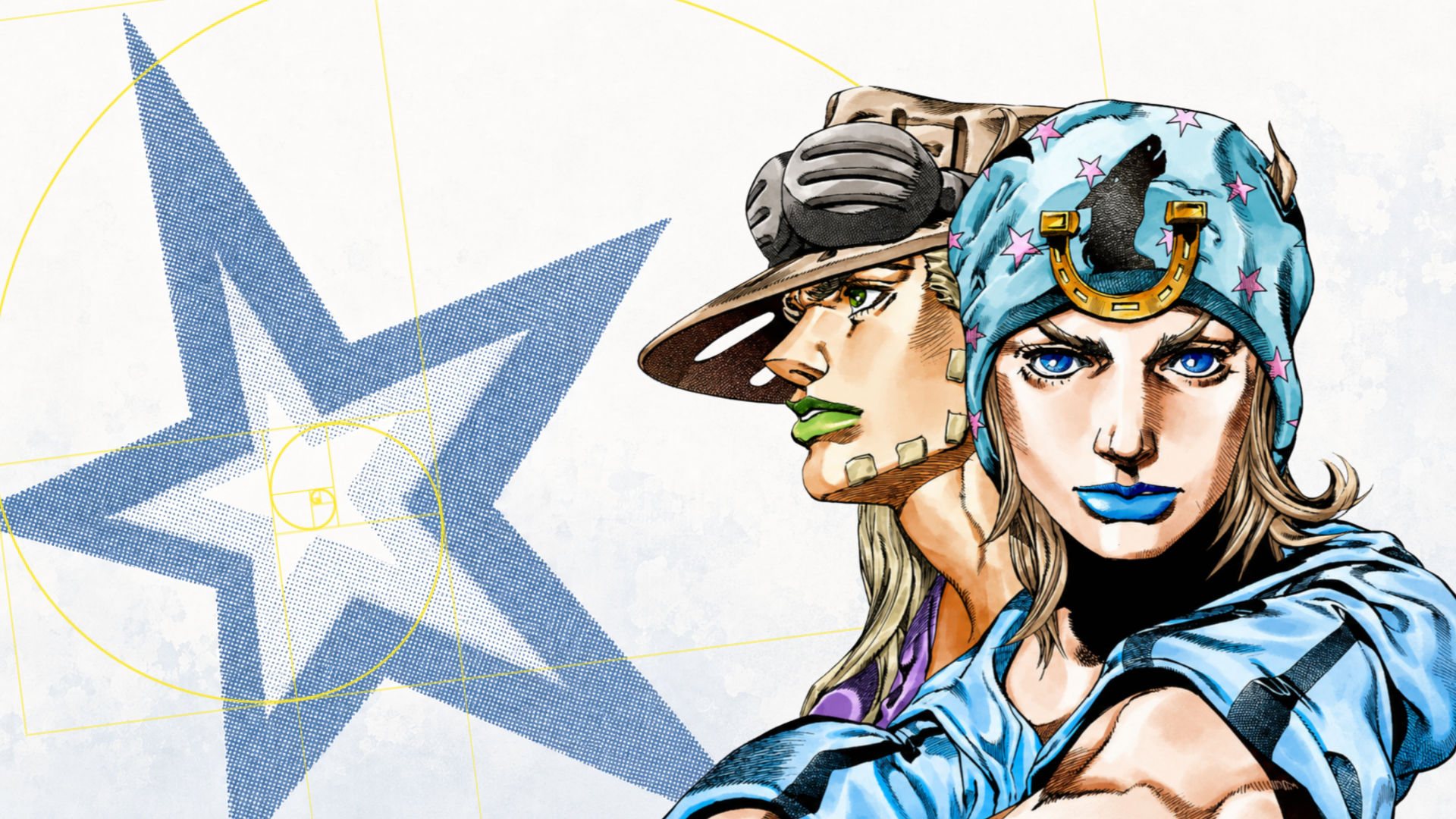
At the beating heart of Part 7 are two of the most layered, compelling protagonists in sequential art. Johnny Joestar is an intentional subversion of the lineage that preceded him. Paralyzed from the waist down following an act of arrogant vanity, Johnny is not a chivalrous crusader like Jonathan or a swaggering tactician like Jotaro. He is broken, spiteful, desperate, and plagued by what Araki explicitly terms “dark determination”—the burning, unflinching willingness to kill or cross any ethical boundary if it means regaining the ability to stand.
Johnny’s evolutionary Stand, Tusk, mirrors this harrowing personal trajectory. Transitioning from firing spinning fingernails like desperate bullets to navigating wormholes and ultimately wielding infinite dimensional force, Johnny’s journey is not about achieving moral righteousness; it is about reclaiming his own humanity from the absolute ground zero of self-loathing. Conveying that internal grit on screen requires a vocal performance that balances fragile vulnerability with terrifying, cold-eyed resolve.
Gyro Zeppeli and the Secrets of the Golden Ratio
Opposite Johnny stands Gyro Zeppeli, the spiritual center and immediate crowd favorite of the series. Heir to the executioners of the Kingdom of Naples, Gyro rides the race not out of greed, but out of a desperate, defiant chivalry to earn amnesty for an innocent child condemned to death. Flamboyant, absurdly humorous (who can forget the lyrical masterwork that is the “Cheese Song”?), and possessing devastating martial wisdom, Gyro is the definitive mentor-brother archetype.
Rather than relying solely on Stands, Gyro brings the ancient Neapolitan art of the Spin—a weaponized manifestation of the Golden Ratio found naturally within organic life. Through revolving steel balls that manipulate muscle, space, and biological trajectory, the Spin grounds Steel Ball Run in an ingenious pseudo-science that surpasses the supernatural mechanics of early Hamon. The dynamic between Johnny’s desperate gloom and Gyro’s eccentric swagger forms the emotional anchor of the entire narrative. Without an adaptation that treats their quiet campfire conversations with the same cinematic weight as their high-noon showdowns, the soul of the story risks being lost.
The Equestrian Nightmare: David Production’s Technical Reckoning
Every animator in the industry knows the cold truth: horses are the graveyard of production schedules. Rendering four-legged quadrupedal anatomy in motion—muscles flexing under coats, manes whipped by prairie winds, hooves churning earth at high velocity—is notoriously labor-intensive and punishingly complex. While humanoid figures can rely on familiar skeletal rigs and dynamic camera cuts, horse races require sustained, sweeping tracking shots that test the absolute limits of 2D keyframe animation.
David Production has proven their stylistic mastery time and again, from Phantom Blood to Stone Ocean, seamlessly marrying hyper-stylized color shifts with kinetic, freeze-frame flair. However, Steel Ball Run cannot afford the occasional visual shortcuts that crept into Stone Ocean’s batch-released episodes. The race itself is a continuous, living entity across several thousand pages. The industry dilemma is clear:
Will David Production utilize high-end 3D CGI cel-shaded hybrid models for the horses, or will they assemble an elite team of specialized 2D mecha/animal animators to tackle the kinetic sequences by hand?
Modern hybrid approaches have made monumental leaps, but integrating 3D steeds with Araki’s heavily cross-hatched, detailed 2D character designs is fraught with uncanny-valley perils. Rumors within the animation community suggest that David Production has spent an unprecedented amount of pre-production time prototyping engine tests, ensuring that whenever the starting pistol fires, the spectacle honors Araki’s hyper-detailed line work rather than compromising it.
Patriotism, Morality, and the Threat of Funny Valentine
No discussion of Steel Ball Run is complete without acknowledging its chief antagonist: the 23rd President of the United States, Funny Valentine. Boasting a Stand of reality-splitting complexity—Dirty Deeds Done Dirt Cheap (D4C)—Valentine is easily Araki’s most politically charged and charismatic creation. Armed with an indomitable philosophy about “taking the first napkin,” Valentine does not view himself as an agent of evil. In his mind, he is an absolute patriot willing to sacrifice the well-being of the rest of the world to usher in an eternity of prosperity for America.
The clash between Johnny’s deeply selfish, individualistic desire to reclaim his legs and Valentine’s fanatical, macroscopic utilitarianism creates an ideological tension rarely matched in media. There is no clear-cut moral high ground, no simplistic declaration of justice. When Valentine makes his final ideological plea beneath the blinding prairie sun, audiences are left genuinely questioning who to root for. Capturing the dizzying multidimensional parallel-universe paradoxes of D4C will demand directional brilliance and mind-bending storyboarding.
The Starting Pistol Hasn’t Fired, But the Dust Is Rising
The wait for Steel Ball Run is undoubtedly agonizing, but it is also deeply necessary. This is not a project to be rushed out to satisfy a seasonal television programming block. It is a historical epic, a psychological reconstruction of human frailty, and an artistic reinvention of one of the longest-running, most influential franchises in Japanese pop culture. When David Production finally drops that long-awaited teaser trailer, it won’t just be a celebration for JoJo fans—it will herald the arrival of one of the most ambitious undertakings in the history of anime.
How do you think David Production should tackle the legendary horse race—pure 2D hand-drawn grit, or an innovative 3D hybrid approach? And who is your dream voice-actor pairing for Johnny and Gyro? Drop your theories in the comments below, and stay tuned to Wibux.com for all the latest updates on the road to the frontier!