Ever since Jolyne Cujoh’s universe-shattering confrontation with Enrico Pucci brought the original timeline to a cosmic crescendo in Stone Ocean, the anime sphere has existed in a state of suspended animation. The air across social media platforms, anime conventions, and message boards crackles with the same unyielding question: When will David Production announce Steel Ball Run? For over a decade, Hirohiko Araki’s western epic has occupied an almost mythological status in contemporary manga lore. Consistently rubbing shoulders with Berserk at the absolute zenith of MyAnimeList’s top-rated manga rankings, Part 7 isn’t just another installment in the multi-generational tapestry of JoJo’s Bizarre Adventure—it is widely celebrated as Araki’s undisputed magnum opus.
Yet, the path toward realizing this American frontier odyssey on the small screen is fraught with technical trepidation, ideological reinvention, and colossal narrative stakes. Adapting Steel Ball Run represents David Production’s greatest challenge to date—a transition from claustrophobic prison yards to infinite plains, from juvenile shonen kineticism to mature, morally bankrupt seinen existentialism.
A Continental Odyssey: Hirohiko Araki’s Reinvention of the JoJo Mythos
To understand the immense cultural pressure bearing down on David Production, one must appreciate the radical metamorphosis Araki underwent between 2004 and 2011. Emerging from the convoluted climax of Part 6, Araki hit the metaphysical reset button, untethering himself from the Joestar bloodline’s entrenched continuity. Steel Ball Run thrusts audiences into late-19th-century America on the brink of industrial modernity, framing its story around a grueling, 4,000-mile transcontinental horse race from San Diego to New York City.
The stakes, initially pitched as a cutthroat pursuit of a $50 million purse, quickly devolve into an esoteric clash for political dominion and divine providence. Araki’s serialized shift from the pages of Weekly Shonen Jump to the monthly publication Ultra Jump allowed his craft to mature dramatically. Pacing widened into sprawling landscapes, panel compositions took on the textural nuance of Sergio Leone’s spaghetti westerns, and the violence became unapologetically visceral. In adapting this, the studio cannot simply rely on the technicolor bombast and neon palate swaps that defined Stardust Crusaders or Golden Wind; Part 7 demands cinematic grit, weathered gritstone palettes, and expansive directorial scope.
The Sacred Geometry of the Spin
Narratively, Araki also dismantled his own combat paradigms. While Stands remain the series’ mechanical bedrock, Steel Ball Run introduces the Spin—an ancient Neapolitan martial art grounded in the Fibonacci sequence and the pursuit of the Golden Ratio. This mathematical mysticism, expressed through revolving iron orbs that manipulate kinetic energy and cellular biology, demands a completely fresh visual language. When Johnny Joestar harnesses this power via his Stand, Tusk, the transformation from meager fingernail projectiles to dimension-shredding infinite rotations must carry an awe-inspiring, cosmic terror that makes prior power systems pale in comparison.
Broken Legs and Steel Spheres: The Psychology of Johnny and Gyro
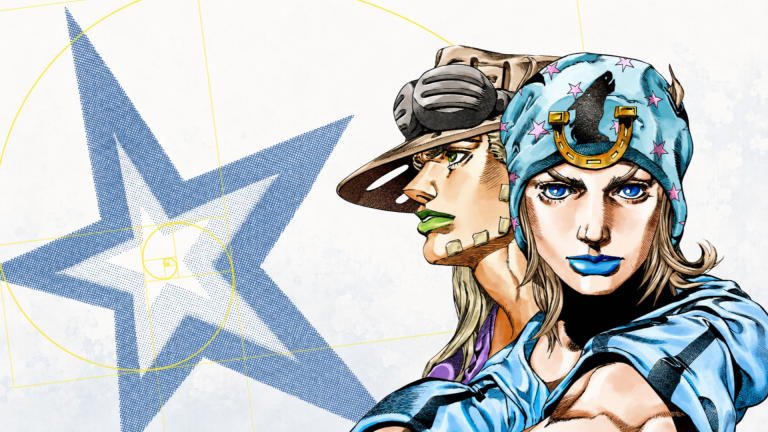
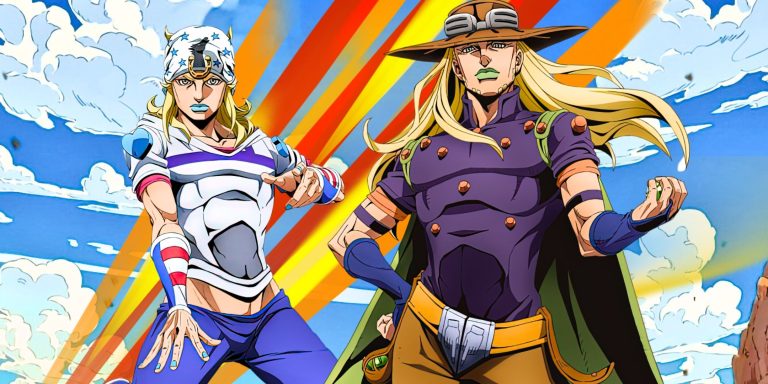
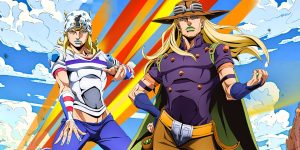
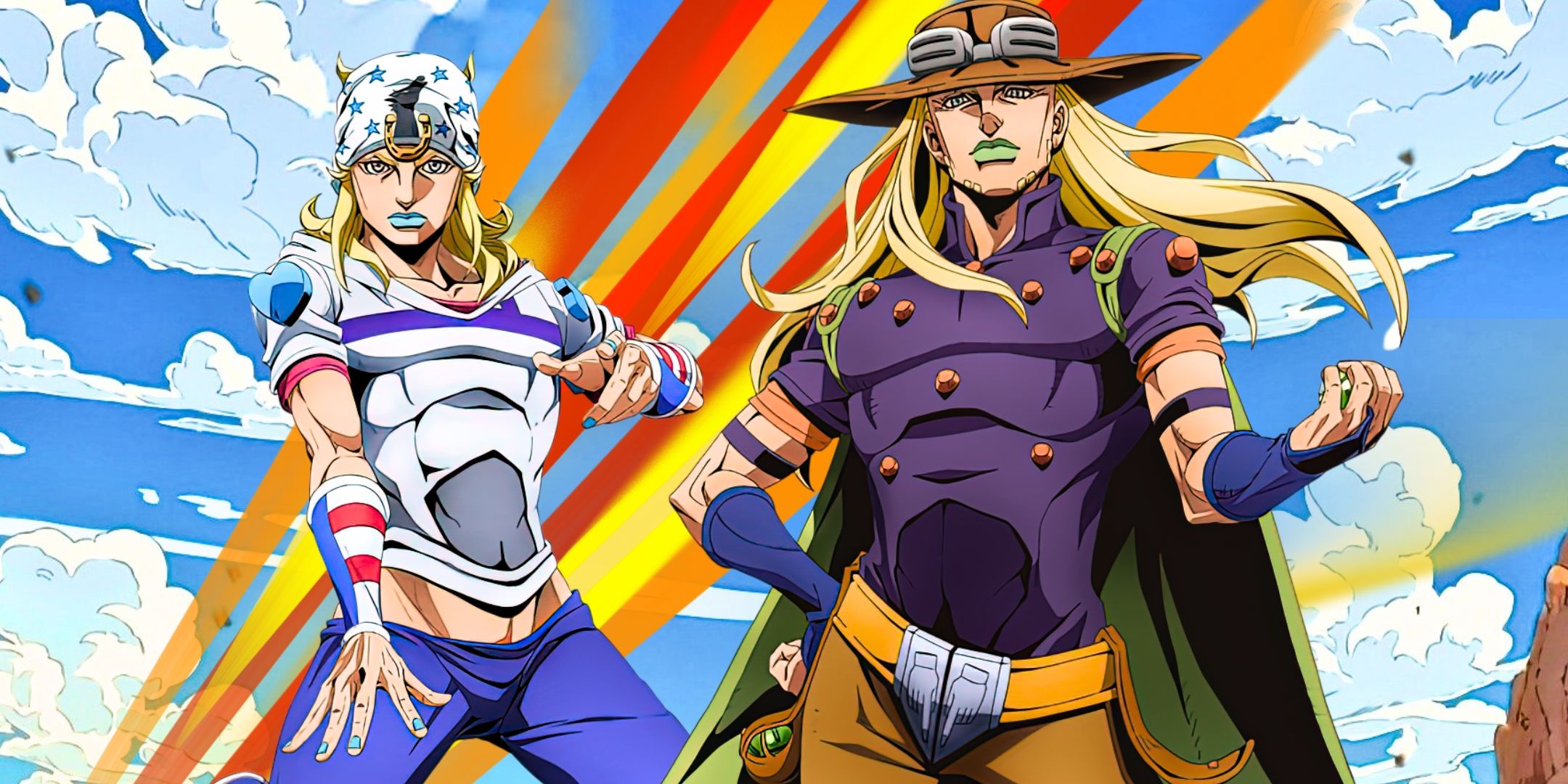
At the beating heart of the race lies the most complex, psychologically realized dynamic in the entire franchise: Johnny Joestar and Gyro Zeppeli. Their rapport elevates Steel Ball Run from a dazzling genre pastiche into an intensely moving treatise on trauma, failure, and spiritual reclamation.
Johnny Joestar is an audacious subversion of the traditional shonen protagonist. Unlike the noble, incorruptible Jonathan Joestar of Phantom Blood, Johnny begins as a disgraced, arrogant horse-racing prodigy whose hubris leaves him paraplegic and fundamentally broken. He possesses what characters explicitly describe as “dark determination”—an unblinking, pitiless willingness to murder anyone who impedes his journey toward self-restoration. Johnny’s pursuit of the race, and later the relics scattered across the terrain, is driven not by righteous justice, but by an existential hunger to bring his personal count from “negative” back to “zero.”
Balancing Johnny’s brooding, predatory focus is Gyro Zeppeli, a flamboyant, grill-wearing Neapolitan executioner’s son burdened by an empathetic crisis of conscience. Fleeing his homeland to secure political amnesty for an innocent child condemned to death, Gyro acts as Johnny’s mentor, foil, and comedic counterpart. The organic alchemy between them—trading absurdist gags about operatic recipes one chapter, then risking their souls for each other against sadistic Stand users the next—is sacred to the fandom. Nailing this interplay requires a voice cast of generational caliber, capable of oscillating between screwball camaraderie and devastating tragedy.
The CGI Nightmare: David Production’s Equestrian Hurdle
Industry insiders and animation historians know all too well why David Production has hesitated to fire the starting pistol: horses. In the animation industry, quadrupeds—and horses in particular—are widely considered the single most labor-intensive, technically agonizing subjects to render in traditional 2D. The complex biomechanics of four legs galloping in rhythmic symmetry, the volumetric deformation of muscle tissue, and the shifting anatomical weight during extreme physical exertion have historically broken production schedules across the medium.
Now consider that Steel Ball Run features dozens of racers charging simultaneously across fluctuating terrains, executing acrobatic tactical maneuvers at breakneck speeds. A purely hand-drawn 2D adaptation would be suicide for any modern studio’s scheduling, while a reliance on cheap, jarring 3D models could irrevocably butcher the visual majesty Araki spent years illustrating.
The litmus test for David Production lies in their evolving hybrid pipeline. Having refined their stylized 3D integration in Fire Force and the background work in Stone Ocean, the studio must pioneer a seamless synthesis. Fans are looking toward the hyper-detailed cel-shaded rendering seen in modern video games and boutique studio films—technologies that can preserve Araki’s distinct cross-hatching and anatomically dense line-work without collapsing under the frame-rate demands of a continuous horse race. If they cut corners here, the adaptation will buckle at the starting line.
The Corpse, The President, and Political Mysticism
Beyond the galloping stallions and esoteric geometry lies the ideological conflict that defines the narrative’s second half: the search for the Saint’s Corpse and the confrontation with the 23rd President of the United States, Funny Valentine. Armed with the reality-fracturing Stand Dirty Deeds Done Dirt Cheap (D4C), Valentine is arguably Araki’s most compelling antagonist.
Valentine is not a cartoonish maniac like Diavolo or a theatrical hedonist like Dio Brando; he is a fervent, hyper-patriotic ideologue motivated by utilitarian supremacy. His monologue regarding the “First Napkin”—a masterclass in political philosophy exploring who sets the social paradigm for the world to follow—elevates the narrative into biting social satire. The cat-and-mouse game across dimensional splinters challenges every thematic notion of justice and American exceptionalism, contextualizing Johnny’s deeply personal struggle against a titan wielding manifest destiny like a blunt instrument.
The Road to the Starting Line
Adapting Steel Ball Run is not an ordinary seasonal undertaking; it is a cultural event, a monumental gauntlet that will define the legacy of David Production and the modern anime ecosystem. Between the psychological torment of Johnny Joestar, the magnetic gravitas of Gyro Zeppeli, and the sheer logistical impossibility of its equestrian spectacle, the stakes couldn’t possibly be higher.
Whenever that fateful teaser finally drops—be it tomorrow or two years from now—the world will be watching to see if David Production can capture lightning in a bottle once again. Until then, JoJo devotees will keep their eyes trained on the horizon, waiting for the crack of the starting gun across the San Diego shore.
What do you think is the biggest hurdle facing the Steel Ball Run anime? Are you comfortable with heavy CGI horses if it guarantees cinematic backgrounds and immaculate Stand battles? Sound off in the comments below!