Few announcements in the contemporary anime landscape carry the seismic, quasi-mythological gravity of David Production adapting JoJo’s Bizarre Adventure: Steel Ball Run. Ever since the melancholic, universe-resetting chords of Stone Ocean faded in late 2022, the collective anime fandom has cast its eyes toward the western horizon. Part 7 is not merely the next linear entry in Hirohiko Araki’s four-decade-spanning generational saga; it is universally revered as his undisputed magnum opus. Consistently vying for the topmost echelons of manga ranking aggregators alongside Miura’s Berserk, Steel Ball Run represents an intoxicating fusion of revisionist Americana, existential character drama, and peerless tactical brilliance. For David Production, it presents their most tantalizing creative opportunity—and their most terrifying production hazard.
The Reinvention of Araki’s Universe: A Gritty American Odyssey
To understand the ravenous hunger for an anime adaptation, one must appreciate the context of Steel Ball Run‘s birth. Serialized beginning in 2004, the series marked a monumental shift: Araki transitioned away from the weekly grind of Weekly Shonen Jump to the monthly pages of Ultra Jump. The shackles were discarded. Freed from demographic constraints and suffocating deadlines, Araki traded the neon suburban claustrophobia of Morioh and the flamboyant underworld of Naples for the unforgiving, sun-bleached expanse of 1890s America.
The premise operates as a high-octane alternate history: the Steel Ball Run, a grueling, cross-country equestrian race spanning 6,000 kilometers from San Diego Beach to New York City. With a grand prize of fifty million dollars on the line, the event lures an international rogue’s gallery of outlaws, duelists, native warriors, and covert operatives. Yet behind the dust and blood of the track lies a far darker conspiracy—a race orchestrated to unearth the scattered relics of the Saint’s Corpse, supernatural anatomical artifacts possessing the power to manipulate reality and concentrate global fortune into whoever wields them.
Johnny and Gyro: Tragedy, Cynicism, and the Golden Spin
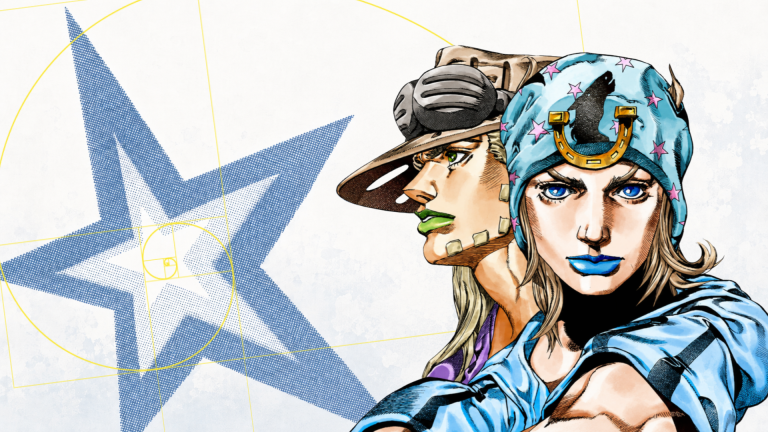
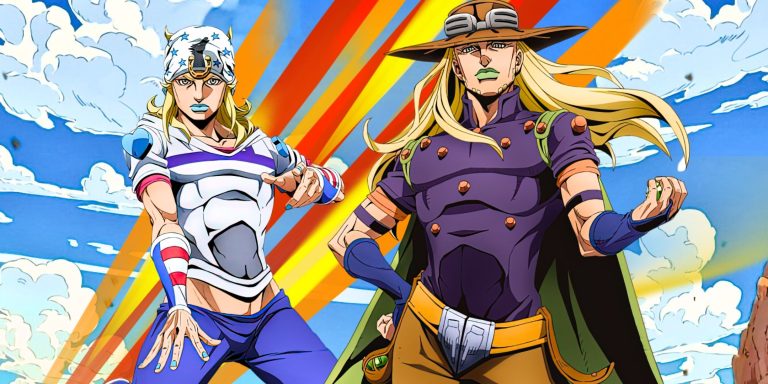
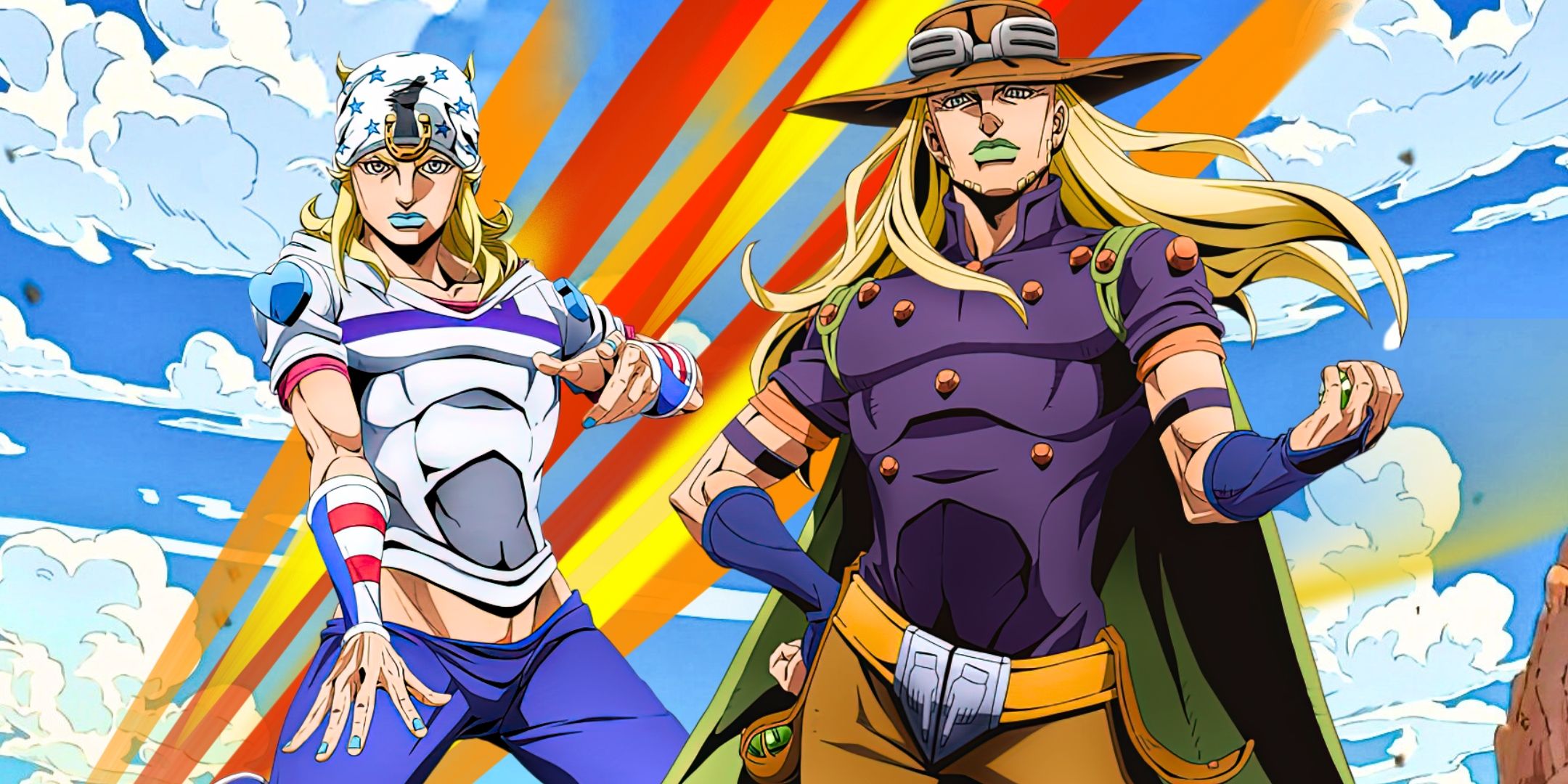
At the beating heart of Part 7 is the finest dual-protagonist dynamic Araki has ever committed to paper. Far removed from Jonathan Joestar’s virtuous chivalry or Jotaro Kujo’s stoic invulnerability, Steel Ball Run grounds itself in deep psychological frailty.
The Fall and Rebirth of Johnny Joestar
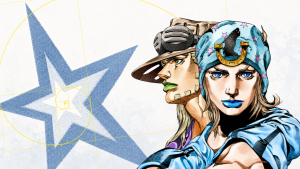
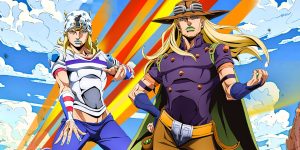
Johnny Joestar is not a hero when we meet him; he is a ruined man. A former equestrian prodigy struck down by arrogance, Johnny was shot and left paraplegic, abandoned by his family and society. He is bitter, calculating, and self-serving. Unlike his predecessors, Johnny possesses a distinct moral ambivalence—frequently noted throughout the narrative for possessing “the eyes of a killer.” His motivation for entering the race is uncomfortably intimate: he does not wish to save the world; he merely wants to find out if the mysterious kinetic energy wielded by a flamboyant Neapolitan can help him walk again. Johnny does not fight to reach a moral “plus”; his explicit goal is simply to drag himself back from the negative to “zero.”
Gyro Zeppeli and the Philosophy of the Spin
Enter Gyro Zeppeli, a disgraced royal executioner fleeing the moral rot of the Kingdom of Naples to win freedom for an innocent child condemned to die. Armed with steel spheres engraved with mystic grooves, Gyro introduces the Spin—a discipline rooted in the Golden Ratio, tapping into the infinite rotational power of nature itself. Gyro is the tonal counterbalance to Johnny’s brooding despair: boastful, wildly eccentric, fond of atrocious puns, yet burdened by an agonizing code of empathy. Their evolving bond from reluctant tutor and desperate student to sworn brothers remains unmatched across all of JoJo, anchoring the escalating supernatural madness in raw, poignant humanity.
The Elephant in the Studio: The Equestrian Animation Challenge
If the thematic narrative is pristine, the physical production logistics are downright daunting. The primary reason David Production has maintained radio silence regarding an official release window boils down to a single word: horses.
In traditional hand-drawn 2D animation, quadrupedal motion is notoriously labor-intensive, technically exhausting, and prohibitively expensive. Horses possess complex skeletal musculature; animating dozens of them galloping simultaneously across shifting terrains, changing angles, and engaging in close-quarters Stand battles for twenty-four or more episodes is an animator’s worst nightmare. Previous industry attempts, from the early iterations of Kingdom to mixed scenes in Attack on Titan, frequently leaned on jarring 3D CGI models that risked shattering immersion.
For David Production to succeed, Steel Ball Run demands a pioneering production pipeline. Speculation within the sakuga community suggests the studio must lean on advanced cel-shaded 3D assets meticulously composited with dynamic 2D line work for rider-mount synergy. If David Production can pull this off without sacrificing the vibrant, idiosyncratic color palettes and stylized linework that defined their previous adaptations, it will set a brand-new technical benchmark for modern action anime.
The Corpse Parts, Valentine, and the Evolution of the Stand
Beyond the technical hurdles lies the evolution of combat itself. Part 7 radically redefines Araki’s quintessential mechanic. Stands are no longer merely punch-ghosts exchanging blistering volleys of rapid strikes; they are surreal, conceptual, and intrinsically linked to the physical environment and the anatomy of the Saint.
From the terrifying biological virus of Diego Brando’s Scary Monsters to the dimensional fold-play of Funny Valentine’s mind-bending Dirty Deeds Done Dirt Cheap (D4C), the stakes are cosmic yet palpably physical. President Funny Valentine stands among the greatest antagonists in manga history—a fiercely patriotic, charismatic leader whose twisted utilitarianism forces viewers to question what constitutes true righteousness. Pitting Valentine’s utilitarian absolutism against Johnny’s raw, individualistic desperation elevates the final act of Steel Ball Run into an emotional tour-de-force that demands uncompromising cinematic adaptation.
The Next Frontier: Why the Wait Will Be Worth It
The anticipation surrounding David Production’s next move is at an all-time high. With Part 9, The JOJOLands, currently charging forward in print, the franchise’s cultural currency has never been more potent. The studio has spent over a decade proving their reverence for Hirohiko Araki’s vision, navigating everything from the gothic horror of Phantom Blood to the high-fashion avant-garde aesthetic of Golden Wind.
Adapting Steel Ball Run is David Production’s final proving ground. It requires an expansion of scope, an unprecedented technical evolution, and an unyielding commitment to mature, character-driven storytelling. When that starting pistol finally fires and Johnny and Gyro ride onto our screens, anime as a medium may never be quite the same.
What are your biggest hopes—and deepest anxieties—for the Steel Ball Run anime adaptation? Do you think David Production can pull off the horses with hybrid CGI, or should they take all the time they need? Drop your theories in the comments below, and keep your browsers locked to Wibux.com for breaking updates on Part 7.