Ever since the tragic, cosmic crescendo of Stone Ocean closed the curtain on the original Joestar bloodline, an unspoken countdown began ticking in the hearts of anime fans worldwide. For over a decade, David Production has pulled off one of modern anime’s most miraculous feats: adapting Hirohiko Araki’s genre-defying, multi-generational epic with an infectious swagger, color-palette-shifting boldness, and reverent stylistic precision. Yet, all roads, all Stand battles, and all stylistic reinventions have merely been prelude to this singular horizon. We have arrived at the precipice of JoJo’s Bizarre Adventure: Steel Ball Run—Araki’s undisputed western-supernatural magnum opus, and David Production’s most terrifying mountain yet to climb.
Whispers of pre-production rumors, trademark filings, and cryptic animator interviews have set social feeds ablaze. Steel Ball Run isn’t merely the next installment in a long-running franchise; it represents a paradigm shift. It is a soft-reboot, an ambitious seinen elevation, and a 6,000-kilometer cross-country odyssey through a gritty, dust-choked alternate 1890s America. The buzz isn’t just about if it’s coming—it’s about whether modern television anime can actually survive the monumental task of bringing it to life.
A Seinen Rebirth: The Trans-American Odyssey of Part 7
To understand why the hype for Steel Ball Run borders on religious fervor, one must revisit 2004. Midway through the manga’s original serialization, Araki made the historic jump from the demographic constraints of Weekly Shonen Jump to the mature, monthly expanse of Ultra Jump. The shackles came off. Gone were the rigid deadlines and sanitizing editorial limits; in their place bloomed sprawling double-page landscape spreads, morally murky philosophical quandaries, and psychological body horror executed with haute couture grace.
The premise is pure pulp ambition: eccentric philanthropist Steven Steel organizes the world’s first transcontinental horse race, offering a jaw-dropping $50 million grand prize. Racers from every corner of the globe gather on the San Diego coastline to traverse treacherous deserts, frozen tundras, and lawless frontiers to reach New York City. Yet beneath the grueling sporting event lies a geopolitical conspiracy spearheaded by United States President Funny Valentine, who is covertly using the race to gather the scattered relics of the sacred Saint’s Corpse—a supernatural artifact capable of granting absolute prosperity to whoever controls it.
Broken Spirits and Golden Rotations: Johnny and Gyro’s Unmatched Chemistry
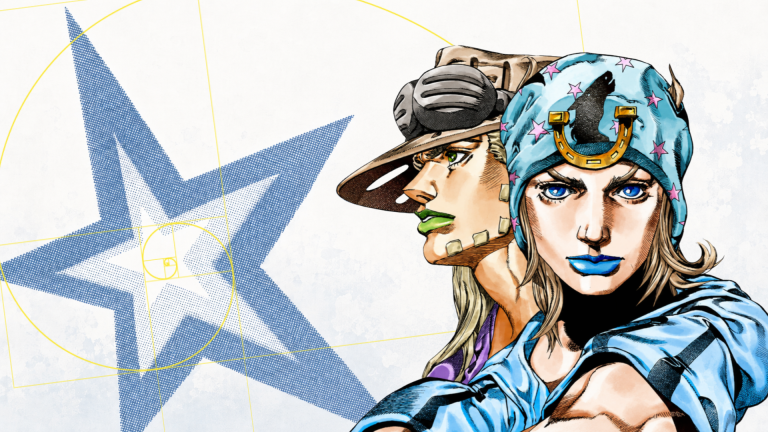
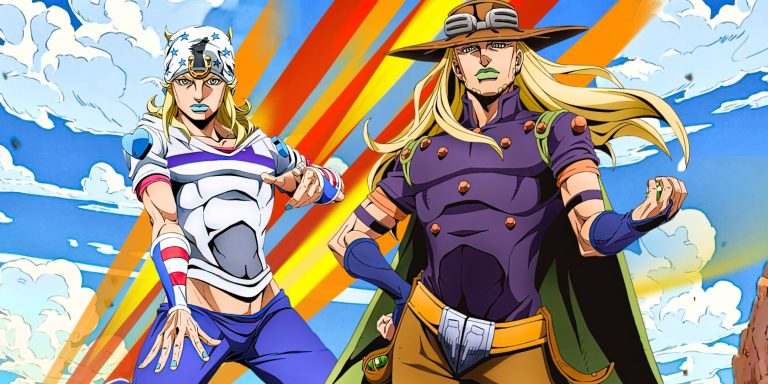
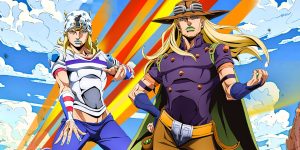
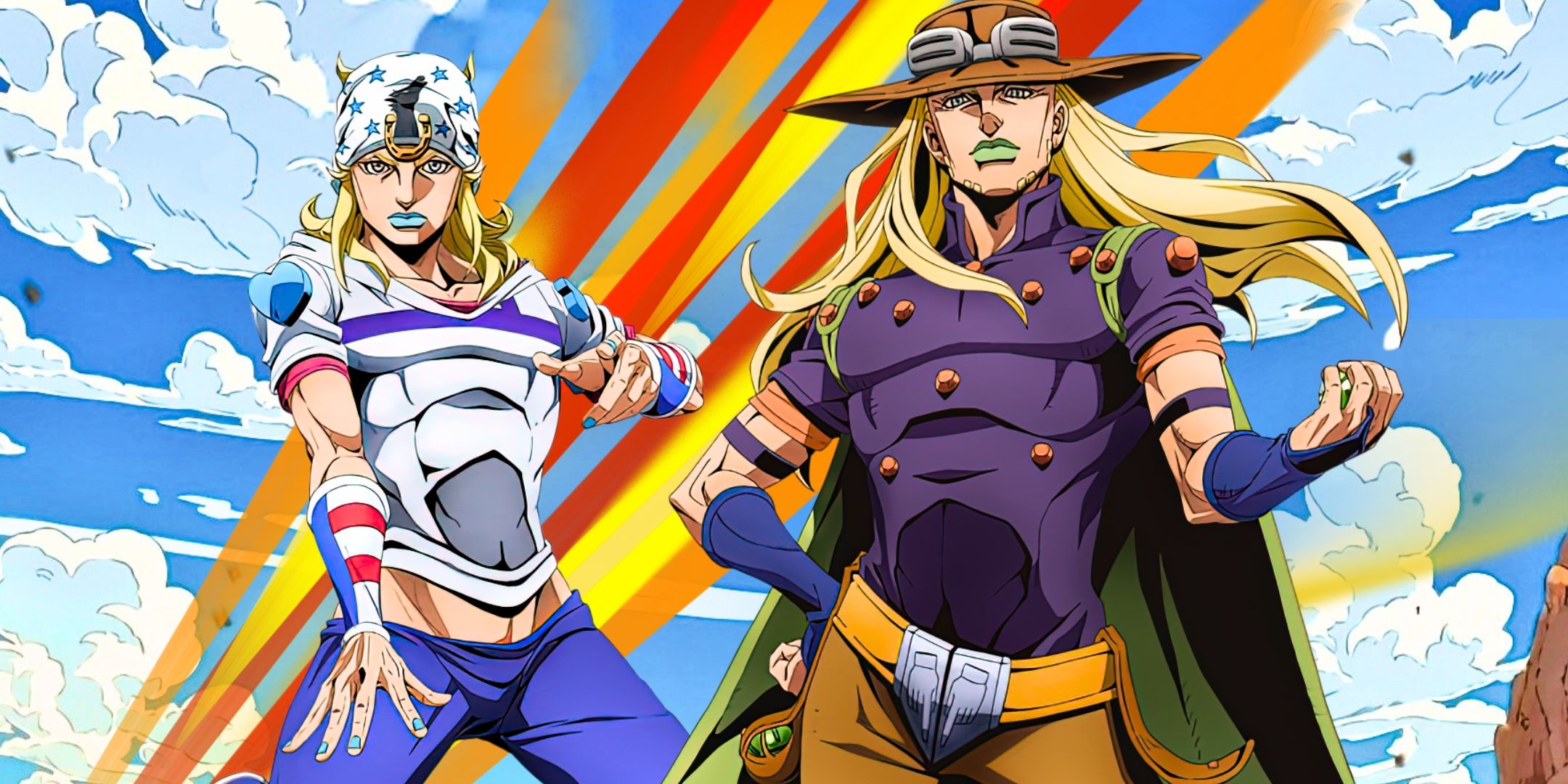
At the beating heart of this frontier epic is what many fans and literary critics argue is Araki’s greatest character dynamic: the brotherly, co-dependent journey of Johnny Joestar and Gyro Zeppeli.
Johnny is a radical departure from the archetypal, morally upright JoJos of past generations. A former horse-racing prodigy whose arrogance led to a shooting that left him paraplegic, Johnny begins the story not as an aspiring hero, but as a hollow, bitter shell of a man. He lacks the nobility of Jonathan, the trickster charisma of Joseph, or the stoic chivalry of Jotaro. Instead, Araki gifts Johnny with what he explicitly terms “Dark Determination”—a ruthless, terrifying survival instinct driven by a desperate desire to walk again, both physically and spiritually. When he witnesses Gyro utilize a mysterious, kinetic power, Johnny finds his first spark of hope in years.
Gyro Zeppeli, by contrast, is an indelible tour-de-force of charisma. Flashing gold teeth etched with the words GO! GO! ZEPPELI, singing nonsensical earworms about European delicacies, and cracking terrible puns, Gyro easily disarms anyone in his path. But underneath the theatrical flair is a disgraced royal executioner from the Kingdom of Naples carrying a heavy, saint-like burden: competing in the lethal race to win amnesty for an innocent child condemned to death. Gyro isn’t just a companion; he is Johnny’s mentor, therapist, and foil.
The Mechanics of the Spin and the Golden Ratio
While Stands naturally make their return—manifesting here not as punch-ghost apparitions at first, but as bizarre psychological extensions of the user’s tools—the crowning mechanical innovation of Part 7 is The Spin. Rooted in ancient Neapolitan execution techniques, the Spin is a weaponized martial art revolving around rotational energy and the mathematical purity of the Golden Ratio.
Where Hamon was mystical breathing and Stands were psychic avatars, the Spin is metaphysical physics. Watching Gyro manipulate gravity, flesh, and ballistic trajectories with his twin steel spheres provides an entirely fresh tactile language to JoJo’s combat. As Johnny slowly internalizes the Spin, awakening his multi-evolutionary Stand, Tusk, their dynamic morphs into an unforgettable master-and-apprentice bond forged through gunfire, campfire coffee, and blood-soaked sand.
The Elephant (and Horse) in the Room: David Production’s Equestrian Crucible
For all of the narrative brilliance awaiting adaptation, one logistical nightmare looms over the production: the horses. In the traditional 2D animation industry, drawing quadrupeds in motion—particularly muscular, anatomically complex animals like horses running at full sprint—is universally recognized as the fastest way to break an animation pipeline. Now consider that Steel Ball Run features dozens of simultaneous equestrians across dynamic desert landscapes in nearly every single episode.
This technical hurdle has been the primary reason fans have held their breath with equal parts excitement and dread. David Production proved with Stone Ocean that they are willing to utilize 3D CGI models for complex Stand abilities and crowd shots, but a full-fledged equestrian race requires something far more seamless. For Part 7 to achieve masterpiece status on screen, the studio must strike a delicate, expensive equilibrium between MAPPA-level hand-drawn dynamic action and Studio Orange-tier bespoke CGI integration.
Insiders suspect that David Production’s recent slate—juggling smaller, visually hyper-stylized projects like Urusei Yatsura and technical showcases like Undead Unluck—has essentially served as an R&D playground. The studio knows the monumental prestige attached to Part 7; cutting corners with jarring, low-framerate CGI horses would ignite a rebellion across an exceptionally vocal global fanbase.
Patriotic Zealotry and Divine Relics: Why Part 7 Hits Harder Today
Beyond the kinetic spectacle, Steel Ball Run possesses a thematic resonance that feels eerily tailored for contemporary audiences. The central antagonist, Funny Valentine, stands tall as arguably the best-written villain in anime history. Armed with his reality-hopping Stand, D4C (Dirty Deeds Done Dirt Cheap), Valentine is not driven by personal malice, petty sadism, or mundane world domination. He is an uncompromising, charismatic ultranationalist whose goal is to use the Saint’s Corpse to build an impenetrable geopolitical shield around America, intentionally deflecting all misfortune onto the rest of the world.
His iconic ideological clash with Johnny Joestar flips traditional heroic tropes on their head. Valentine fights for the collective, imperialist glory of his nation; Johnny fights out of raw, selfish human desire to redeem his broken life. This ideological friction elevates the story far above typical battle shonen skirmishes, turning the finale into a haunting philosophical treatise on trauma, national exceptionalism, and the ethical price of miracles.
The Verdict: When Will the Starting Pistol Fire?
The cultural appetite for JoJo’s Bizarre Adventure: Steel Ball Run has reached an undeniable boiling point. Fans have endured years of memes, manga panel dubs, and speculative leaks because they know that beneath the flamboyant aesthetic lies a foundational masterpiece of modern graphic fiction. If David Production can harness the technical mastery, narrative reverence, and cinematic visual flair this story demands, the resulting anime will not simply dominate seasonal discourse—it will redefine western action epics within the medium.
The race across the American frontier is inevitable. The only question that remains is whether David Production is ready to take the reins, spin the sphere, and usher in the golden rotation of JoJo anime history.
What are your biggest hopes and fears for the Steel Ball Run anime? Are you dreading CGI horses, or do you have absolute faith in David Production’s vision? Drop your hottest takes in the comments below, and stay locked to Wibux.com for breaking updates on Part 7!