Ever since the melancholic strains of Duffy’s “Distant Dreamer” faded over the rebooted universe of Stone Ocean in late 2022, a singular, deafening question has echoed across the anime fandom: When is Steel Ball Run? For over a decade, David Production has pulled off one of the most audacious, faithful, and culturally defining runs in modern television, meticulously shepherding Hirohiko Araki’s multi-generational bloodline from Victorian manors to prison yards in Florida. Yet, for an overwhelming majority of manga scholars and hardcore JoJo enthusiasts, everything up to Part 6 was merely a prologue. The real prize—the holy grail resting upon the horizon of anime discourse—is Part 7: Steel Ball Run.
Widely celebrated as Araki’s absolute magnum opus, Steel Ball Run does not merely raise the stakes of the franchise; it completely dismantles and reconstructs them. As industry whispers swell regarding David Production’s next logistical frontier, the conversation surrounding Part 7 is unique. It is a potent cocktail of desperate creative anticipation and sheer technical dread. Adapting this sprawling, supernatural trans-American race is perhaps the most daunting challenge any modern animation studio could undertake.
The Seinen Shift: Araki’s Masterpiece of Dust, Blood, and Divinity
To understand why the hype for Steel Ball Run eclipses almost any upcoming shonen or seinen adaptation, one must understand its historical context within Hirohiko Araki’s career. Serialized initially in 2004 in Weekly Shonen Jump before migrating to the monthly pages of Ultra Jump, the relocation unshackled Araki from the punishing weekly deadlines and strict demographic guidelines of teen-targeted manga. The result was transformative.
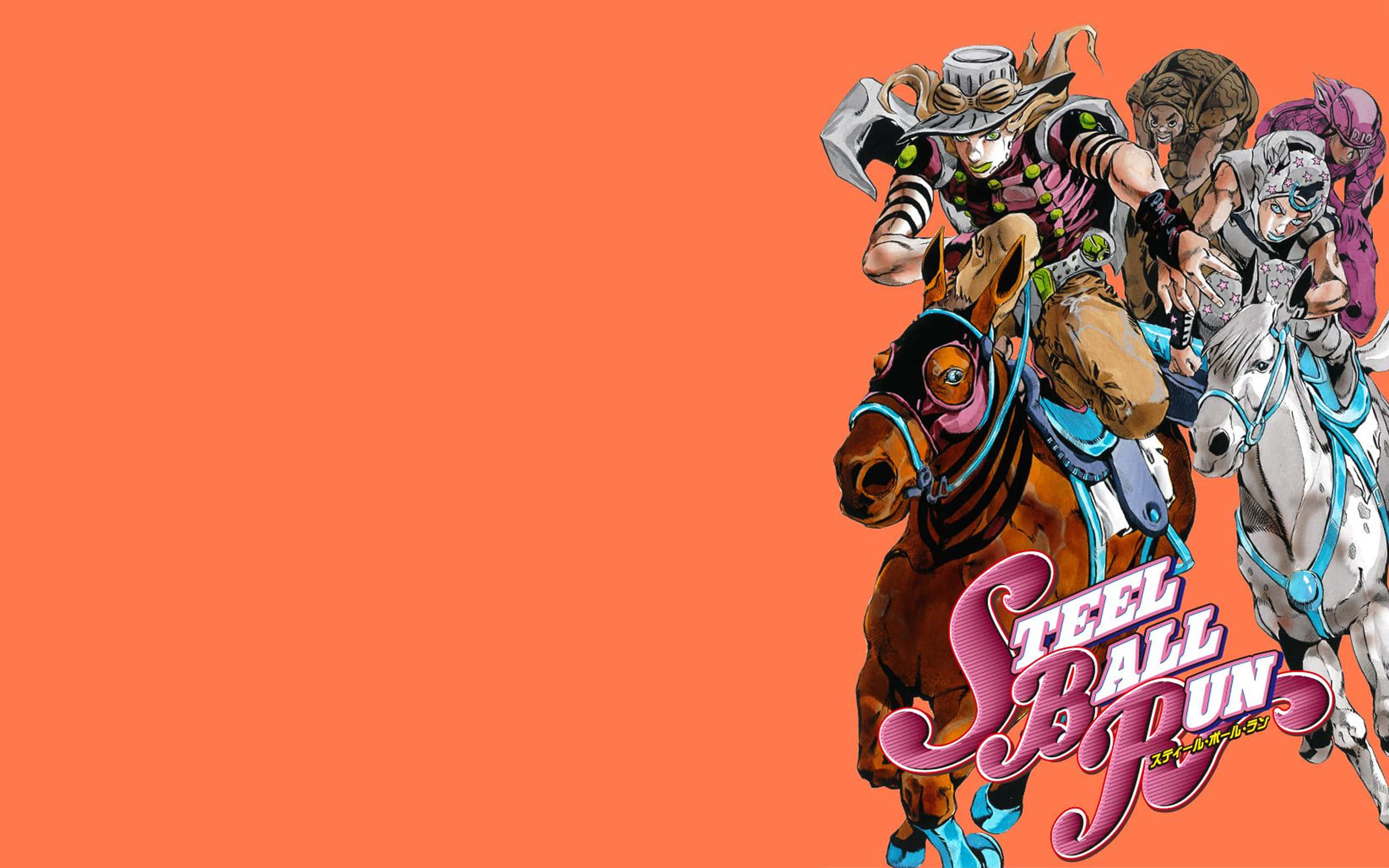
Set against the backdrop of 1890, Steel Ball Run reboots the entire universe, thrusting audiences into a 3,700-mile, coast-to-coast equestrian race from San Diego to New York. The 50-million-dollar purse organized by eccentric promoter Stephen Steel serves as the narrative catalyst, but the real pursuit quickly warps into an espionage-laden, metaphysical hunt for the mummified pieces of the Holy Corpse. It is Sergio Leone meets David Lynch, executed with the flamboyant visual bravura that only Araki can muster. The narrative blends historical fiction, political philosophy, and raw cosmic horror into a mature, cohesive masterpiece that routinely battles Berserk for the top spot on historical manga rating aggregators.
Flawed Humanity: The Dual Dynamic of Johnny and Gyro
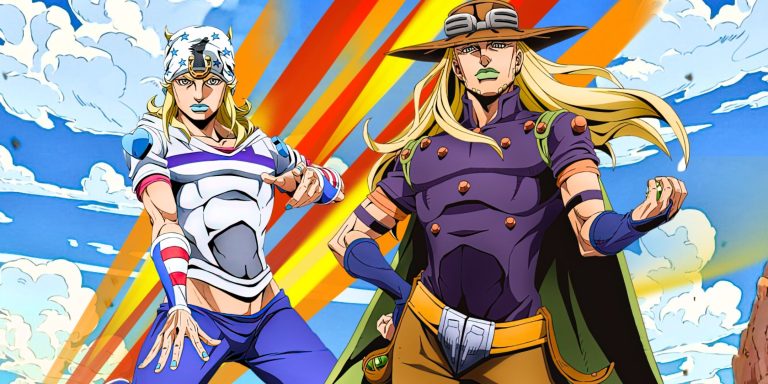
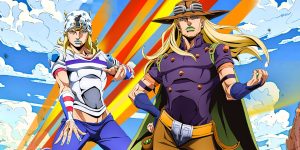
At the beating heart of this cross-country sprint is what stands as Araki’s most emotionally complex character dynamic: the symbiotic brotherhood between Johnny Joestar and Gyro Zeppeli.
Johnny Joestar’s Dark Determination
Johnny is a stark departure from the chivalrous paragons like Jonathan or the stoic badasses like Jotaro. A former horse-racing prodigy whose career and mobility were stolen by a foolish, ego-driven mistake, Johnny begins the story paraplegic, deeply cynical, and emotionally broken. His motivation to enter the Steel Ball Run is not noble; it is intensely, selfishly personal. After witnessing Gyro’s mysterious kinetic abilities momentarily reactivate his legs, Johnny embarks on the race driven by what Araki frequently terms “dark determination”—a cold, unyielding flame that borders on anti-heroism. He is one of the rare protagonists in manga whose journey is not about becoming a better hero, but simply climbing from “negative” back to “zero.”
Gyro Zeppeli and the Legacy of the Spin
Balancing Johnny’s brooding desperation is Gyro Zeppeli, a character whose charisma explodes off the page. A disgraced executioner and physician from the Kingdom of Naples, Gyro races to earn amnesty for an innocent child condemned to death. Beyond his grill-toothed swagger and surrealist humor (who can forget his musical musings on mozzarella?), Gyro serves as Johnny’s mentor in the ways of The Spin—an ancient martial art operating on the geometric laws of the Golden Ratio. By utilizing perfectly crafted steel spheres to harness infinite rotational energy, the Spin acts as a spiritual and mechanical evolution of the original Hamon, breathing fresh kinetic intrigue into combat long before Stands take center stage.
The Technical Crucible: David Production’s Equestrian Nightmare
If Steel Ball Run is a thematic triumph, why has an official production announcement remained elusive? The answer lies in one of the most notoriously terrifying words in the animation industry: horses.
Animating horses in high-octane motion is notoriously one of the most labor-intensive tasks an animator can tackle. Unlike human anatomy, a galloping quadruped requires intricate bone-and-muscle deformation, fluid mane physics, and constant spatial awareness across changing perspectives. In Steel Ball Run, horses are not occasional background transport; they are the primary visual vehicle of the story. Dozens of mounts clash neck-and-neck through blizzards, muddy trenches, and deserts at breakneck speeds.
David Production, legendary for their artisanal commitment to Araki’s visual quirkiness—from signature color-shift palettes to on-screen katakana sound effects—faces a crossroads:
- The Full 3D CGI Route: An approach popularized by studio Orange (Trigun Stampede) could alleviate the labor bottleneck. However, JoJo fans are famously protective of 2D aesthetic fidelity, and poorly blended CGI steeds could shatter the tactile realism of Araki’s 19th-century grit.
- The Hybrid Pipeline: The more likely, yet logistically demanding solution, is a hybrid model similar to MAPPA’s work on Attack on Titan or Ufotable’s vehicles. Here, 3D horse models serve as volumetric base armatures, meticulously traced over and shaded with traditional 2D hand-drawn linework to preserve the cross-hatching of the late-era Araki style.
Furthermore, following community frustration over how the Netflix batch-release model crippled the organic weekly discourse for Stone Ocean, David Production and Warner Bros. Japan are under immense pressure to treat Steel Ball Run with the prestige, weekly broadcast rollout it inherently deserves.
The Trans-American Horizon
The anticipation for Steel Ball Run is not standard franchise momentum; it is a cultural checkpoint for modern anime. From the philosophical gravitas of President Funny Valentine and his dimension-hopping Stand Dirty Deeds Done Dirt Cheap to the existential dread surrounding the Holy Corpse, the adaptation promises an elevation of the medium’s creative limits. It represents the point where Hirohiko Araki graduated from brilliant eccentric to untouchable literary craftsman.
David Production has conquered vampire clans, Aztec deities, suburban serial killers, and Neapolitan mafiosos. But conquering the vast American frontier atop a running horse will define the studio’s legacy for the next decade. When that starting gun finally fires, anime will bear witness to a race unlike anything seen before.
Now over to you, Wibux readers: How do you think David Production should tackle the legendary horse-animation dilemma? What are your dream voice-cast picks for Johnny and Gyro? Sound off in the comments below!