Ever since the melancholic, bittersweet notes of Duffy’s “Distant Dreamer” faded over the final frames of Stone Ocean, the global anime fandom has inhabited a state of suspended animation. With the generational curse of the original Joestar bloodline resolved in a cosmic, bittersweet reset, all eyes inevitably turned toward the horizon—specifically, the sun-baked, dust-choked expanse of late-nineteenth-century North America. For over two decades, Hirohiko Araki’s JoJo’s Bizarre Adventure: Steel Ball Run has reigned atop critical hierarchies, persistently holding the runner-up crown on MyAnimeList’s all-time manga rankings. It is universally lauded not merely as a high point for the franchise, but as a towering monument of modern sequential art. Yet, as rumors churn and production whispers intensify surrounding David Production’s prospective adaptation, the conversation has shifted from hopeful yearning to an urgent technical and thematic interrogation: Can the industry actually pull off Araki’s masterpiece?
The Seinen Evolution: Araki’s Masterwork Reborn
To understand the sheer magnitude of the anticipation surrounding Steel Ball Run, one must appreciate the tectonic creative shift that birthed it. Originally serialized in Weekly Shonen Jump in 2004 before migrating to the monthly, mature pages of Ultra Jump, Part 7 freed Hirohiko Araki from the grinding weekly crunch and editorial squeamishness of traditional shonen publishing. This transition unleashed an auteur operating at the zenith of his illustrative and narrative powers.
Gone were the primary-colored brawls of morality-driven youths fighting to save the world in fifty days. In their stead, Araki constructed a grueling, 6,000-kilometer equestrian race from San Diego to New York, set against an unforgiving American frontier. It is an odyssey steeped in historical revisionism, existential grit, and an unflinching examination of ambition. The stakes are profoundly personal rather than altruistic. Here, heroism is not an inherent trait passed down through aristocratic bloodlines; it is an agonizing, mud-splattered pursuit negotiated over bone-breaking terrain.
The Paraplegic and the Executioner: Deconstructing Johnny and Gyro
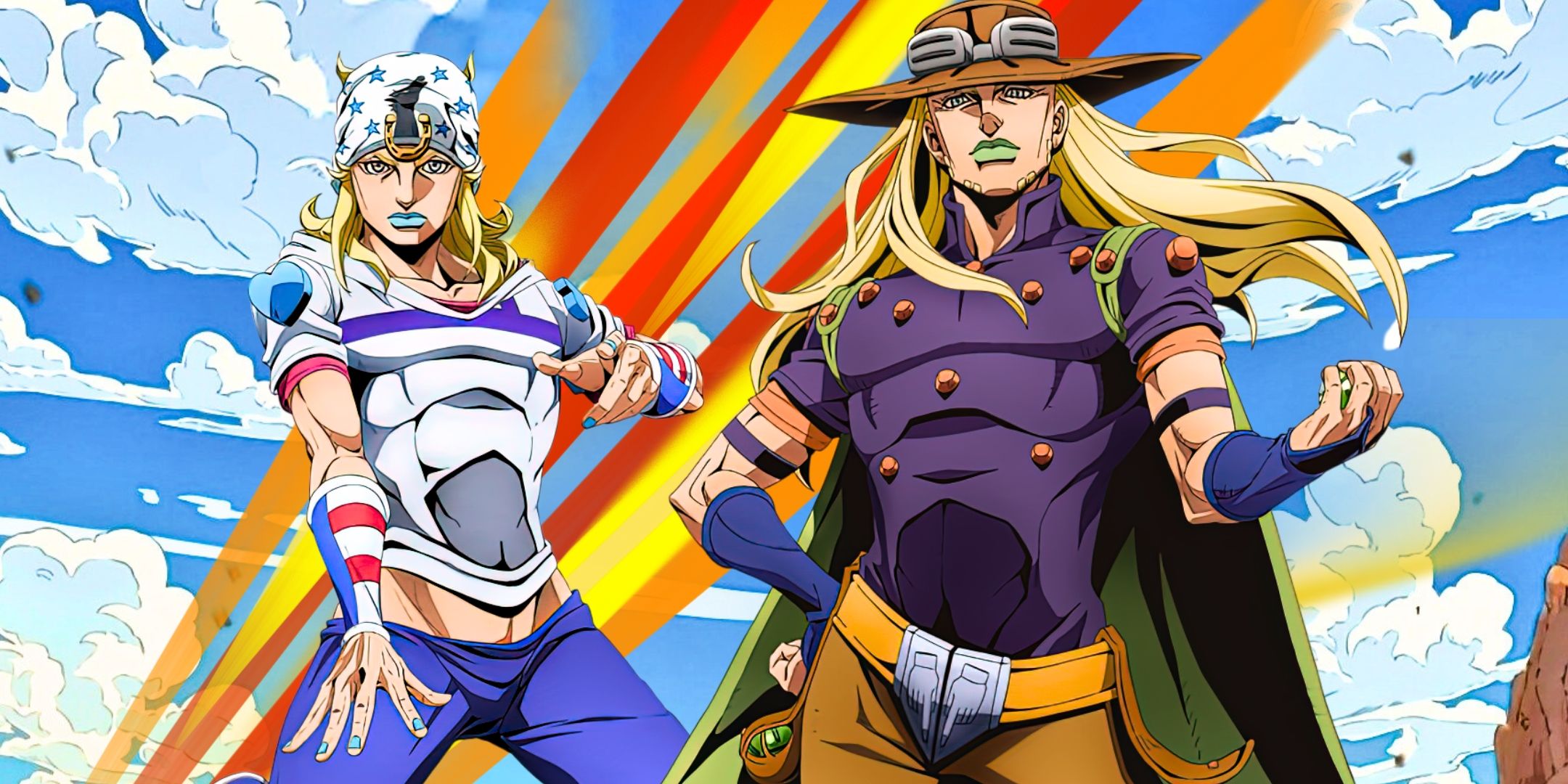
At the beating heart of Steel Ball Run lies what is arguably the most nuanced, emotionally resonant dual-protagonist dynamic in manga history. Johnny Joestar is a subversion of every JoJo archetype that preceded him. A former prodigy jockey struck down by hubris and paralyzed from the waist down by a stray bullet, Johnny begins his journey not as a champion of justice, but as a bitter, washed-up shell driven by a singular, desperate fixation: the faint hope that he might walk again.
He is selfish, pragmatic, and possessor of a gaze that fans and characters alike recognize as “dark determination”—a remorseless willingness to kill if it advances his trajectory. Johnny does not fight for the world; he fights to get back to zero, to drag himself out of the negative integers of his own shattered psyche.
Contrasting Johnny’s coiled, introspective darkness is Gyro Zeppeli, a disgraced Neapolitan executioner wielding the enigmatic mystical art of the Spin. Flamboyant, absurdly charismatic, and prone to composing terrible gags about mozzarella cheese, Gyro carries a deeply buried nobility that mirrors the tragic lineage of Zeppelis before him. His participation in the race is driven by an attempt to win amnesty for an innocent child condemned to die on his homeland’s scaffold.
The Geometry of Miracles: The Spin and Stand Physiology
Part 7 revolutionizes the series’ combat mechanics by marrying traditional Stands with the “Spin”—a technique founded upon the Golden Ratio and the mathematical perfection of the Fibonacci sequence. The kinetic visualization of this system will present David Production with an extraordinary visual palette:
Johnny’s Stand, Tusk, does not emerge fully formed as an invincible, time-stopping powerhouse. Instead, it evolves through four distinct Acts, each reflecting Johnny’s physical and psychological maturation. From firing rotating fingernails like bullets to creating micro-singularities that travel through solid matter, the choreography is visceral, surgical, and conceptually breathtaking. Animating the physical weight of Gyro’s steel balls curving air currents and warping muscle tissue demands an artistic rhythm unlike anything David Production has tackled in prior iterations.
The Equine Dilemma: David Production’s Technological Trial
For all of Steel Ball Run’s thematic genius, an unspoken terror stalks its path to screen: horses. In the animation industry, quadrupeds are notoriously despised. The anatomical complexity, muscular deformation, and rhythmic cadence of galloping horses require an astronomical number of bespoke drawings per second to avoid looking uncanny or weightless.
Industry veterans frequently cite Part 7 as an “unanimatable” project under conventional television budgets. When studios attempt to circumvent this through cheap 3D CGI models, the result is often visually catastrophic, immediately breaking immersion (as seen in early seasons of Kingdom or notorious sequences in Attack on Titan). However, David Production holds a singular reputation for stylistic ingenuity. The studio’s celebrated pedigree relies on bold line-shading, aggressive chiaroscuro, kinetic sound-effect typography, and daring color shifts.
Industry analysts anticipate that a successful Steel Ball Run adaptation will necessitate a hybrid pipeline reminiscent of modern theatrical productions. By utilizing intricately rigged, cel-shaded 3DCG models for distant pack-racing sequences alongside hand-drawn, high-impact key animation for medium and close-up engagements, the studio could balance visual fidelity with financial reality. The sheer ambition required explains the protracted radio silence since Stone Ocean concluded; David Production cannot casually stroll into Part 7. They must fundamentally re-engineer their technological pipeline.
A Clash of Manifest Destiny: Valentine and Moral Ambiguity
No analysis of the forthcoming adaptation can overlook its central ideological collision. The race across the continent is covertly orchestrated to unearth the scattered parts of the Holy Corpse—implied to be the physical remains of Jesus Christ—which grant omnipotent fortune to the sovereign territory that claims them.
Standing in the protagonists’ way is President Funny Valentine, widely heralded as Araki’s most sophisticated antagonist. Valentine is not a cartoonish megalomaniac like Dio Brando, nor a pathologically private serial killer like Yoshikage Kira. He is a steadfast patriot whose Stand, Dirty Deeds Done Dirt Cheap (D4C), allows him to leap across parallel dimensions. Valentine genuinely believes that monopolizing the Corpse will bring everlasting prosperity to the United States, unbothered by the fact that this prosperity directly requires directing all the world’s misfortune onto other nations.
When the lines between Johnny’s self-serving obsession and Valentine’s self-sacrificing nationalism cross, Steel Ball Run transcends typical genre fare to deliver a devastating critique of exceptionalism, colonial ambition, and divine right. Bringing this dense, politically charged ideological war to life will test the directorial restraint and tonal maturity of the production team like never before.
The Horizon Awaits: What Must Come Next
The cultural discourse surrounding Part 7 is also deeply entangled with platform politics. The fragmented, three-batch Netflix release strategy for Stone Ocean famously neutralized the week-to-week communal hype that historically fueled JoJo’s virality across social platforms. If Steel Ball Run is to conquer the mainstream zeitgeist the way Stardust Crusaders or Golden Wind did, it demands a synchronized weekly global broadcast. Fans deserve to dissect every nail-shot, speculate on every Golden Rectangle revelation, and debate every stage of the cross-country sprint together in real time.
Steel Ball Run is not just the next season of a beloved anime; it is the ultimate crucible for David Production and a litmus test for what prestige seinen storytelling can look like on the global stage. If the studio takes its time, honors the uncompromising visual detail of the source material, and solves the equine puzzle without sacrificing soul for expediency, we are not simply looking at the return of JoJo. We are standing on the precipice of an anime classic for the ages.
How do you think David Production should tackle the legendary horse-racing sequences: hand-drawn craft, high-end hybrid CGI, or something entirely experimental? Let us know your thoughts and theories in the comments below!