
Ever since the melancholic strains of Duffy’s “Distant Dreamer” faded out over the climactic horizon of Stone Ocean in late 2022, the global anime community has lived in a perpetual state of hyper-vigilance. For over a decade, David Production pulled off what critics once considered impossible: an immaculate, stylish, and reverent multi-generational adaptation of Hirohiko Araki’s sprawling family chronicle. Yet, as the original Joestar bloodline reached its bittersweet apotheosis, all eyes pivoted westward. The chatter across Reddit forums, Sakugabooru threads, and Tokyo industry corridors has coalesced into a single, breathless question: When will David Production officially greenlight JoJo’s Bizarre Adventure: Steel Ball Run?
Widely heralded as Araki’s magnum opus, Steel Ball Run is not simply another sequel in the eccentric franchise. It is a sacrosanct piece of modern sequential art—a sweeping, 24-volume historical odyssey that fundamentally reinvented what JoJo could be. Adapting it is not a routine production milestone; it is the ultimate gauntlet of modern anime craftsmanship.
A Transcontinental Rebirth: Araki’s Pivot to Seinen Brilliance
To grasp why the adaptation hype burns with such intensity, one must understand what Steel Ball Run represents in the canon of Hirohiko Araki. Serialized beginning in 2004, the series initially wore the disguise of an unrelated western race before revealing itself as Part 7 of the franchise. More importantly, its early transfer from Weekly Shonen Jump to the monthly pages of Ultra Jump unchained Araki from the grueling weekly grind and the stifling editorial mandates of teen-targeted magazines.
The result was an astonishing artistic and narrative renaissance. Set against the sun-bleached, unforgiving canvas of 1890s North America, Steel Ball Run chronicles an unprecedented transcontinental horseback race from San Diego Beach to New York City. The stakes are immense: a $50 million purse orchestrated by eccentric promoter Steven Steel. Yet beneath the dust and grit of manifest destiny lies a terrifying supernatural conspiracy involving the mummified relics of a holy figure. Unshackled by monthly pacing, Araki indulged in atmospheric world-building, razor-sharp psychological tension, and some of the most meticulously detailed page layouts ever committed to print.
Johnny and Gyro: A Masterclass in Character Symbiosis
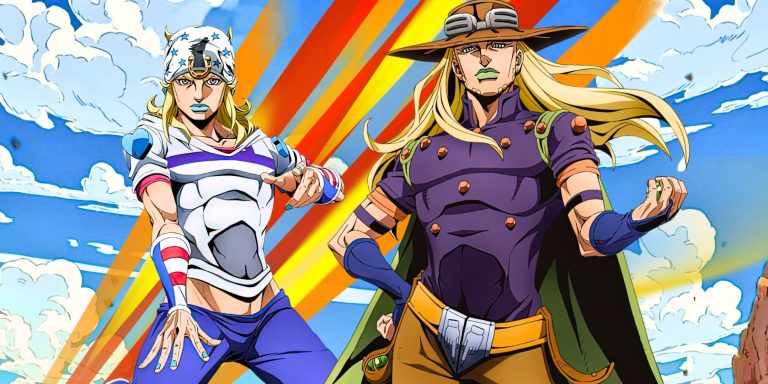
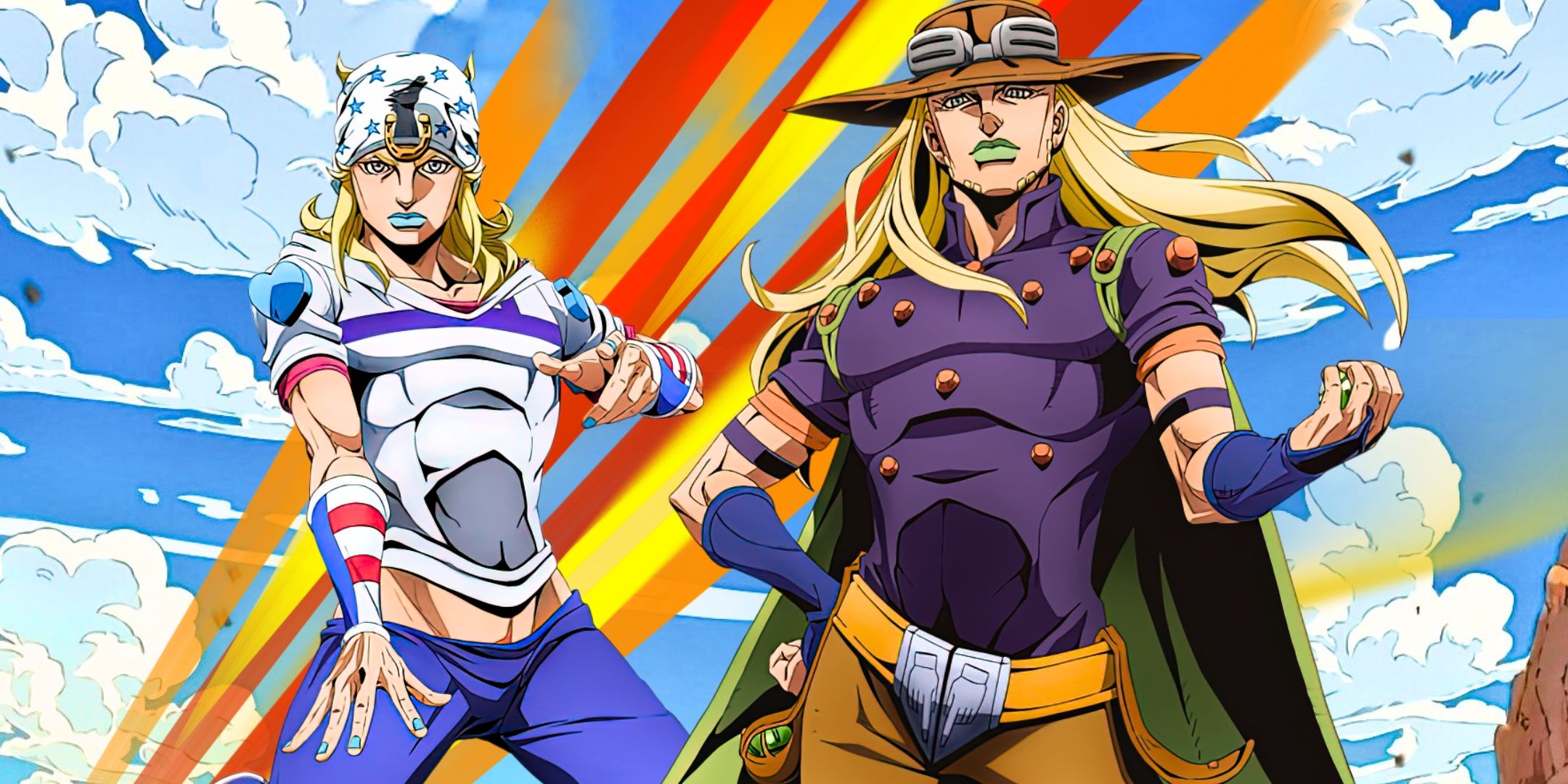
At the beating heart of this trans-American odyssey lies arguably the most compelling duo in modern comic history: Johnny Joestar and Gyro Zeppeli.
The Paraplegic Prodigy and Dark Determination
Unlike his chivalrous namesake Jonathan or the stoic demigods that followed, Johnny Joestar begins his journey as an anti-hero broken in both body and spirit. A former horse-racing prodigy whose arrogance cost him the use of his legs, Johnny is introduced not as an aspirational savior, but as a bitter, self-pitying pariah. What drives Johnny is not nobility, but an obsessive hunger for personal redemption. Araki endows him with what the narrative explicitly calls “Dark Determination”—a cold, unflinching willingness to kill or sacrifice anything to claw his way back from rock bottom. It is a nuanced, profoundly human character arc that subverts conventional shonen protagonist tropes.
The Neapolitan Executioner and the Legacy of the Spin
Counterbalancing Johnny’s brooding desperation is Gyro Zeppeli, a disgraced royal executioner from the Kingdom of Naples who enters the race to win clemency for an innocent child condemned to death. Gyro is a quintessential Araki creation: flamboyant, petty, endlessly theatrical (complete with gold teeth inscribed with “GO! GO! ZEPPELI”), yet burdened by an agonizing moral conscience.
Gyro is the master of the Spin, an ancient physiological martial art that harnesses the divine mathematics of the Golden Ratio and the Fibonacci sequence. Replacing the conventional Hamon energy of early parts, the Spin transforms ordinary steel spheres into kinetic instruments of anatomical distortion and gravitational disruption. The dynamic between Gyro—the flawed mentor—and Johnny—the relentless disciple—evolves into an emotional masterclass of brotherhood, trauma recovery, and existential grace.
The Technical Crucible: David Production’s Equestrian Nightmare
If Steel Ball Run is a masterpiece on paper, it is also an absolute logistical horror show for an animation studio. Industry insiders have long pointed to one singular, terrifying hurdle: the horses.
Equine anatomy is notoriously the most difficult subject to animate in traditional 2D sakuga. A horse in full gallop requires a complex, multi-jointed cycle of movement that demands flawless perspective, muscle tension, and weight shifting. Multiplying that difficulty across dozens of racers charging through dust storms, rushing rivers, and jagged canyons presents a labor cost that would bankrupt a conventional production pipeline.
This technical bottleneck explains David Production’s deliberate silence. The studio, which proved its stylistic versatility across Urusei Yatsura and Fire Force, faces a pivotal artistic decision:
- Full 2D Sakuga: Stunning, emotionally resonant, but practically impossible to sustain over an estimated 36-to-48-episode run without catastrophic production melts.
- 3D CGI Integration: Utilizing high-end cel-shaded CG models for the horses—akin to the hybrid approach pioneered by MAPPA in Attack on Titan or Orange in Trigun Stampede—while keeping the riders and Stand manifestations in hand-drawn 2D.
For purists, the word “CGI” evokes immediate skepticism. However, if David Production leverages their signature mastery of hyper-saturated color shifts, dramatic typography overlays, and dynamic camera direction, a meticulously composited 3D/2D hybrid may be the only realistic way to do Araki’s kinetic cavalry battles justice.
The Corpse, The President, and Tactical Stand Warfare
Beyond its technical hurdles, Steel Ball Run demands a tonal maturity that dwarfs preceding seasons. The central antagonist, 23rd U.S. President Funny Valentine, stands as one of the most conceptually terrifying villains in fiction. Armed with his dimension-hopping Stand, Dirty Deeds Done Dirt Cheap (D4C), Valentine is driven by an unyielding, radicalized patriotism—the philosophical doctrine of taking the “first napkin” to dictate the world’s destiny.
Furthermore, Stands in Part 7 mutate from punch-ghost brawlers into deeply abstract, environmental puzzles. From the time-looping revolver shootouts of Ringo Roadagain’s Mandom to the terrifying, geometry-shattering evolution of Johnny’s Tusk Act 4, the encounters are ruthless, gory, and cerebral. Translating these metaphysical showdowns requires a director capable of pacing intense psychological duels alongside blistering kinetic action.
The Fandom Vigil and the Post-Netflix Horizon
The anticipation surrounding Part 7 is also deeply entangled with broadcast strategy. The fragmented, three-batch Netflix release model of Stone Ocean noticeably fractured the anime’s cultural momentum, suffocating the weekly community analysis and trending hashtags that fueled the golden eras of Stardust Crusaders and Golden Wind.
Anime circles are virtually unanimous: Steel Ball Run must not be buried under a binge-model algorithm. It is an episodic epic built for the weekly cultural watercooler—a grand pilgrimage where every cliffhanger, every death, and every revelation of the Holy Corpse deserves room to breathe across the global stage.
The Starting Pistol Awaits
Whether David Production unveils the adaptation at an upcoming Jump Festa or keeps the project under wraps while refining its bespoke pipeline, Steel Ball Run is an inevitability. It represents the ultimate summit of Hirohiko Araki’s lifelong career—a tragic, triumphant western that reimagines heroism from the saddle of a galloping horse. When that starter pistol finally cracks, anime fandom will bear witness to an event like nothing before it.
How do you think David Production should tackle the animation of Steel Ball Run’s equestrian battles? Are you holding out for a traditional 2D approach, or can a refined CGI hybrid carry Araki’s masterpiece? Sound off in the comments below!