
Ever since the melancholic, bittersweet notes of Duffy’s “Distant Dreamer” faded over the rebooted horizon of Stone Ocean in late 2022, the global anime community has collectively held its breath. For over a decade, David Production accomplished what many once considered an insurmountable feat: translating Hirohiko Araki’s idiosyncratic, fashion-forward, pose-striking masterpiece into an era-defining animated pantheon. Yet, every celebrated punch-ghost beatdown from Cairo to Green Dolphin Street Prison was merely a prologue to the ultimate prize. We have arrived at the precipice of JoJo’s Bizarre Adventure: Steel Ball Run—a work consistently locked in battle with Kentaro Miura’s Berserk for the highest-rated manga of all time on MyAnimeList, and an undeniable titan of modern sequential art.
The whisper network surrounding Part 7’s prospective greenlight has graduated from wishful forums to fever-pitch industry speculation. Steel Ball Run is not just another seasonal cour; it is a seismic cultural reset. Transporting fans to a hyper-stylized 1890s American frontier, it represents an auteur shedding the commercial shackles of demographic expectations to construct a gritty, metaphysical western. But as David Production stares down the barrel of this legendary epic, they face not only monumental narrative expectations but also one of the most infamously terrifying technical hurdles in television animation history.
A Seinen Rebirth: Transcending the Shonen Mold Across the American Frontier
To understand the electric buzz surrounding Steel Ball Run, one must first recognize its unique historical context. When the manga debuted in early 2004, it was initially serialized in Weekly Shōnen Jump under the simple moniker Steel Ball Run, deliberately downplaying its lineage to reset reader expectations. However, the true turning point arrived in 2005 when Araki transferred the series to the monthly seinen publication Ultra Jump.
The consequences of this migration cannot be overstated. Free from the grueling weekly grind and the sanitizing gaze of a younger demographic, Araki’s storytelling matured exponentially. The panels widened, breathing in the vast, dusty vistas of the American badlands. Violence became genuinely visceral, psychological stakes turned razor-sharp, and moral absolutism evaporated into shades of sun-bleached gray. The narrative framework—a cross-country equestrian race spanning from San Diego Beach to New York City for a staggering fifty-million-dollar purse—provided a dynamic, relentless forward momentum that classic “villain of the week” formulas could never match.
What begins as an eccentric, steam-powered transcontinental rally quietly unravels into a supernatural conspiracy involving divine intervention, manifest destiny, and geopolitical supremacy. It is a work that captures Araki at the absolute zenith of his creative confidence.
The Broken Jockey and the Executioner: Character Psychology Reimagined
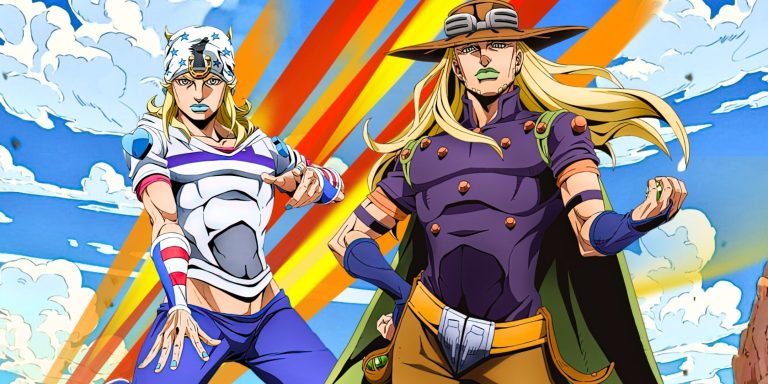
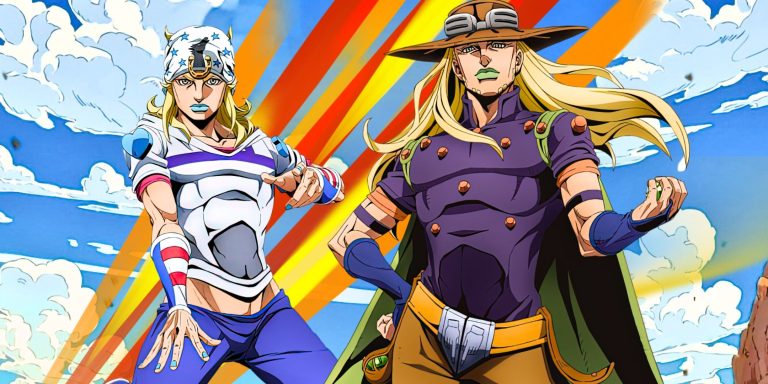
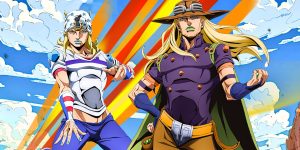
At the beating heart of Steel Ball Run lies the greatest dual-protagonist dynamic Araki has ever penned: Johnny Joestar and Gyro Zeppeli.
Johnny Joestar: The Subversion of the Noble Archetype
Unlike Jonathan Joestar’s pristine chivalry or Jotaro Kujo’s stoic righteousness, Johnny Joestar is introduced as a deeply flawed, spiritually bankrupt ex-prodigy. Paralyzed from the waist down due to his own juvenile arrogance, Johnny begins his odyssey not to save the universe, but from a desperate, profoundly selfish urge to rediscover his own footing—both literally and emotionally. Throughout the narrative, Araki frequently draws attention to Johnny’s “dark determination”—a cold, ruthless glint in his eyes that signals a protagonist willing to sacrifice everything, and anyone, to claw his way out of personal despair. This makes him arguably the most complex, human, and morally ambiguous hero in the franchise’s history.
Gyro Zeppeli: Charisma, Duty, and the Golden Ratio
Serving as Johnny’s mentor, foil, and soulmate of circumstance is Gyro Zeppeli, a disgraced Neapolitan royal executioner equipped with steel teeth, green lip-paint, and a bewildering sense of humor. Gyro enters the race to win royal amnesty for an innocent child condemned to death. While Johnny is hollowed out and searching for substance, Gyro is overburdened by heritage and duty.
Their interaction shifts the entire thematic foundation of combat in the series. While Stands remain integral, Araki introduces The Spin (Kaiten)—a forgotten physiological and mystical art tied to the Golden Ratio and the Fibonacci sequence. The Spin transforms mundane steel spheres into reality-warping vectors of kinetic energy. Watching David Production translate the complex, mathematical sacred geometry of the Spin into sound and motion is one of the most anticipated visual prospects in modern anime.
The Four-Legged Crucible: David Production’s Technical Mountain
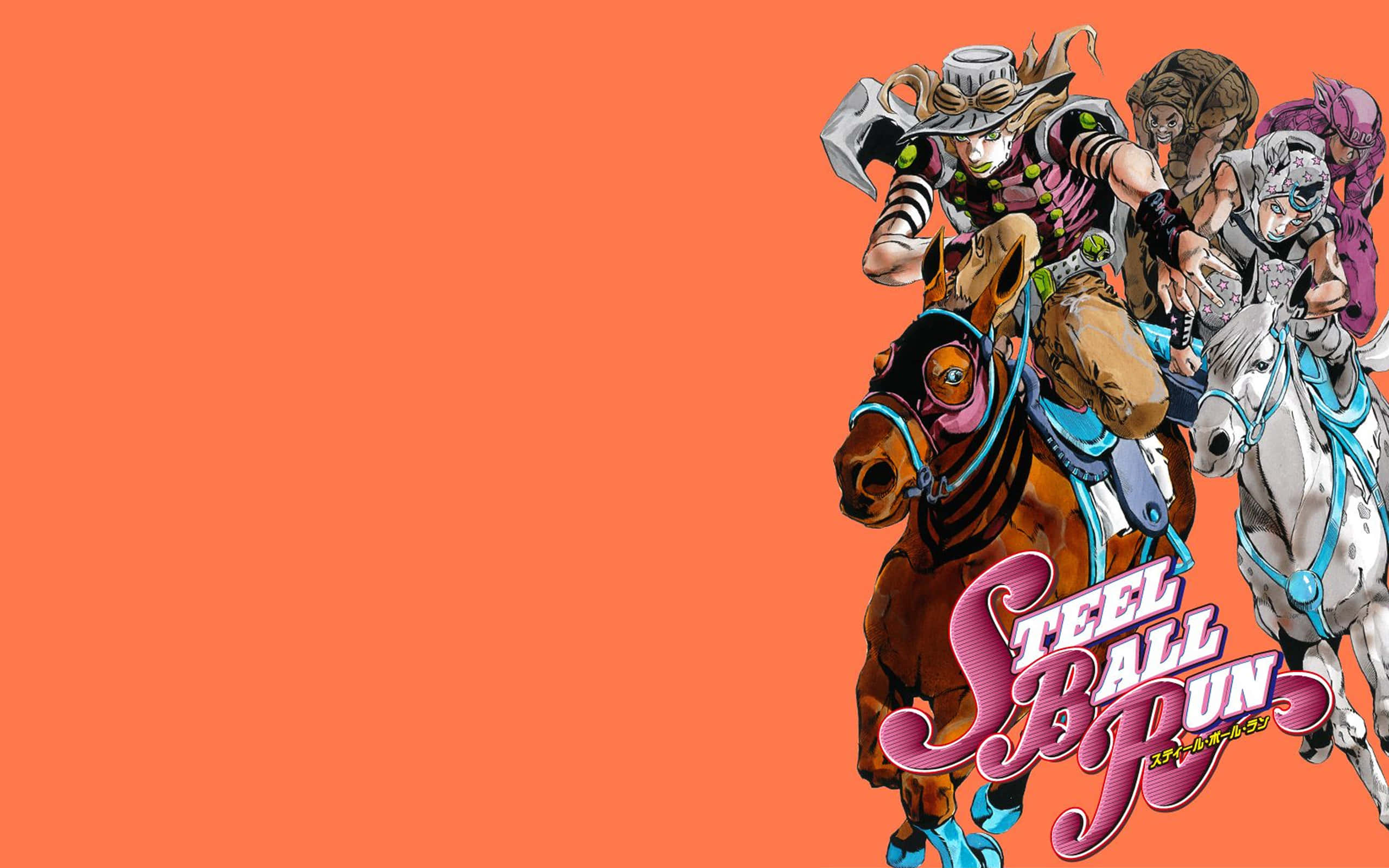
Why hasn’t a Steel Ball Run anime arrived already? The answer can be summarized in a single word: horses.
In the animation industry, horses are universally recognized as an illustrator’s living nightmare. A four-legged equine gait requires an astonishingly intricate interplay of muscle deformation, skeletal shifting, and shifting perspectives. Historically, even prestige studios have faltered when animating dynamic cavalry charges—frequently resorting to stiff, jarring CGI models that clash horribly with hand-drawn character art. Steel Ball Run does not merely feature occasional horses; it is an epic where the primary characters spend hundreds of chapters galloping at breakneck speeds while aiming steel spheres, summoning interdimensional abilities, and navigating rough terrain.
David Production, celebrated for its expressive character designs, neon-soaked hyper-stylized color swaps, and kinetic framing, faces an unprecedented pipeline hurdle:
- The Hybrid 2D/3D Paradigm: To pull this off without bankrupting the studio or destroying animators’ schedules, DP will likely need to pioneer a hybrid workflow akin to Studio Orange’s boundary-pushing 3DCG or MAPPA’s dense integration in Chainsaw Man. Dynamic camera sweeps following a galloping horse while Johnny unleashes his Stand, Tusk, will require bleeding-edge cel-shaded rendering seamlessly integrated with hand-drawn key frames.
- Pacing the Journey: At 95 monthly chapters (roughly equivalent to over 150 weekly chapters in length and density), Steel Ball Run cannot be unceremoniously crammed into a standard 24-episode order. Fans and industry analysts anticipate a prestige roll-out—possibly an ambitious three-cour run or split seasons spanning 36 to 48 episodes—to allow the quiet, fireside character moments between Johnny and Gyro to breathe alongside the cataclysmic set-pieces.
Patriotism, Napkins, and Divine Relics: The Villainy of Funny Valentine
An adaptation discussion cannot exist without acknowledging the presence of the 23rd President of the United States, Funny Valentine. Boasting an unyielding patriotic resolve and armed with the interdimensional horrors of his Stand, Dirty Deeds Done Dirt Cheap (D4C), Valentine elevates the narrative into high political philosophy.
His infamous “First Napkin” monologue—a thesis on power, societal initiative, and ideological dominance—remains one of the most iconic villain diatribes in pop culture. Valentine’s quest to assemble the mummified pieces of the Holy Corpse to secure eternal prosperity for his nation, regardless of the catastrophe offloaded upon the rest of the world, provides a fascinating, unnerving mirror to Johnny’s selfish pursuit. This collision of worldviews transcends typical action tropes, transforming Part 7 into an intellectual duel of existential convictions.
The Road to San Diego Beach
David Production has proved time and time again that they treat Hirohiko Araki’s legacy with a reverence rarely afforded in commercial television anime. Adapting Steel Ball Run will be their ultimate test—a project that demands technological innovation, unmatched directorial vision, and an uncompromising artistic spirit. The creative reward, however, is limitless. Bringing Part 7 to life means delivering not just another hit anime season, but a sprawling, melancholic, rock-and-roll epic that redefines the parameters of the medium.
The race is inevitable; the starting gun simply hasn’t fired yet. Pack your saddlebags, practice your golden spins, and keep your gaze firmly fixed on the Western horizon.
What are your biggest hopes and fears for David Production’s adaptation of Steel Ball Run? Do you want to see a full 2D push, or are you confident in a hybrid 3D approach for the horses? Drop your predictions in the comments below, and stay tuned to Wibux.com for all your frontline anime scoops!