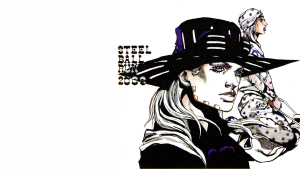
Ever since Jolyne Cujoh’s tragic, triumphant symphony concluded the original Joestar bloodline in late 2022, a singular, thunderous chant has echoed through every corner of the anime community: Steel Ball Run. Hirohiko Araki’s seventh serialized arc is not merely another chapter in a multi-generational saga; it is widely regarded across the medium as an untouchable magnum opus. Holding a near-permanent position as the second highest-rated manga of all time on MyAnimeList—trailing only Kentaro Miura’s Berserk—Part 7 represents an evolutionary quantum leap. It is where Araki shed the structural constraints of standard shonen storytelling, embraced monthly seinen serialization, and crafted an uncompromising, dust-choked American epic.
Yet, as whispers and speculative leaks regarding David Production’s next move continue to ignite social media, the discourse around an adaptation has morphed from pure excitement into an intoxicating blend of awe and anxiety. Adapting Steel Ball Run is a monumental undertaking that could easily break an unprepared studio. Between the brutal psychological grit of its fractured leads and the sheer technical horror of animating hundreds of horses galloping across the American frontier, Part 7 stands as David Production’s ultimate crucible.
The Seinen Pivot: Rebuilding the Joestar Mythos from the Saddle Up
To understand why the anticipation for Steel Ball Run reaches near-religious fervor, one must understand its historical context within the franchise. Serialized in 2004, the story initially debuted without the “JoJo” moniker explicitly dominating the title, masquerading as a fresh historical piece before revealing itself as an alternate-universe reimagining of the core mythology. When the series migrated from Weekly Shonen Jump to the monthly pages of Ultra Jump in 2005, the handcuffs came off.
Araki leveraged this transition to weave a sprawling, 1890 cross-country race across the United States—from the shores of San Diego to the bustling streets of New York City. The Steel Ball Run race, orchestrated by the eccentric promoter Steven Steel, offers a staggering $50 million grand prize. However, beneath the superficial spectacle of steam engines, dirt tracks, and eccentric racers lies a deeply geopolitical conspiracy involving the collection of the mummified Corpse of a Saint—heavily implied to be Jesus Christ—orchestrated by the charismatic, ruthlessly patriotic 23rd President of the United States, Funny Valentine.
By untethering himself from the established continuity of Parts 1 through 6, Araki did not just hit a reset switch; he shattered his own stylistic ceiling. The monthly format allowed for expansive, cinematic panel layouts, complex multi-chapter Stand battles, and a nuanced moral ambiguity unseen in prior parts.
Johnny Joestar and Gyro Zeppeli: Flawed Humanity and Unbreakable Kinship
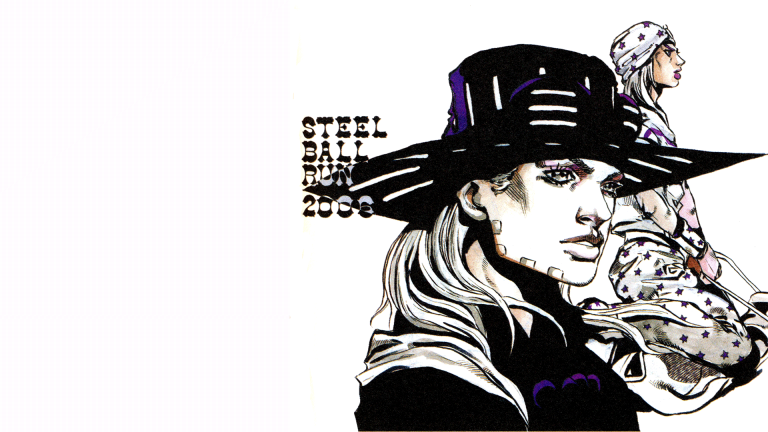
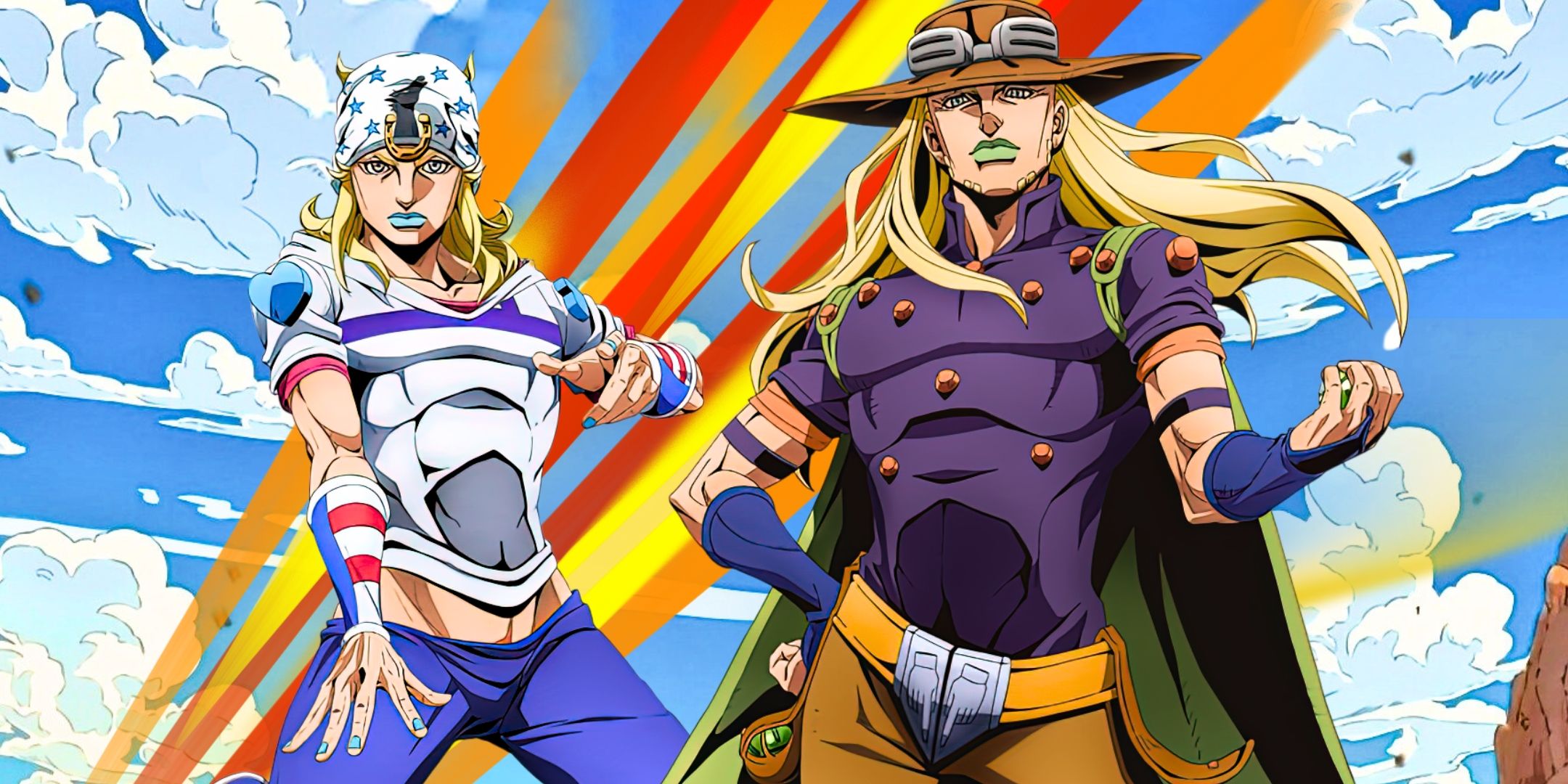
At the beating heart of this sprawling Western lies anime’s most compelling, meticulously developed duo: Johnny Joestar and Gyro Zeppeli. Unlike the charismatic, righteous heroes that populated previous arcs, Johnny begins his odyssey as an arrogant, fallen prodigy. Struck down at the height of his career as a horse racing prodigy, a senseless act of vanity leaves him paraplegic, bitter, and discarded by society. He is not setting out to save the world, rescue a mother, or avenge a lineage. Johnny is utterly, desperately selfish—a man motivated solely by the hope that the mysterious powers he witnesses might allow him to walk again.
Araki pulls no punches in depicting Johnny’s “dark determination.” His eyes harbor the cold, unforgiving flame of a killer willing to sacrifice almost anything for his personal resurrection. This moral cynicism makes him one of the most uniquely textured protagonists in modern fiction, balanced only by the magnetic swagger of Gyro Zeppeli.
Gyro—a disgraced executioner from the Kingdom of Naples—rides into the race to secure royal amnesty for a wrongfully condemned child. Beneath his golden grill, bizarre gags about cheese, and abrasive demeanor lies a soul burdened by familial duty and rigorous ethical conviction. The dynamic between Johnny and Gyro shifts the narrative from a cutthroat sports thriller into an intimate character study. Their campfire banter, philosophical sparring, and slowly forged brotherhood ground the supernatural chaos, providing the story with an emotionally devastating core.
The Golden Ratio: Elevating the Stand Power System
Part 7 also introduces what many purists consider Araki’s most elegant power system: The Spin. Rather than completely abandoning the mystical energies of Hamon or the localized manifestations of Stands, Araki synthesized them through the lens of Renaissance mathematics and natural physics.
The Geometry of Miracles
Rooted in the Fibonacci sequence and the visual manifestation of the Golden Rectangle, the Spin is a rotational technique developed for both execution and medicine by the Zeppeli family. When channeled through Gyro’s steel spheres, it manipulates human anatomy, deflects trajectories, and unlocks kinetic phenomena that defy standard spatial logic. For Johnny, unlocking the secrets of the Spin becomes intrinsically tied to the awakening of his Stand, Tusk.
Tusk’s evolution—transitioning through four distinct Acts—mirrors Johnny’s psychological and physical rehabilitation. From firing kinetic nail bullets to tearing open dimensional tears that transcend space-time, Tusk is an extraordinary conceptual triumph. In a potential animated form, mapping the glowing spiral patterns, mathematical grids, and visceral impact of the Spin will require an art direction capable of translating complex, abstract geometry into kinetic, heart-pounding sakuga.
The David Production Dilemma: The Equestrian Nightmare
If the narrative pedigree of Steel Ball Run is undisputed, the practical reality of bringing it to television screens is a logistical nightmare. In the animation industry, one rule is universally acknowledged: animating horses is hell.
A quadruped animal with complex skeletal motion, shifting musculature, and continuous kinetic weight is notoriously difficult to draw consistently by hand. Now, multiply that difficulty by dozens of horses charging through varied terrain—swamps, deserts, rocky bluffs, and snowy forests—over dozens of consecutive episodes. Animating this purely in traditional 2D would obliterate the production schedule and budget of almost any contemporary studio.
David Production, which has masterminded the JoJo franchise since 2012, faces a monumental crossroads. Will they lean heavily into custom-engineered, cel-shaded 3DCG models for the horses, reserving high-end 2D key animation for close-ups, emotional climaxes, and character interactions? Modern production pipelines, such as those utilized in Studio Orange’s Trigun Stampede or MAPPA’s hybrid sequences in Attack on Titan, demonstrate that 3DCG horses can be integrated seamlessly if given adequate compositing, lighting, and frame-rate modulation. However, the anime community’s historical aversion to jarring CGI remains a precarious tightrope for the production committee to walk.
The Horizon Calls: What an Adaptation Means for Anime
Despite the silence from Warner Bros. Japan and David Production following the conclusion of Part 6, the arrival of Steel Ball Run feels less like a question of “if” and more an inevitable matter of “when.” The creative team knows the sheer weight of what they are holding. Rushing Part 7 would be artistic sacrilege; patience is the only path to doing justice to Araki’s masterwork.
When Johnny Joestar finally mounts Slow Dancer, and Gyro Zeppeli releases his first iron sphere across a dust-swept western plain, it will signal the beginning of a transformative era for anime adaptations. Steel Ball Run isn’t just an adventure; it is a profound testament to human resilience, flawed redemption, and the relentless search for personal salvation.
How do you think David Production should tackle the legendary horse race? Should they embrace full 3DCG for the mounts, or take their time to deliver a handcrafted 2D spectacle? Let us know your theories and dream voice-cast choices in the comments below!