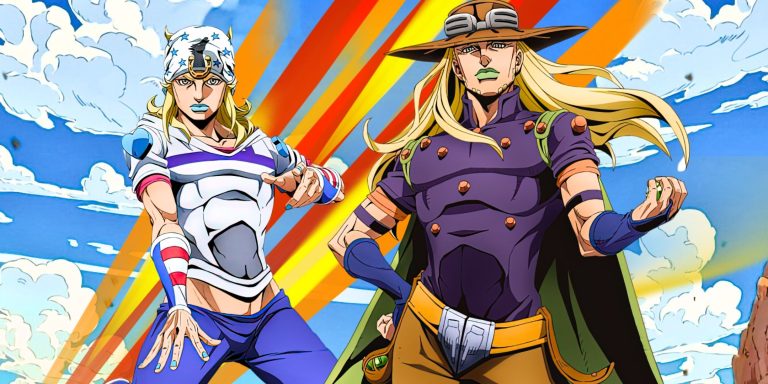
Ever since the reality-shattering strings of Jolyne Cujoh’s Stone Ocean drew to an emotionally exhausting, universe-resetting close, the global anime community has held its collective breath. For casual observers, the end of Part 6 marked the resolution of an eccentric, multi-generational lineage fighting a vampiric curse. But for the initiated—the millions of manga readers who have watched Hirohiko Araki’s craft mature across four decades—it merely cleared the track for the main event. We have officially arrived at the precipice of JoJo’s Bizarre Adventure: Steel Ball Run, a work consistently locked in a fierce duel with Kentaro Miura’s Berserk for the crown of the highest-rated manga of all time on MyAnimeList.
Adapting Steel Ball Run is not just the next logical commercial step for Warner Bros. Japan and David Production; it is a creative Rubicon. Part 7 represents a dramatic reinvention of the franchise’s visual identity, thematic weight, and structural ambition. As whispers within the industry grow louder and speculative timelines point toward upcoming production showcases, the buzz surrounding Johnny Joestar and Gyro Zeppeli has shifted from hopeful wish-fulfillment to an urgent, analytical question: How does an animation studio translate Araki’s indisputable western-supernatural magnum opus to the screen without breaking under its staggering weight?
The Trans-American Epic: Araki’s Masterwork Reborn
To understand the sheer magnitude of the Steel Ball Run fever, one must appreciate the context of its creation. Serialized initially in Weekly Shonen Jump in 2004 before transitioning to the monthly seinen magazine Ultra Jump, Part 7 freed Araki from the grueling weekly deadlines and editorial constraints of demographic-mandated shonen storytelling. The result was nothing short of an artistic renaissance. Araki’s hyper-stylized anatomy grounded itself in classical Greco-Roman realism, his backgrounds expanded into sprawling, panoramic vistas, and his storytelling evolved into a gritty, morally ambiguous cross-country race across a mythologized 1890s America.
The premise is deceptively cinematic: thousands of eccentric racers from around the globe converge on San Diego to race across the North American continent to New York City for a staggering fifty-million-dollar grand prize. Yet underneath the dust, gunsmoke, and mechanical gears lies a high-stakes conspiracy steeped in American folklore, geopolitical tension, and biblical mysticism. Steel Ball Run ditches the self-contained episodic “monster-of-the-week” pacing that occasionally bogged down prior adaptations, replacing it with a relentless, momentum-driven survival odyssey where the environment itself is just as lethal as any enemy Stand user.
Johnny and Gyro: Flawed Humanity Meets the Golden Ratio
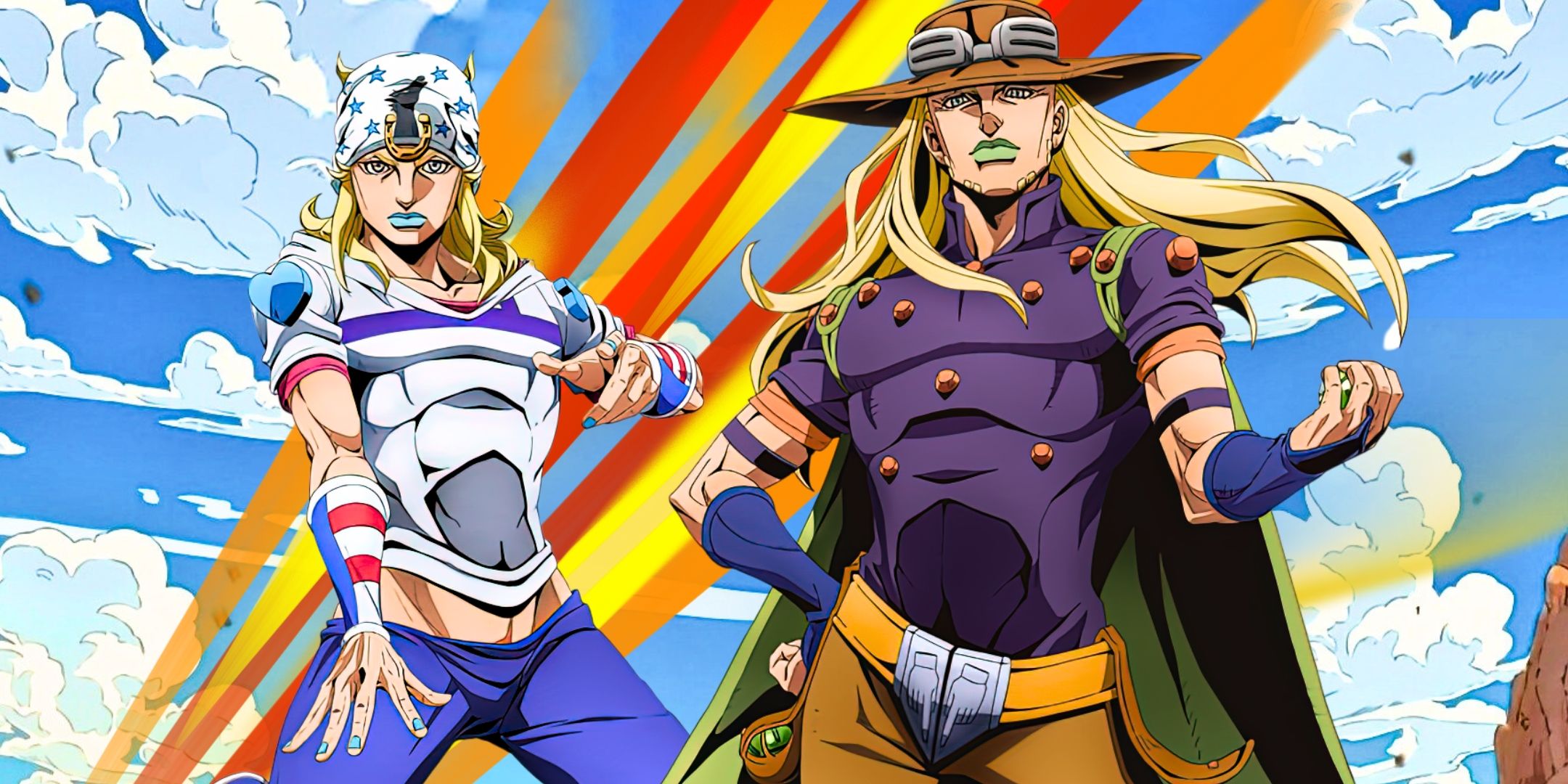
At the beating, bruised heart of Part 7 is the dynamic between two of the most thoroughly developed characters in modern graphic literature. Where earlier JoJo protagonists—particularly Jonathan or Jotaro—often operated as archetypes of chivalric justice or stoic invulnerability, Johnny Joestar enters the frame stripped of all traditional heroism. Paralyzed from the waist down following an act of youthful arrogance, the former horse-racing prodigy is cynical, clinically depressed, and driven by a desperate, borderline-terrifying “dark determination.”
The Subversion of the Joestar Paragon
Johnny does not embark on the Steel Ball Run to save the world; he does so because an encounter with an eccentric Neapolitan executioner briefly caused his lifeless legs to twitch. His journey is defined by raw, unapologetic vulnerability. Watching Johnny crawl through snow, drag himself across desert scrub, and make cutthroat decisions complicates our traditional moral allegiance. His Stand, Tusk, evolves not through simple emotional awakenings, but through painful psychological milestones that force him to confront his profound grief and familial guilt.
Gyro Zeppeli and the Philosophy of the Spin
Standing alongside him—often singing nonsensical compositions about mozzarella cheese—is Gyro Zeppeli. Equal parts arrogant mentor, disgraced nobleman, and deeply empathetic humanist, Gyro provides the emotional counterbalance to Johnny’s bitter edge. More importantly, Gyro introduces the franchise’s most brilliant combat system: The Spin.
Replacing Hamon and existing as a profound precursor and complement to Stands, the Spin is rooted in the mathematical perfection of the Fibonacci sequence and the Golden Ratio. By channeling kinetic energy through steel spheres, Araki elevated combat into an art of geometric balance. In an anime adaptation, the visual execution of the Spin—translating the invisible mathematics of nature into vibrant, reality-warping animation—presents an aesthetic opportunity that could easily rival the psychedelic visual peaks of Mob Psycho 100 or Jujutsu Kaisen.
The Technical Hurdle: David Production vs. The Horse Paradox
If the narrative pedigree of Steel Ball Run is universally lauded, the silence regarding its greenlight has a very pragmatic, terrifying explanation: horses. Within the anime industry, horses are notorious animators’ graveyards. Equine anatomy is notoriously complex to draft by hand; capturing the fluid musculature, gallop cycles, and weight shifts of dozens of horses in a high-speed pack requires an astronomical budget and a caliber of key animation talent that few modern television schedules permit.
Industry insiders have long recognized that a standard 2D production pipeline would implode under the weight of animating the Steel Ball Run race. David Production, which has faithfully adapted every chapter of the saga since 2012, faces a crossroads. Will they lean heavily into state-of-the-art 3D CGI cel-shading—akin to the trailblazing work done by Studio Orange (Trigun Stampede) or Kamikaze Douga (who created the iconic original JoJo CGI openings)? Or will they attempt a hybrid model, reserving detailed hand-drawn cuts for close-ups while relying on digital assets for wide-angle pack riding?
For David Production, Steel Ball Run is the ultimate trial by fire. Fans are fiercely protective of Araki’s intricate line work from this era. Striking the balance between the kinetic speed of a cross-country sprint and the hyper-detailed cross-hatching that defines the manga’s aesthetic will determine whether the adaptation is hailed as a masterpiece or lamented as an over-ambitious compromise.
Morality at the Edge of the Frontier: Enter Funny Valentine
No discussion of Part 7’s prestige can ignore its primary antagonist, Funny Valentine, the 23rd President of the United States. Armed with the dimensional-hopping Stand Dirty Deeds Done Dirt Cheap (D4C), Valentine represents a radical shift in Araki’s rogue’s gallery. Unlike the theatrical megalomania of Dio Brando or the psychopathic isolationism of Yoshikage Kira, Valentine operates under a banner of hyper-utilitarian patriotism. His conviction that his pursuit of the miraculous Holy Corpse is for the prosperity of his nation blurs the lines between villainy and statecraft.
The ideological clash between Johnny’s desperate, localized selfishness and Valentine’s grandiose, collectivist righteousness forces viewers into uncomfortable territory. There are no easy victories in the Badlands, and when the narrative reaches its crescendo along the Atlantic coastline, the resolution feels genuinely tragic, transcendental, and monumental.
The Starting Gun Awaits
The appetite for JoJo’s Bizarre Adventure: Steel Ball Run is no longer confined to die-hard manga circles; it is an omnipresent force across the anime landscape. Following the uneven batch-release strategy that slightly dampened the cultural momentum of Stone Ocean on Netflix, fans are practically begging for a return to a weekly, event-television broadcast format. They want the cultural discourse, the weekly meme generation, and the collective awe that this definitive journey deserves.
David Production has spent over a decade proving that they understand Hirohiko Araki’s creative soul better than anyone else in the industry. As we wait for the official key visual to drop and the starter’s pistol to echo across the San Diego shore, one thing remains crystal clear: whenever the ride begins, the anime world will never be the same.
What are your personal hopes for the Steel Ball Run adaptation? Do you think David Production should utilize full CGI for the horses, or are you holding out for pure 2D sakuga? Sound off in the comments below, and keep your browsers locked to Wibux.com for breaking updates on the next frontier of JoJo!