Ever since the bittersweet, universe-altering crescendo of Stone Ocean aired its final frames, an electric hush has fallen over the anime community. For casual viewers, the generational curse of the Joestar bloodline and their fateful clash with DIO had reached its definitive end. But for manga acolytes and long-time purists, the conclusion of Part 6 merely signaled the clearance of the runway for something far more colossal: the long-awaited adaptation of JoJo’s Bizarre Adventure: Part 7 – Steel Ball Run. Consistently jockeying with Kentaro Miura’s Berserk and Takehiko Inoue’s Vagabond for the highest ratings in manga history, Steel Ball Run is Hirohiko Araki’s undisputed magnum opus. Translating this 1890s cross-country equestrian race to the screen represents both the ultimate artistic triumph and the most terrifying logistical minefield David Production has ever confronted.
A Masterpiece in the Crosshairs: The Transcendence of Part 7
To understand the sheer magnitude of the anticipation, one must understand how Steel Ball Run fundamentally redefined Araki’s legacy. When serialization began in 2004 in Weekly Shonen Jump, it was originally billed without the “JoJo” moniker attached, presenting itself as an eccentric American historical epic. However, the seismic shift occurred in 2005 when the series migrated to the monthly seinen publication Ultra Jump. Freed from the oppressive weekly deadlines and thematic sanitization of shonen magazine editorial mandates, Araki’s pen exploded with unprecedented visual nuance and literary maturity.
Set against the sprawling, hostile backdrop of a post-Civil War American frontier, the narrative chronicles the titular trans-continental race: a grueling, 6,000-kilometer trek from San Diego to New York City with a staggering $50 million grand prize on the line. Yet, beneath the veneer of an adrenaline-soaked sporting spectacle lies a layered supernatural thriller fueled by geopolitics, religious mysticism, and deeply personal quests for absolution. It is visceral, psychologically complex, and visually jaw-dropping—a combination that has elevated expectations for its eventual adaptation to an almost mythic threshold.
The Dynamic of Broken Men: Johnny Joestar and Gyro Zeppeli
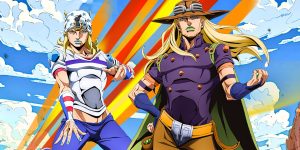
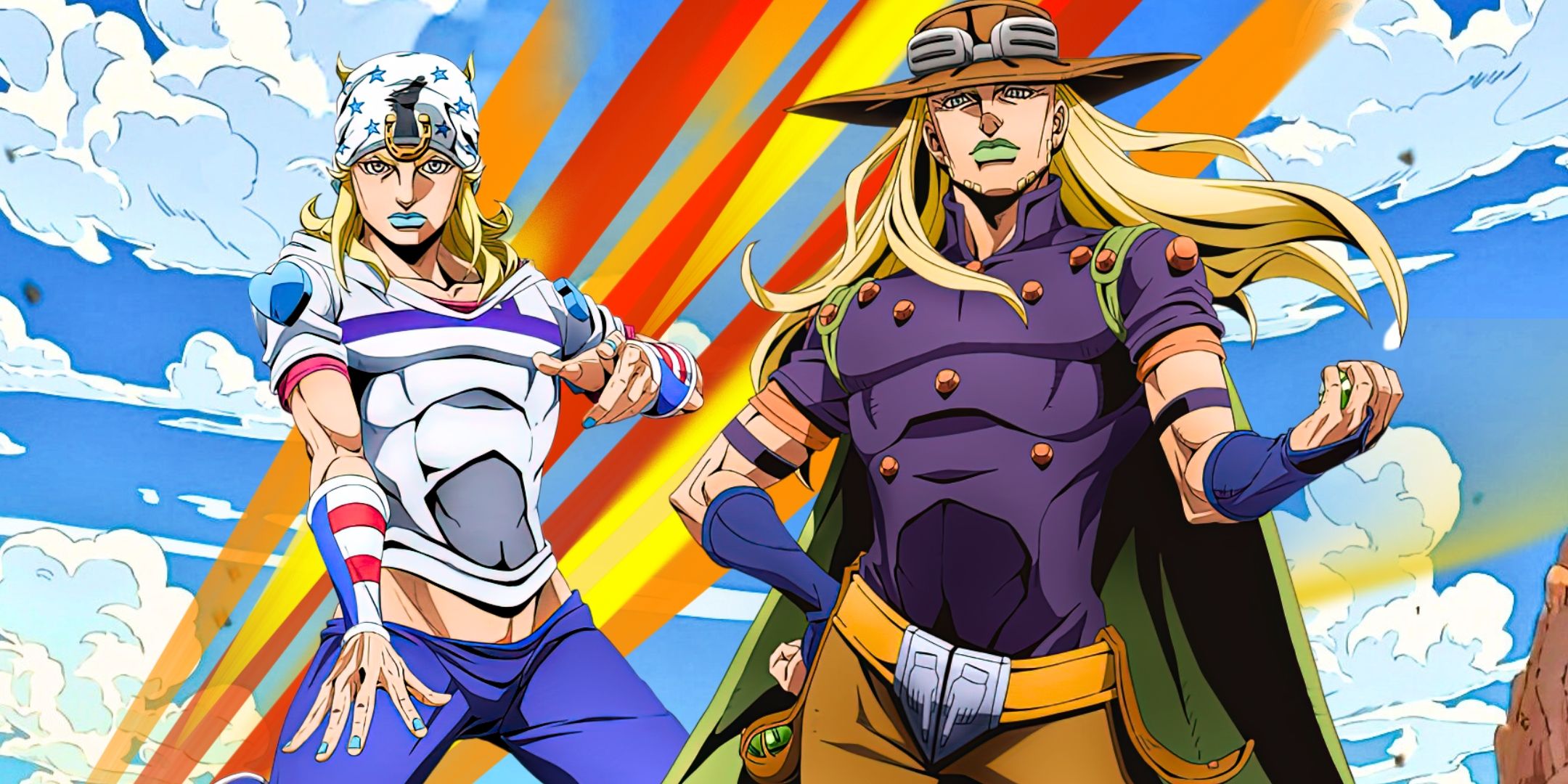
At the center of this sun-scorched odyssey is arguably the most impeccably written duo in modern sequential art. Unlike the noble paragons or flamboyant tricksters of earlier parts, our primary leads are fundamentally broken human beings traversing an existential purgatory.
The Paraplegic Prodigy and the “Dark Determination”
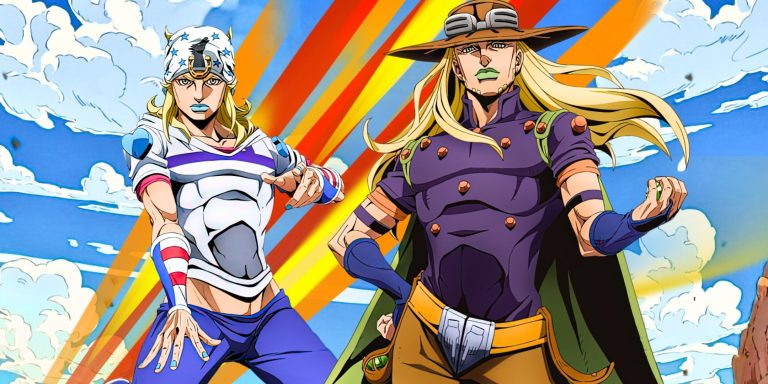
Johnny Joestar is a far cry from his virtuous namesake, Jonathan. A former horse-racing prodigy whose career and mobility were stolen by an act of senseless arrogance, Johnny begins the story as a cynical, bitter paraplegic adrift in self-loathing. He does not join the race out of patriotism or glory; he rides because touching a mysterious rotating sphere wielded by an eccentric Neapolitan executioner briefly restores sensation to his legs. Johnny’s character arc is defined by what Araki famously terms “Dark Determination”—a chilling, wide-eyed willingness to commit murder or sacrifice anything in his pursuit of spiritual and physical reclamation. He is not a hero striving to save the world; he is a man desperately clawing his way back from negative zero to absolute zero.
The Golden Ratio, Spin, and Gyro’s Absurdist Tragedy
Counterbalancing Johnny’s brooding volatility is Gyro Zeppeli, a character whose charisma practically radiates off the page. Serving as Johnny’s mentor, rival, and brother-in-arms, Gyro brings an irresistible blend of bizarre levity—complete with engraved gold teeth and nonsensical musical compositions about Italian food—and deeply rooted family honor. Through Gyro, Araki introduces the Spin (Kaiten), a metaphysical martial art governed by the mathematics of the Golden Rectangle and Fibonacci sequence. The kinetic interplay between Johnny’s evolving Stand, Tusk, and Gyro’s lethal steel spheres re-invents the series’ tactical combat, turning mathematics and kinetic rotation into high-stakes choreographic brilliance.
The Horse in the Room: David Production’s Technical Gauntlet
If Steel Ball Run is a thematic paradise, it is an animator’s absolute nightmare. Within the anime industry, animating horses is widely regarded as one of the most punishing, labor-intensive tasks an animation team can undertake. Quadruped anatomy requires a labyrinth of shifting muscle masses, complex skeletal kinematics, and dynamic perspective shifts that frequently break the sanity of 2D key animators.
In Steel Ball Run, horses are not incidental background set-dressing; they are lead characters. They sprint in packs across desert dust storms, scale treacherous snowcapped mountains, and engage in frantic, close-quarters Stand battles. David Production stands at a monumental crossroads regarding their production pipeline:
- The Hybrid CG Model: The studio must likely adopt high-end 3D CGI models for the equines—similar to the workflow employed by MAPPA in later seasons of Attack on Titan or Studio Orange in Trigun Stampede. The supreme challenge will be seamlessly blending these digital assets with Araki’s signature cross-hatched, hyper-stylized 2D character line-work.
- Pacing and Release Strategy: Fans are vocally campaigning against the controversial “batch release” model that Netflix inflicted upon Stone Ocean, which severely dampened week-to-week community theorizing and cultural momentum. A sprawling, 70-to-80-episode saga of Part 7’s scope demands a return to traditional, weekly broadcast programming to let its cinematic gravitas breathe.
Ideological Warfare: Funny Valentine and the Divine Stakes
No discussion of Part 7’s prestige can bypass its central antagonist: the 23rd President of the United States, Funny Valentine. Backed by his reality-bending dimensional Stand, Dirty Deeds Done Dirt Cheap (D4C), Valentine seeks to gather the scattered mummified relics of a holy figure (strongly implied to be Jesus Christ) to grant America eternal global supremacy through divine providence.
Valentine is an ideological titan whose terrifying utilitarianism—crystallized in his iconic “First Napkin” philosophical monologue—frequently forces the audience to question who the true villain of the narrative actually is. His clash with Johnny Joestar is not a standard battle of good versus evil, but an irreconcilable collision of pure patriotic zealotry against the desperate survivalism of an individual soul. Recreating this tense, dimension-hopping political thriller will demand top-tier voice talent and masterful sound design to fully realize its chilling atmospheric weight.
The Final Leg: Bracing for the Inevitable
While David Production and Warner Bros. Japan remain officially tight-lipped, industry chatter suggests the studio has spent the post-Stone Ocean window recalibrating its technical infrastructure to meet Part 7’s monstrous production requirements. Steel Ball Run is not just another seasonal anime run; it is the definitive turning point for Hirohiko Araki’s artistic canon, a neo-western triumph that stands shoulder-to-shoulder with the finest historical fiction in literature.
When that opening starting pistol finally cracks and Johnny Joestar takes his marks upon the white mare Slow Dancer, anime history will be written anew. The race of a lifetime is looming just beyond the horizon—and when it arrives, nothing in the medium will be able to outrun it.
What are your biggest hopes and fears for David Production’s adaptation of Steel Ball Run? Do you think they can pull off the horses with 2D sakuga, or is a 3D hybrid pipeline non-negotiable? Sound off in the comments below and keep your eyes locked on Wibux.com for all breaking JoJo updates!