

Ever since the bittersweet, melancholic notes of Stone Ocean’s reset universe faded into silence, a quiet yet deafening murmur has echoed across the global anime community. For over a decade, enthusiasts treated the prospective adaptation of Hirohiko Araki’s seventh installment not merely as an eventuality, but as an almost sacred milestone. JoJo’s Bizarre Adventure: Steel Ball Run is not just another seasonal cour waiting in the wings; it is an epochal shift in aesthetic, narrative ambition, and technical audacity. To broach the topic of Steel Ball Run is to step onto the scorched sands of San Diego Beach in 1890, gazing across an unforgiving North American frontier filled with cutthroat racers, supernatural relics, and a philosophical depth unprecedented in modern shonen or seinen history.
As industry whispers intensify surrounding David Production’s roadmap, the discourse has moved from if Part 7 will see the light of day to how the powerhouse studio plans to tackle Araki’s undisputed magnum opus. Translating this sprawling, 24-volume historical odyssey into television format stands as one of the most tantalizing, perilous creative gambles in contemporary Japanese animation.
The Resonant Rebirth: Why Part 7 is Araki’s Undisputed Magnum Opus
To understand the sheer magnitude of the anticipation, one must look back to 2004. Shifting mid-serialization from the breakneck editorial demands of Weekly Shonen Jump to the monthly, creator-friendly confines of Ultra Jump liberated Hirohiko Araki. The transition allowed his panels to breathe, his linework to evolve into a hyper-detailed fusion of classical European chiaroscuro and high-fashion eccentricity, and his writing to venture into uncompromising psychological realism.
Steel Ball Run acts as a thematic recalibration of the entire JoJo mythos. By wiping the slate clean and placing the narrative within an alternate 19th-century trans-American horse race boasting a $50 million grand prize, Araki abandoned the traditional villain-of-the-week formula. In its place, he forged a continuous, cross-country kinetic journey where every stage introduces hostile biomes, shifting alliances, and political conspiracies masterminded from the highest echelons of government. It is a period piece, a supernatural western, and an existential pilgrimage bundled into a single unrelenting sprint.
Flawed Saints and Reluctant Mentors: The Psychology of Johnny and Gyro
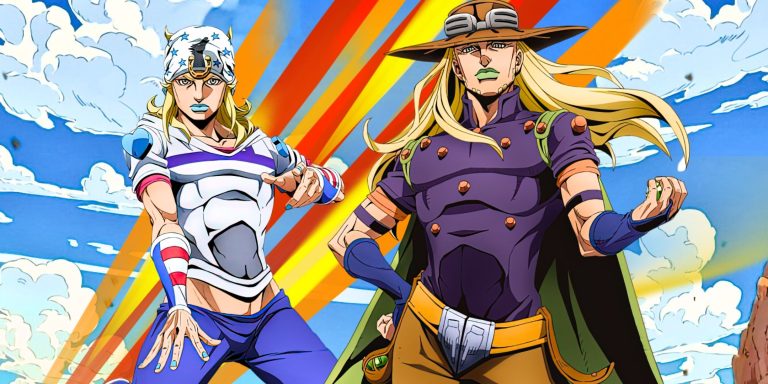
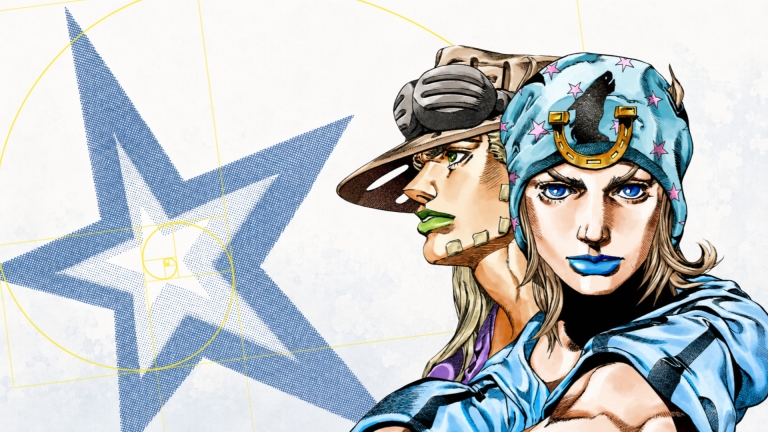
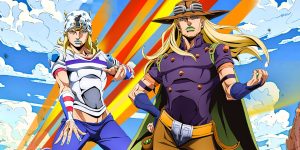
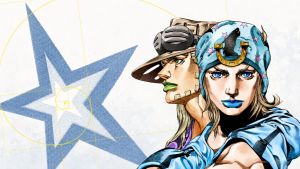
At the beating heart of this cross-continental epic lies the most intricate dual-protagonist dynamic Araki has ever penned: Johnny Joestar and Gyro Zeppeli.
Johnny Joestar’s Dark Determination
Johnny is a staggering departure from the chivalric Jonathan Joestar or the cool, indomitable Jotaro Kujo. Paralyzed from the waist down due to his own youthful hubris, Johnny begins his arc not as a paragon of virtue, but as a broken, cynical outcast. He possesses what Araki canonically defines as “Dark Determination”—a cold, unflinching willingness to commit morally abhorrent acts if it means reclaiming his humanity. Johnny’s Stand, Tusk, physically manifests this psychological evolution across four distinct “Acts,” tracing his trajectory from an insecure crawler shooting fingernails to an interdimensional sovereign uncoiling infinite force. He does not race to save the world; he races to bring his soul from negative territory back to “zero.”
The Eccentric Gravity of Gyro Zeppeli
Counterbalancing Johnny’s brooding desperation is Gyro Zeppeli, a disgraced Neapolitan executioner’s son armed with steel spheres, a grill carved with “GO! GO! ZEPPELI,” and an absurd penchant for terrible puns. Beneath his ostentatious theatricality lies a man crushed beneath the weight of familial duty and political tyranny, racing against the clock to secure an amnesty pardon for an innocent nine-year-old peasant boy sentenced to die. Gyro serves as Johnny’s mentor, companion, and mirror. Their campfire conversations about the days of the week or opera lyrics do not merely serve as comic relief; they constitute the emotional backbone of the series, turning two damaged men into brothers bound by fate.
The Geometry of Miracles: The Spin and the Saint’s Corpse
Mechanically, Steel Ball Run rewrites the battlefield lexicon of the franchise. While Stands remain integral, they are grounded by the introduction of The Spin (Kaiten), a pseudo-scientific, metaphysical discipline that refines the original concept of Hamon into a devastating martial art.
Based on the Fibonacci sequence and the mathematical perfection of the Golden Rectangle, the Spin transforms kinetic throwing weapons into reality-warping vectors of force. It requires mastery of spatial awareness, equestrian riding, and pure organic physics. This geometric discipline collides violently with the story’s central macabre MacGuffin: the fragmented, mummified remains of the Saint’s Corpse—widely implied to be Jesus Christ Himself—scattered along the American trail.
By transforming holy relics into power sources that manipulate fortune, calamity, and parallel dimensions, Araki crafts a blistering deconstruction of American exceptionalism and “Manifest Destiny.” The villain, President Funny Valentine, operates not from mustache-twirling villainy, but from an intoxicating, ultra-nationalistic fervor that makes him one of the most chillingly charismatic antagonists ever committed to manga paper.
The Equestrian Nightmare: David Production’s Looming Hurdle
Why has the production taken so long? The answer lies on four legs. In the animation industry, horses are notorious; they are kinetic, multi-jointed, anatomical nightmares to animate consistently in hand-drawn 2D. Steel Ball Run is not a show with occasional cavalry charges; it is a story where dozens of named horses gallop across prairies, snowfields, and rocky canyons in nearly every single chapter.
David Production, whose stewardship of Parts 1 through 6 solidified their status as adaptive legends, faces a crossroads:
A pure, hand-drawn 2D production of Steel Ball Run’s horse races could easily break standard television production schedules, leading to catastrophic delays or visual degradation. The alternative—relying on full 3D CGI models—risks alienating a purist audience deeply attached to Araki’s tactile, hyper-stylized linework. The most viable path forward appears to be a sophisticated hybrid approach: custom-shaded 3D horse armatures mapped with bespoke 2D hand-drawn touch-ups for riders, close-ups, and dramatic Stand-activating finishes, similar to the techniques pioneered by modern cinematic spectacles.
Add to this the sheer length of the source material. A truncated 24-episode adaptation would be catastrophic for the narrative’s nuanced pacing; Part 7 demands a lavish, multi-cour structure spanning anywhere from 36 to 48 episodes, possibly segmented across strategic seasons to preserve high-tier visual fidelity.
A Horizon Awaiting Its Riders
The cultural momentum behind JoJo’s Bizarre Adventure: Steel Ball Run has crossed the point of no return. Its viral endurance across social media, the endless tributes to Johnny and Gyro’s journey, and its consistent placement near the apex of critical manga rankings have built an expectation rarely seen in the medium. When David Production finally fires the ceremonial starting gun, the world will not simply be tuning into another anime—we will be witnessing the arrival of modern fiction’s most daring, stylish, and heartbreaking trans-American race.
How do you think David Production should handle the infamous horse races—stylized 3D CGI or painstakingly hand-drawn 2D? And who is your dream voice-casting choice for Gyro Zeppeli? Sound off in the comments below!