Ever since the universe reset under the tragic, operatic twilight of Stone Ocean, the anime community has been suspended in an agonizing state of anticipation. For nearly two decades, Hirohiko Araki’s Steel Ball Run has stood not merely as the seventh installment of the legendary JoJo’s Bizarre Adventure saga, but as the mangaka’s undisputed magnum opus. Consistently rubbing shoulders with titans like Berserk and Vinland Saga on all-time manga rankings, Part 7 represents the holy grail of speculative anime adaptations. Now, with David Production having officially closed the book on the original Joestar bloodline, the collective whispers across social media and convention floors have swollen into an ear-splitting roar. The anime industry is approaching what could be its most daring visual undertaking yet: adapting an 1890s trans-American equestrian death race drenched in metaphysical geometry, political intrigue, and bruised redemption.
A New Frontier: The Seinen Rebirth of Hirohiko Araki
To grasp why the hype surrounding Steel Ball Run is so qualitatively distinct from prior JoJo installments, one must look at the seismic shift that occurred during its serialization. When Araki initially debuted Part 7 in 2004 within the pages of Weekly Shōnen Jump, it was devoid of the “JoJo” moniker, masquerading simply as a grand period piece. However, its subsequent migration to the monthly seinen imprint Ultra Jump in 2005 marked an artistic emancipation. Unshackled from juvenile editorial guidelines, Araki radically elevated his storytelling, exchanging kinetic teenage bravado for brooding existential realism, visceral body horror, and moral complexity.
Set within a divergent timeline, Steel Ball Run strips away the conventional vampire-hunting lineages and stands as a standalone historical epic. The race itself—spanning from the sun-bleached shores of San Diego to the cobblestone streets of New York City—is a ruthless deconstruction of the American frontier mythos. Adapting this shift will require David Production to fundamentally reinvent the aesthetic framework that defined their work from Phantom Blood through Stone Ocean. Gone are the neon-saturated pop-art palettes of modern Morioh; in their place, the studio must deliver the cinematic sweep of Sergio Leone’s spaghetti westerns, washed in dust, sweat, chiaroscuro lighting, and vast, merciless horizons.
Spin, Sin, and Salvation: Johnny Joestar vs. Gyro Zeppeli
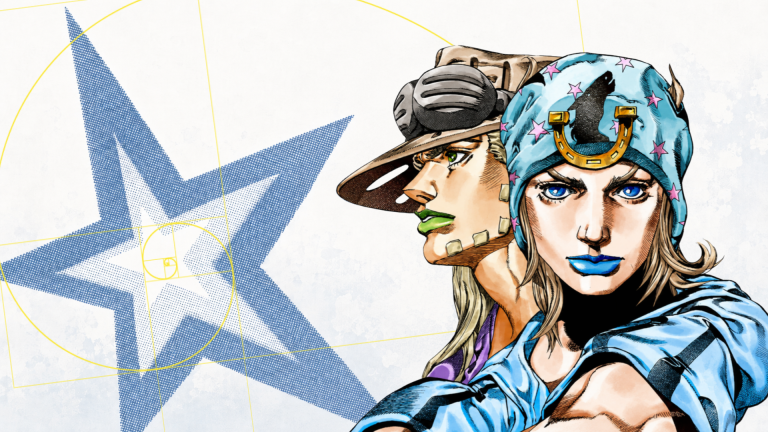
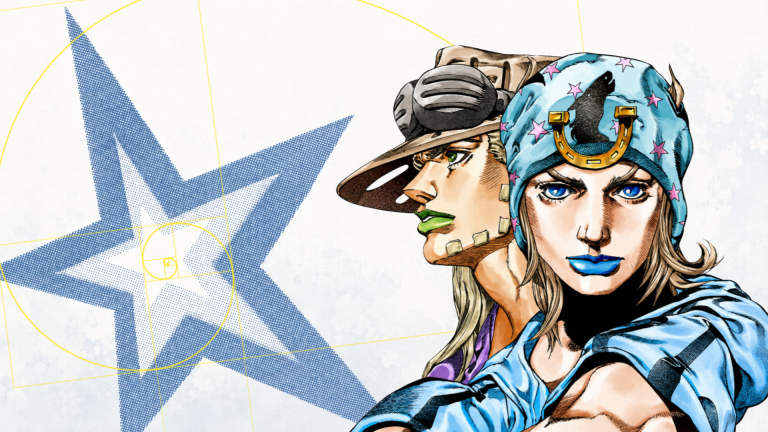
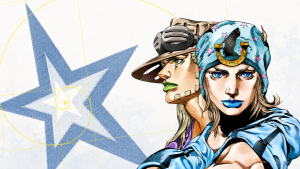
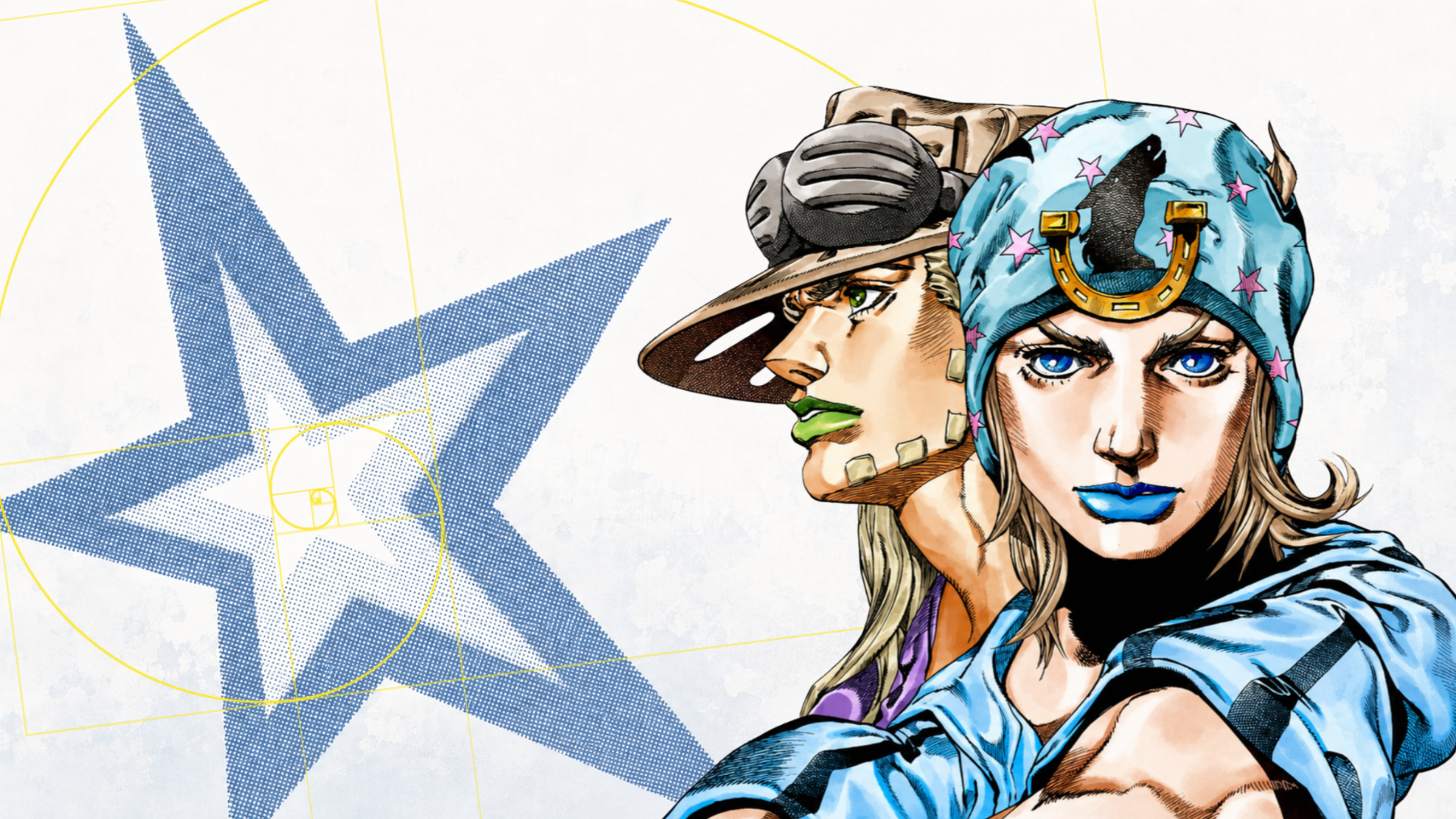
At the center of this sun-scorched odyssey is the single most compelling dual-protagonist dynamic in sequential art: the crippled former jockey Johnny Joestar and the flamboyant Neapolitan executioner Gyro Zeppeli. Their partnership moves far beyond the classic battle shonen paradigm of rivals-turned-allies.
Johnny Joestar and the “Dark Determination”
Johnny Joestar is an unprecedented subversion of the JoJo archetype. Paralyzed from the waist down in a senseless tragedy born of his own hubris, Johnny begins the story not as an aspiring hero, but as a bitter, discarded shell of a man. His moral alignment is notoriously murky; Araki famously characterized Johnny as possessing a “dark determination”—a chilling, pitiless glint in his eyes that surfaces whenever his survival or goals are imperiled. Johnny is not riding across the continent to save the world; he is chasing the faint hope of spiritual and physical reclamation through the enigmatic energy known as the Spin. His Stand, Tusk, evolves not purely out of tactical necessity, but alongside his tortuous journey toward coming to peace with his own trauma, moving from a negative state of existence back to “zero.”
The Golden Ratio: Gyro’s Tragic Burlesque
Acting as both mentor and spiritual ballast is Gyro Zeppeli, a character who instantly commands every frame he occupies. Armed with his signature revolving Steel Balls, Gyro introduces the lore of the Spin—a miraculous discipline rooted in the Golden Ratio that weaponizes kinetic torque into devastating reality-warping attacks. Yet beneath Gyro’s eccentric exterior, terrible jokes, and gold-capped teeth lies a soul suffocating under the weight of filial duty. He enters the brutal race not for glory, but to win amnesty for an innocent child condemned to state execution back home in Naples. The dynamic between Johnny’s cold resolve and Gyro’s theatrical nobility yields campfire dialogues that are as deeply poignant as they are absurdly hilarious. Casting these two leads will be a monumentally scrutinized decision for David Production, demanding voice actors who can pivot seamlessly between slapstick camaraderie and gut-wrenching tragedy.
The Animator’s Crucible: Overcoming the Equestrian Hurdle
If the narrative of Steel Ball Run is an undisputed masterpiece, its logistics present a production nightmare. The central reason an official announcement has lingered in limbo is known across the anime industry as the “equestrian wall.”
In traditional 2D animation, quadrupedal motion—specifically the complex, shifting anatomy of a galloping horse—is notoriously difficult and cost-prohibitive to animate with proper mass and fluidity. Steel Ball Run does not merely feature occasional horse-riding; it features dozens of thoroughbreds charging abreast through mud, canyons, blizzards, and rivers for nearly a hundred consecutive chapters. The physical strain this level of continuous hand-drawn animation would place on a studio cannot be overstated.
Industry analysts anticipate that David Production will pioneer a sophisticated hybrid workflow. Drawing inspiration from modern breakthroughs in cel-shaded CGI, the production may utilize high-fidelity 3D models for complex pack-running sequences and extreme spatial camera movements, overlaid with hand-drawn 2D correction frames for character close-ups and dramatic flourishes. David Production has consistently demonstrated a willingness to push technical envelopes—evidenced by the fluid pyrotechnics of Fire Force and the dazzling retro-futurism of Urusei Yatsura. However, Part 7 will serve as their definitive litmus test: balancing technical viability with the raw, textured hatching that defines Araki’s mid-2000s illustration style.
The Sacred Corpse and the Gospel of Funny Valentine
The stakes of the trans-American race escalate dramatically once Araki reveals that the event is merely a façade for a global geopolitical conspiracy orchestrated by the 23rd President of the United States, Funny Valentine. The true objective? Locating the scattered, mummified remains of the Sacred Corpse—widely coded as the relics of Jesus Christ—which bestow reality-bending blessings upon their bearer.
Valentine stands as arguably the most layered and intellectually terrifying antagonist in the entire franchise. Driven not by petty avarice, but by an unyielding, hyper-patriotic ideology, Valentine genuinely believes he is securing eternal prosperity for his nation by redirecting all misfortune outward to the rest of the world. His Stand, Dirty Deeds Done Dirt Cheap (D4C), introduces jaw-dropping multiversal traversal that challenges conventional spatial continuity. When Valentine delivers his celebrated discourse on “taking the first napkin,” the narrative transcends conventional battle manga, transforming into a philosophical treatise on power, authority, and sacrificial morality.
The Horizon of the American Trail
David Production stands before its greatest creative crucible. JoJo’s Bizarre Adventure: Steel Ball Run is more than the next chronological step in an anime franchise; it is an epic that demands the thematic reverence of a prestige drama and the technical bravura of an industry-leading feature film. If the studio takes the necessary time to refine its hybrid production pipeline, this journey across the dust-choked American plains will not just satisfy long-term fans—it will fundamentally redefine what high-concept seinen adaptations can achieve on the global stage.
What are your predictions for David Production’s approach to the horse animation? Who would you cast to deliver Gyro Zeppeli’s iconic laugh? Let us know your theories in the comments below, and stay tuned to Wibux.com for all breaking updates on the JoJo universe!