

Few titles in the pantheon of modern sequential art carry the monolithic, almost mythical weight of JoJo’s Bizarre Adventure: Steel Ball Run. Long before the final, bittersweet frame of Stone Ocean faded from Netflix screens, the international anime community was already looking toward the horizon—specifically, the dust-choked plains of late 19th-century America. Among manga purists and casual anime observers alike, Hirohiko Araki’s seventh installment isn’t viewed merely as the next sequential arc to be checked off an adaptation bucket list; it is routinely held as Araki’s magnum opus, consistently trading punches with Berserk at the absolute peak of critical manga rankings.
Yet, as anticipation reaches a fever pitch, an unspoken tension grips the fandom. Transitioning from the enclosed, claustrophobic corridors of Green Dolphin Street Prison to a 6,000-kilometer cross-country equestrian marathon represents an artistic, technical, and thematic leap unprecedented in the franchise’s history. For David Production—the studio that has painstakingly translated Araki’s idiosyncratic visual grammar for over a decade—Steel Ball Run is not just another production cycle. It is their ultimate trial by fire.
The Seinen Rebirth: Araki’s Narrative Masterpiece
To understand why the buzz surrounding Steel Ball Run is fundamentally different from any prior JoJo adaptation, one must look back at its 2004 inception. Beginning serialization in Weekly Shonen Jump before migrating to the monthly, mature-skewing pages of Ultra Jump, SBR granted Araki total creative liberation. Untethered from the relentless pace and editorial censorship of standard shonen demographics, he tore down the foundational mythology of his own universe to construct an alternate-history Western epic dripping with grit, moral ambiguity, and metaphysical wonder.
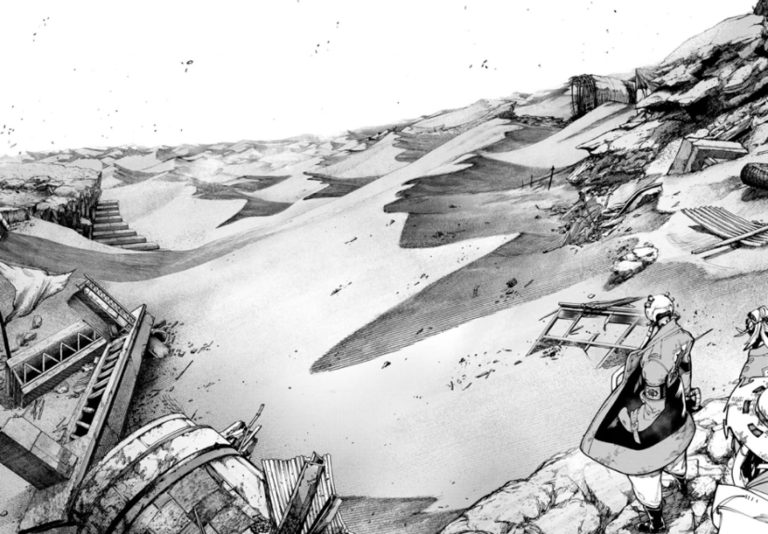
The premise is deceptively accessible: in 1890, eccentric philanthropist Steven Steel organizes a continent-spanning horse race from San Diego to New York City, promising an astronomical $50 million grand prize. Yet underneath the thundering hooves, the race serves as an elaborate smokescreen for a clandestine geopolitical conspiracy involving the scattered relics of a divine Saint’s Corpse. By combining historical frontier romanticism with uncanny supernatural warfare, Araki crafted a high-octane stage where every mile conquered exacts an excruciating emotional and physical toll.
Johnny Joestar, Gyro Zeppeli, and the Anatomy of Dark Determination
The Subversion of the Shonen Hero
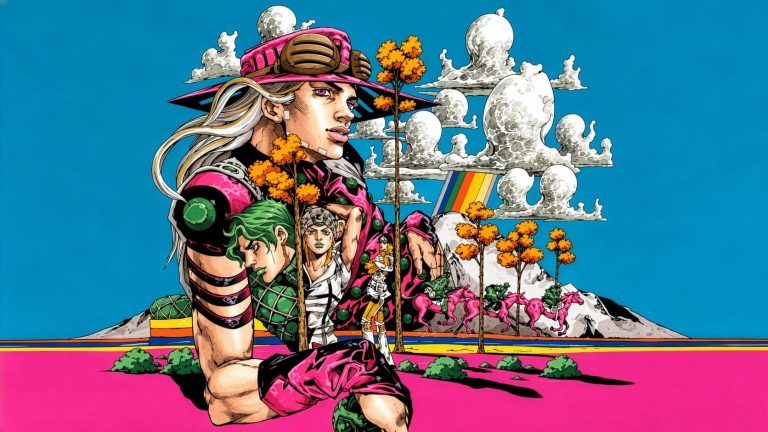
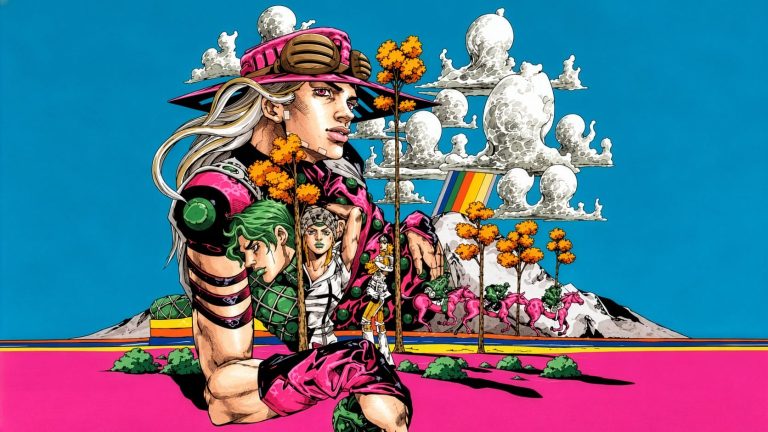
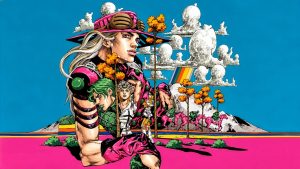
At the beating heart of Steel Ball Run lies the dynamic between Johnny Joestar and Gyro Zeppeli—arguably the most meticulously written duo in modern action fiction. Johnny stands as a radical departure from the noble lineage of Jonathan or the swaggering machismo of Jotaro. A former horse-racing prodigy whose career and mobility were shattered by his own arrogant hubris, Johnny begins his journey as an embittered, paraplegic outcast. His quest is devoid of righteous altruism; he is driven by a singular, desperate obsession to regain feeling in his legs and pull himself up from “negative to zero.”
Araki frequently characterizes Johnny through what he defines as “dark determination” (shikkoku no ishi)—a chilling, cold-blooded willingness to sacrifice anything and anyone to achieve his goal. It is an unvarnished psychological portrait rarely seen in mainstream anime protagonists, giving the narrative an electric, unpredictable undercurrent.
The Golden Spin and the Neapolitan Executioner
Balancing Johnny’s brooding desperation is Gyro Zeppeli, a flamboyant Neapolitan royal executioner carrying the burden of an unjust capital sentence he seeks to overturn. Gyro introduces the Spin (Kaiten)—a rotational martial discipline derived from the golden ratio of nature that serves as Araki’s elegant evolution of Part 1 and 2’s Hamon. Unlike the established Stand mechanics of Parts 3 through 6, the Spin anchors combat to mathematical physics, biology, and environment, slowly evolving throughout the race before manifesting some of the most conceptually devastating Stand abilities in the entire canon, from Tusk to Ball Breaker.
Their bond isn’t forged through instant camaraderie, but through cold practical alliances, absurd campfire jokes, and mutual existential survival. Capturing the authentic warmth, eccentric banter, and ultimate tragedy of this partnership will be the single most crucial emotional hurdle for whatever vocal cast David Production enlists.
The Technical Reckoning: Conquering the Equestrian Nightmare
If the narrative of Steel Ball Run is a dream for screenwriters, the visual execution is an animator’s worst nightmare. In the animation industry, there is a legendary, whispered maxim: never animate horses unless you are prepared to break your studio.
A horse in motion is a terrifyingly complex organic machine. Capturing the muscular contraction, skeletal shifting, galloping rhythm, and shifting perspectives of dozens of steeds—while their riders wield revolvers, steel spheres, and trans-dimensional Stands—requires an astronomical frame budget. Even industry titans like WIT Studio and MAPPA opted for heavy 3D CGI integration to handle equestrian logistics in Attack on Titan, often drawing mixed reactions from discerning fans.
David Production stands at a perilous crossroad. The studio made its name through highly stylized, heavily textured 2D kineticism, sharp pop-art palettes, and expressive character models. Relying entirely on traditional 2D animation for Steel Ball Run‘s high-speed pursuits is virtually impossible under standard seasonal constraints. The fundamental question isn’t whether CGI will be utilized, but whether the studio can innovate an aesthetic pipeline where 3D cel-shaded models harmonize seamlessly with Araki’s intricate, hatched seinen linework. If the horses feel weightless or uncanny, the foundational tension of the entire race collapses.
The President, The Corpse, and Ideological Clashes
Beyond the logistical hazards, anticipation for Steel Ball Run is stoked by its pantheon of antagonists. Chief among them is the 23rd President of the United States, Funny Valentine, whose reality-bending Stand, Dirty Deeds Done Dirt Cheap (D4C), elevates the psychological complexity of the series to cosmic proportions. Valentine isn’t a megalomaniacal tyrant seeking dominion for vanity; his motivations are deeply rooted in zealous, hyper-nationalistic utilitarianism—the belief that the prosperity of his homeland justifies any atrocity committed against the outside world.
Coupled with unforgettable wildcards like the dinosaur-shifting Diego Brando—an alternate, ruthlessly opportunistic incarnation of the franchise’s eternal adversary—the narrative evolves from a race across terrain into an escalating ideological war. The clash between Valentine’s sovereign tyranny and Johnny’s personal desperation provides a thematic depth that transcends typical battle-manga conventions.
Distribution Trauma and the Path Forward
David Production’s delay in formally greenlighting or showcasing Steel Ball Run may ultimately prove to be a blessing. The fandom remains rightfully scarred by the handling of Part 6: Stone Ocean, where Netflix’s unceremonious “batch drops” extinguished the organic, weekly cultural discussions that had previously sustained the franchise’s global hype engine.
For an epic of SBR’s magnitude, a standard 24-episode order or a compromised streaming dump simply will not suffice. The community is vocally clamoring for a multi-year, premium seasonal rollout—similar to the prestige treatment granted to contemporary juggernauts like Chainsaw Man, Frieren, or Bleach: Thousand-Year Blood War. David Production needs time, massive budgetary backing, and a release format that lets every leg of the race breathe as a global cultural event.
Final Stretch
Steel Ball Run stands as the final frontier for David Production—a colossal, dust-caked monument that will either immortalize their legacy or prove that Araki’s wild imagination has finally exceeded the boundaries of television animation. The hype vibrating through the community isn’t hollow nostalgia; it is the reverence of fans who know they are on the cusp of experiencing one of the grandest adventure epics ever penned.
When Johnny Joestar finally spurs his horse forward and the sound of the starting gun echoes, the anime landscape will never be quite the same. Wibux readers: Are you bracing for heavy CGI cavalry, or do you believe David Production has a visual miracle waiting up their sleeves? Let us know in the comments below.