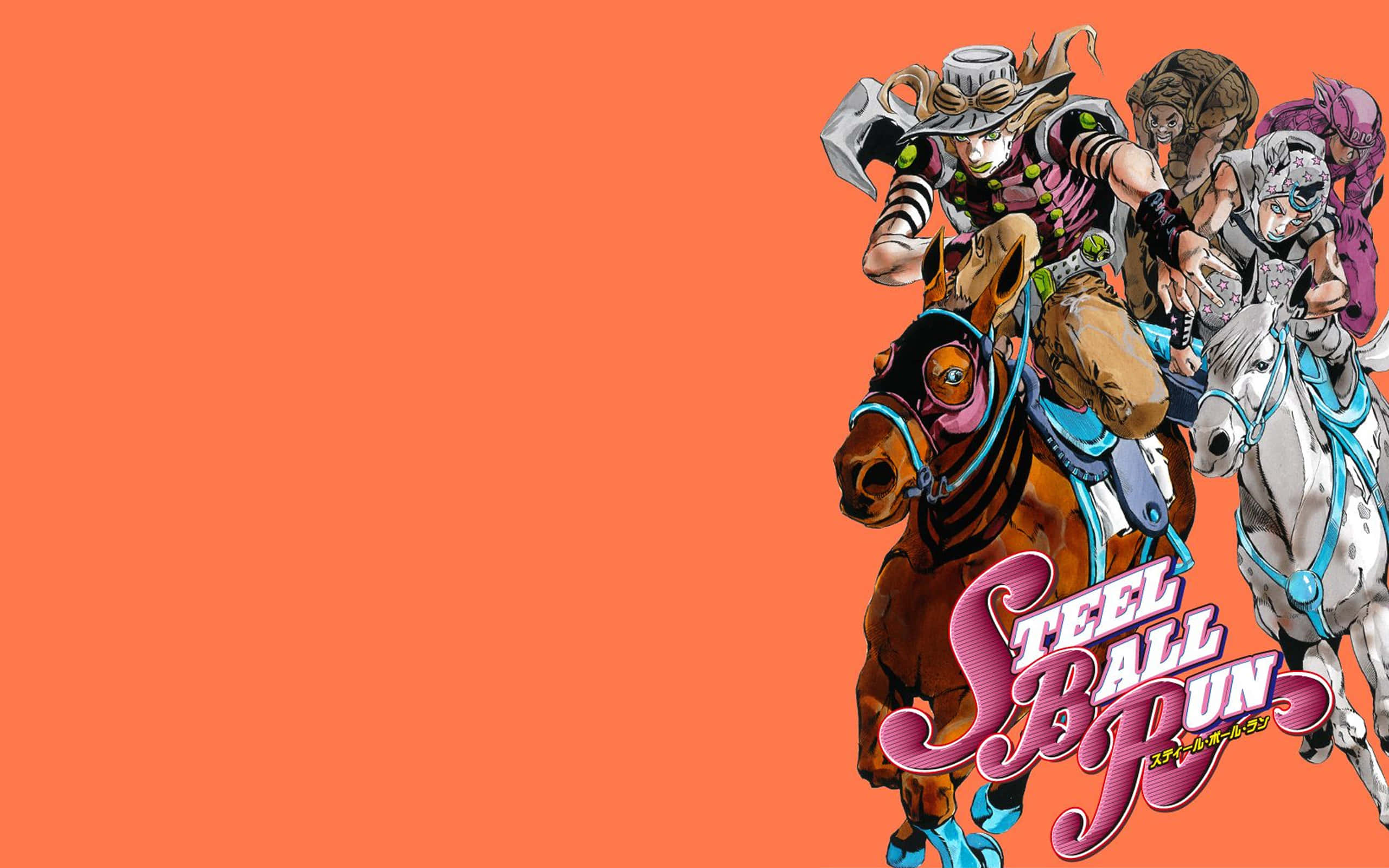
Ever since the bittersweet, melancholic chords of “Distant Dreamer” signaled the end of Stone Ocean in late 2022, a deafening silence has hung over the anime landscape. For casual viewers, Jolyne Cujoh’s stand against Father Pucci marked the conclusive end of an eight-year, multi-generational saga spanning the globe from Victorian England to a maximum-security prison in Florida. But for the devoted disciples of Hirohiko Araki, that cosmic curtain call was never an ending—it was merely the prelude to something transcendent. The collective gaze of the fandom has pivoted west, fixed squarely on the horizon of late 19th-century America. We are waiting on the starting line for JoJo’s Bizarre Adventure: Steel Ball Run.
Routinely jockeying with Kentaro Miura’s Berserk for the highest-rated spot on manga tracking platforms, Steel Ball Run (Part 7) is not simply another chapter in Araki’s long-running anthology; it is widely regarded as his undisputed magnum opus. Combining the raw, unfiltered freedom of his editorial shift to the seinen magazine Ultra Jump with an unprecedented blend of historical fiction, occult mysticism, and athletic grit, Part 7 restructured the DNA of the franchise. Yet, as rumors churn within the industry and speculation peaks around David Production’s production pipeline, the conversation surrounding an anime adaptation has morphed from simple anticipation into an existential query: Can any modern anime studio actually pull this off?
The Great American Rebirth: Beyond the Joestar Pedigree
To understand the hunger for Steel Ball Run, one must grasp the magnitude of Araki’s creative reset in 2004. Unshackled from the tangled generational continuity of the original universe, Part 7 reimagines the narrative landscape by transporting audiences to the twilight of the 19th century. The premise is audaciously cinematic: the Steel Ball Run, a grueling, 6,000-kilometer cross-country horse race stretching from San Diego Beach to New York City, boasting a staggering fifty-million-dollar purse.
Beneath the guise of sportsmanship and frontier bravado lies a labyrinthine web of political intrigue orchestrated by the charismatic, ultra-nationalist U.S. President Funny Valentine. The true objective of the race is not fame or fortune, but the clandestine collection of the scattered, mummified parts of the Holy Corpse—relics radiating reality-bending power. In this narrative sandbox, Araki dismantled the archetypal shonen framework. Gone are the clear-cut battlegrounds of good versus evil found in Stardust Crusaders or Diamond is Unbreakable. In their place stands a harsh, morally gray revisionist Western where survival, personal salvation, and existential ambition violently collide under the desert sun.
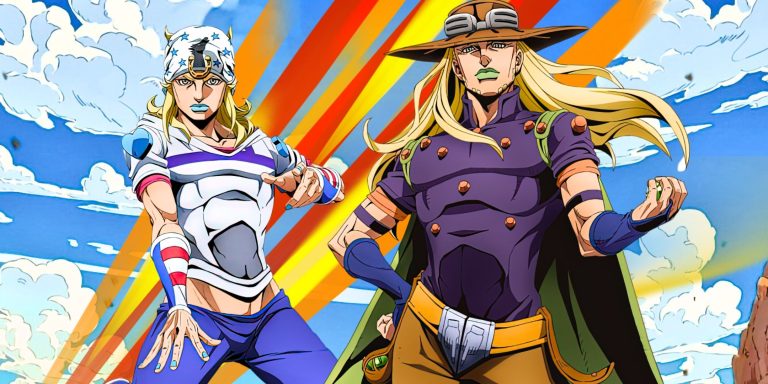
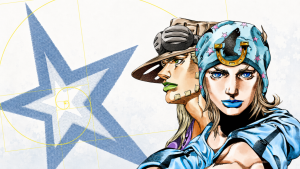
Johnny Joestar and Gyro Zeppeli: Anatomy of Araki’s Masterpiece Duo
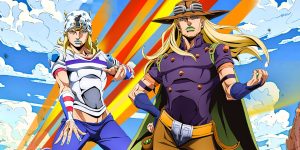
At the beating heart of this cross-continental odyssey is the most meticulously developed dynamic Araki has ever penned: the bond between Johnny Joestar and Gyro Zeppeli. Their relationship discards the traditional mentor-student dynamic in favor of something far more intimate, philosophical, and tragically human.
Johnny Joestar: The Anatomy of a Fallen Prodigy
Unlike his righteous ancestors—the chivalric Jonathan or the swaggering Jotaro—Johnny begins his journey from a state of total emotional and physical bankruptcy. Once an arrogant, privileged horse-racing prodigy, a catastrophic hubris-fueled accident leaves him paralyzed from the waist down and cast out by his aristocratic father. Johnny is bitter, profoundly cynical, and possessed of what Araki explicitly characterizes as a “dark determination”—a ruthless, pitch-black resolve willing to cross moral thresholds without hesitation. His Stand, Tusk, mirrors this harrowing personal trajectory, evolving from an embryonic, desperate fingernail-spinning entity (Act 1) through painful stages of self-actualization into a multiversal force of infinite kinetic energy (Act 4).
Gyro Zeppeli: The Executioner and the Golden Spiral
Balancing Johnny’s brooding desperation is Gyro Zeppeli, a flamboyant disgraced executioner from the Kingdom of Naples whose absurd quips and gold-plated dental grill conceal a staggering weight of personal duty. Gyro enters the race not for glory, but to secure the amnesty of an innocent child sentenced to death by his state’s archaic laws. Through Gyro, Araki introduces the “Spin”—a mystical physical discipline rooted in Renaissance mathematics, cellular rotation, and the Fibonacci sequence’s Golden Ratio. Gyro is the philosophical spine of the story, delivering transcendental life lessons across campfires while teaching Johnny how to reclaim his shattered sense of purpose. Their quiet, character-building exchanges, alternating effortlessly between surreal comedy and gut-wrenching intimacy, provide the quiet foundation that elevates the series’ frantic combat.
The Technical Everest: David Production’s Equestrian Nightmare
If the narrative potential of Steel Ball Run is limitless, its production feasibility is notoriously precarious. Industry insiders and animation veterans have long cited Part 7 as the ultimate logistical nightmare for one glaring reason: horses.
In traditional 2D animation, the anatomy, skeletal fluidity, and mechanical gait of a galloping horse rank among the most labor-intensive tasks an animator can undertake. Multiply that single horse by dozens of competitors surging through turbulent river crossings, craggy canyons, and blizzard-swept plains, and the prospect becomes frankly terrifying. A pure hand-drawn adaptation of the trans-continental stampede would quickly bankrupt a typical production schedule or crush an in-house team under an impossible volume of in-betweens.
David Production, which has handled every adaptation of the franchise since 2012 with reverent authenticity, faces a monumental crossroads:
Will they lean heavily on stylized, cel-shaded 3D CG models to render the equestrian locomotion, as seen in modern technical showcases like MAPPA’s Attack on Titan or Studio Orange’s portfolio? Or will they pioneer a bespoke hybrid pipeline that reserves traditional key animation for intimate character clashes while utilizing advanced algorithmic models for long-distance pack riding? The studio’s signature sound design—the earth-shattering bass drops, the tactile metallic crunches—is already tailor-made for the thunderous clatter of hooves and the whistling whip of spinning steel spheres. But conquering the visual execution without sacrificing the iconic, hyper-detailed linework of Araki’s mature art style remains the single greatest barrier between the page and the screen.
The Golden Ratio: Reinventing Supernatural Combat
Beyond the technical demands of the race, an adaptation must also faithfully translate how combat evolves in Part 7. The series marks a calculated shift away from the straightforward punch-ghosts of Parts 3 through 6. While Stands remain prominent, their mechanics become intensely conceptual, intertwining with the physics of the Spin and the surrounding terrain.
Combat encounters in Steel Ball Run read like tense psychological thrillers played out on horseback. Stand designs like Diego Brando’s Scary Monsters invoke visceral, body-horror paleontology, while Ringom Roadagain’s Mandom turns a desert clearing into a claustrophobic, six-second loop of philosophical dueling. Later, the reality-shattering dimensional manipulation of Funny Valentine’s Dirty Deeds Done Dirt Cheap (D4C) introduces complex spatial geometries that will push David Production’s storyboarding and editing units to their absolute creative limits. The kinetic rhythm of these fights is not dictated by raw power levels, but by angle, velocity, terrain management, and absolute tactical conviction.
The Verdict: A Masterpiece Waiting for Its Horizon
The cultural appetite for a Steel Ball Run anime is no longer a niche, echo-chamber whisper—it is a roaring demand from a global audience that recognizes the story’s unique prestige within the medium. With David Production having recently wrapped up peripheral projects like Undead Unluck and maintaining their mastery over dynamic action choreography, the structural groundwork for Part 7 is quietly crystallizing.
Adapting Hirohiko Araki’s greatest triumph requires more than just an ambitious budget; it demands unprecedented patience, technological innovation, and an unwavering respect for a narrative that transitions seamlessly from an 1890s sporting event into a poignant meditation on grief, sacrifice, and the search for personal wholeness. When that starting pistol finally cracks and Johnny Joestar spurs his mount forward, the anime community will witness the opening salvo of a historic modern classic.
Are you holding out for a fully traditional 2D adaptation, or do you think a hybrid 3D workflow is the only realistic way to bring the horses of Steel Ball Run to life? Who is your dream voice cast for Johnny and Gyro? Drop your thoughts, theories, and Golden Ratio calculations in the comments below!