
Ever since the bittersweet, melancholic notes of “What a Wonderful World” gently closed the curtain on Stone Ocean, a collective, breathless hush has fallen across the anime landscape. For over a decade, David Production pulled off what was once deemed impossible: translating Hirohiko Araki’s kinetic, fashion-forward, anatomical fever dream into a serialized television masterwork. Yet, all five preceding animated generations—spanning Jonathan’s Victorian chivalry to Jolyne’s Floridian prison break—feel like a prolonged prologue for what looms on the horizon. We have arrived at the precipice of JoJo’s Bizarre Adventure: Steel Ball Run, a modern literary landmark that sits perpetually near the pinnacle of MyAnimeList’s all-time manga rankings, rivaled only by Kentaro Miura’s Berserk.
The anticipation is not merely standard fandom hype; it is a seismic cultural event waiting for a release date. Part 7 represents a bold creative tabula rasa—a reinvention that transplanted Araki’s universe from the bustling streets of Morioh and Rome to the dusty, blood-soaked American frontier of 1890. As rumors, cryptic production leaks, and trademark filings continue to fuel online discourse, the question is no longer whether David Production will adapt this trans-continental odyssey, but whether modern television animation can withstand the sheer kinetic and philosophical scale of Araki’s magnum opus.
The Seinen Evolution: Araki’s Trans-American Masterpiece
To understand the ravenous appetite for a Steel Ball Run anime, one must understand its unique publication history. When Steel Ball Run launched in Weekly Shonen Jump in 2004, it initially ran without the explicit “JoJo” moniker, deliberately disorienting longtime readers before transitioning to the monthly seinen magazine Ultra Jump. That editorial shift unlocked a revolutionary creative liberation for Araki. Free from the breakneck weekly deadlines and demographic guardrails of traditional shonen, he injected historical fiction, theological existentialism, body horror, and unapologetic grit into the narrative veins of Part 7.
The premise reads like Sergio Leone directing a cosmic horror blockbuster: a cross-country equestrian race stretching from San Diego Beach to New York City, boasting a staggering fifty-million-dollar purse. Yet beneath the veneer of Steven Steel’s sporting extravaganza lies a clandestine conspiracy orchestrated to assemble the scattered, mummified relics of the Holy Corpse—remnants that bestow reality-bending power upon whoever claims them. It is a work of breathtaking ambition, capturing an untamed America caught in the violent churn of industrialization, manifest destiny, and esoteric mysticism.
Johnny Joestar and Gyro Zeppeli: Flawed Humanity and The Golden Spin
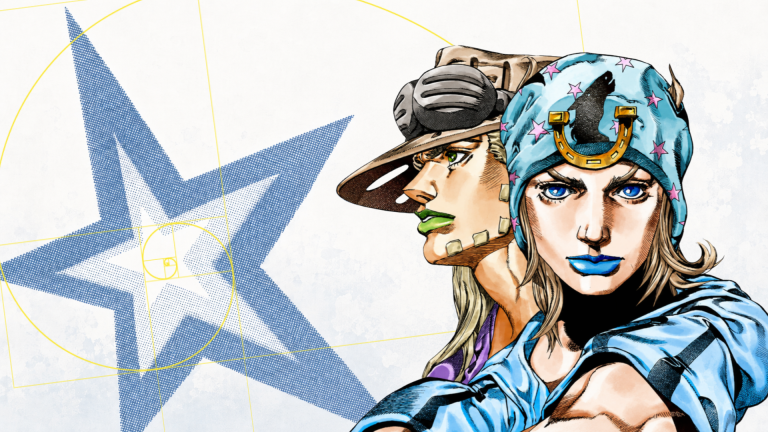
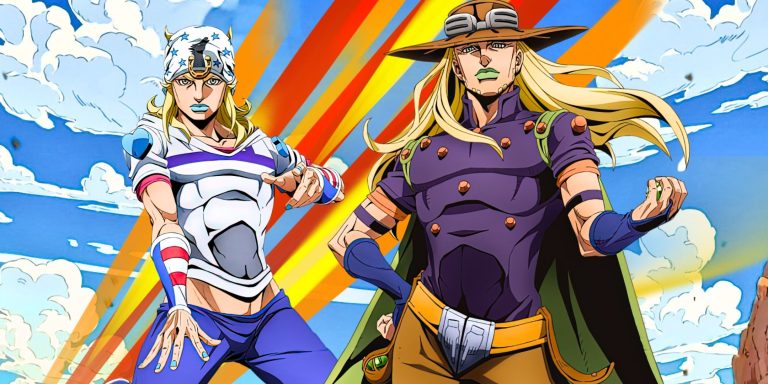
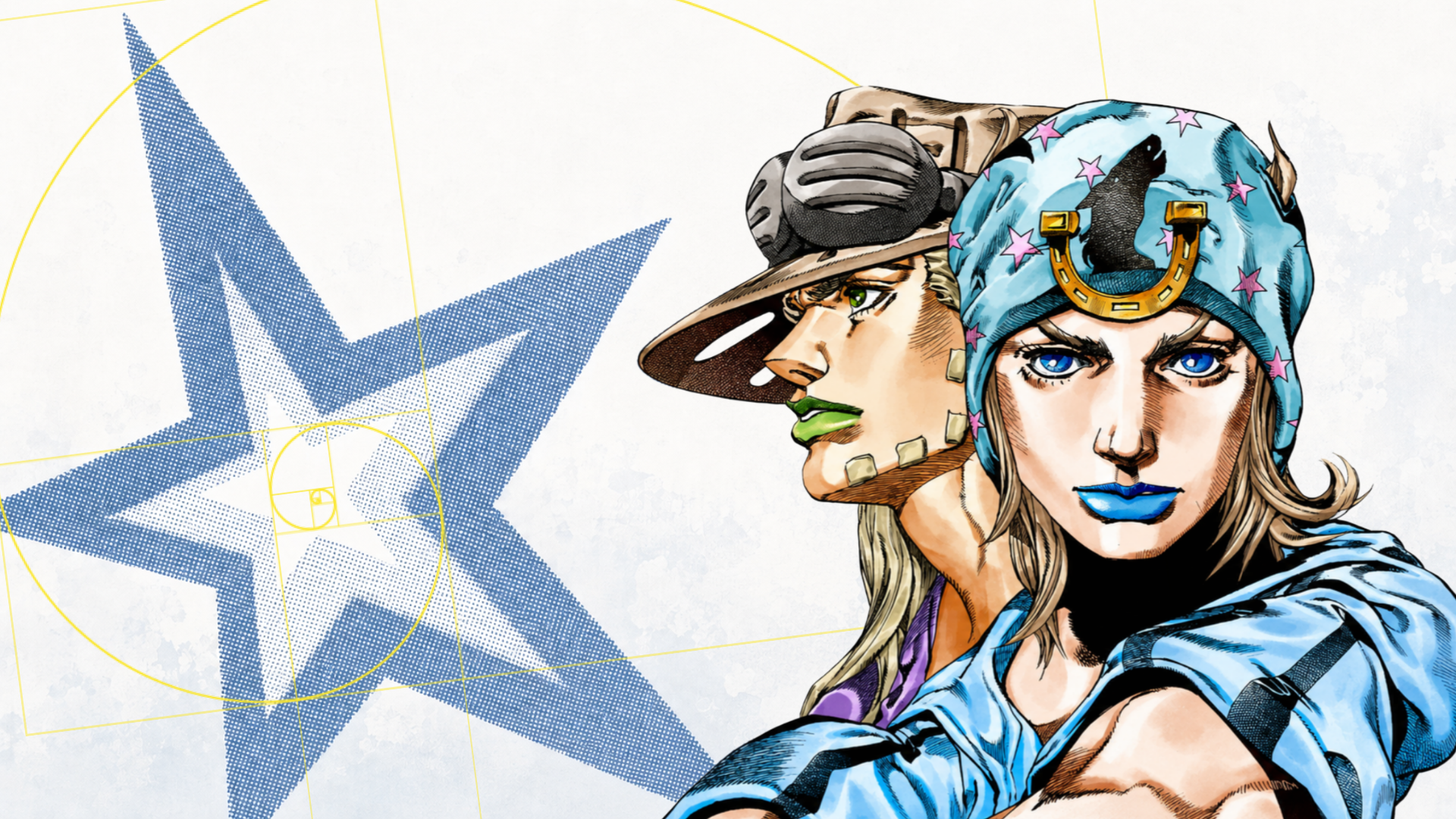
At the center of this dust-swept epic is what is unreservedly the finest dual protagonist dynamic Araki has ever penned. In stark contrast to the unflinching moral righteousness of Jonathan or the effortless tactical genius of Jotaro, Johnny Joestar begins his journey as an absolute wreck. A former horse-racing prodigy whose hubris, narcissism, and unearned entitlement culminated in a bullet to the spine, Johnny is bitter, paraplegic, and emotionally hollowed out. He is driven not by altruism or justice, but by an obsessive, primal desire: the desperate hope that discovering the mechanics behind the “Spin” will allow his broken legs to stand once more.
The Anatomy of Dark Determination
Johnny’s journey introduces what fans and scholars of the series refer to as “dark determination”—a cold, ruthless flame in his eyes signaling a willingness to sacrifice anything, including his own soul, to achieve his goals. His Stand, Tusk, reflects this traumatic metamorphosis, evolving across four distinct ACTs from a weak, spinning-fingernail novelty into an eldritch, dimensional-shattering harbinger of infinite gravity.
Gyro Zeppeli and the Legacy of the Executioner
Balancing Johnny’s brooding desperation is Gyro Zeppeli, a disgraced Neapolitan executioner armed with steel balls, gold-plated grillz, and an absurd penchant for singing about mozzarella cheese. Gyro carries the classic Zeppeli tragedy, but subverts it entirely; his mission is fundamentally philanthropic—to win the race and earn royal amnesty for an innocent child condemned to death. Gyro serves as Johnny’s mentor, big brother, and philosophical anchor. The intricate mechanics of the Spin—a scientific, anatomical martial art rooted in the Fibonacci Sequence and the Golden Ratio—serve as a thematic evolution of Part 1 and 2’s Hamon, grounding the supernatural combat in organic, breathtaking geometry.
The Technical Mountain: The Dreaded Equestrian Hurdle
If fans are frantic with excitement, animators at David Production are undoubtedly sweating over their drafting tablets. In the animation industry, horses are notorious as the single most punishing subject to illustrate. A horse’s anatomy demands complex skeletal rigging, dynamic muscular deformation, constantly moving manes, and synchronized four-legged gallop cadences. Now multiply that baseline difficulty by dozens of steeds thundering across deserts, blizzards, and rivers at breakneck speeds, frame-by-frame, for hundreds of miles.
Modern productions often resort to heavy 3D CGI models to tackle equestrian sequences—a practice that notoriously divided audiences in productions like Attack on Titan and Berserk (2016). While David Production showcased revolutionary mastery of hybrid 3D-2D integration during the early OP sequences created by Kamikaze Douga, a full-length series built around high-stakes horse chases poses an unprecedented logistical challenge. Industry insiders suspect that the elongated wait for Part 7 stems from extensive R&D: whether David Production will lean into sophisticated cel-shaded vehicle engines, enlist specialized studio partnerships, or meticulously craft high-octane 2D sakuga sequences for pivotal duels like the fight against Diego Brando and his prehistoric Stand, Scary Monsters.
The Antagonist Frontier: Funny Valentine and the Politics of the First Napkin
No discussion of Steel Ball Run is complete without its terrifying ideological counterweight: Funny Valentine, the 23rd President of the United States. Valentine radically departs from the campy megalomania of Dio Brando or the psychopathic isolation of Yoshikage Kira. He is a hyper-patriotic zealot possessed by an unyielding belief in utilitarian nationalism. Armed with Dirty Deeds Done Dirt Cheap (D4C)—a terrifying Stand capable of hopping between parallel dimensions via physical compression—Valentine seeks the Corpse Parts not for personal greed, but to divert all global misfortune away from the United States and bestow perpetual prosperity upon his nation.
His iconic monologue regarding “the person who takes the first napkin”—an allegorical meditation on power, social conformity, and societal initiative—remains one of the sharpest philosophical treatises in manga history. The inevitable narrative collision between Valentine’s collectivist tyranny and Johnny’s personal, selfish yearning for redemption transforms the climax of Part 7 into an emotionally exhausting, conceptually stunning showdown that anime-only fans simply are not prepared for.
The Long Road to the Starting Line
David Production has consistently treated Hirohiko Araki’s legacy not as a disposable seasonal commodity, but as sacred pop-culture scripture. From their signature color-palette inversions during emotional peaks to their painstaking fidelity to localized sound effects (katakana tearing across the screen), they have earned the community’s trust. The sheer scope of Steel Ball Run demands an unprecedented budget, prolonged pre-production cycles, and perhaps even a multi-cour, split-season seasonal release format rather than an unbroken, marathon broadcast.
The chatter is deafening, and the hype train has officially left the station. When the official teaser drops and the opening twangs of a spaghetti-western guitar riff ring out over the sweeping, dusty plains of San Diego, it will mark the beginning of one of the most monumental eras in modern anime history. Prepare your stirrups, embrace the Golden Ratio, and get ready for a wild ride.
Which Steel Ball Run confrontation are you most desperate to see animated? Do you think David Production should go all-in on stylized 3D horses or stick to traditional 2D sakuga? Sound off in the comments below, and keep your browsers locked to Wibux.com for breaking updates on Araki’s animated frontier!