
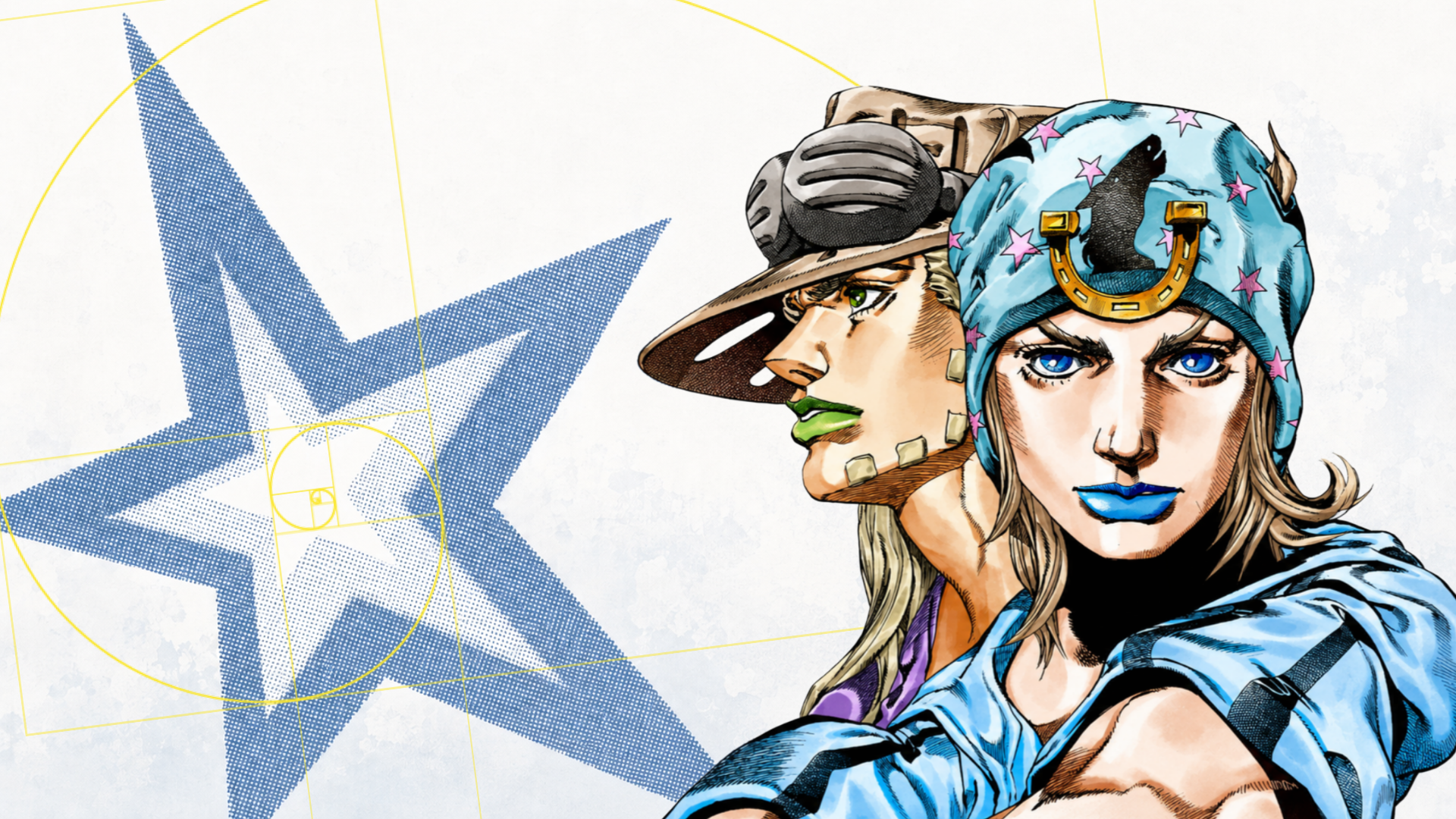
Ever since the melancholic strains of the original universe faded into the bittersweet horizon of Stone Ocean‘s finale, the collective anime zeitgeist has been consumed by a singular, deafening question: When will David Production saddle up for Steel Ball Run? Hirohiko Araki’s seventh installment isn’t merely another chapter in the generational saga of bizarre bloodlines; it stands across critical spaces as an untouchable monument of serialized manga. Ranked perpetually near the summit of MyAnimeList and held with sacred reverence by Western and Eastern audiences alike, JoJo’s Bizarre Adventure: Steel Ball Run is Araki’s undisputed western-supernatural magnum opus. Yet, as rumors churn across production channels and social feeds, the excitement is shadowed by a palpable sense of industry trepidation. Adapting this epic is not just a creative ambition—it is an unprecedented logistical gamble.
The Seinen Evolution: Araki’s Rebirth in the Dust of 1890 America
To understand the explosive fervor surrounding a potential anime adaptation, one must comprehend the monumental metamorphosis Part 7 represents within the franchise’s lineage. When serialized in 2004, the series originally masqueraded under the title Steel Ball Run, detached from the JoJo moniker. It was only when Araki transitioned serialization from the demographic constraints of Weekly Shonen Jump to the monthly, mature pastures of Ultra Jump in 2005 that the narrative truly uncoiled. Liberated from breakneck weekly deadlines and censorship guidelines, Araki redefined his craft.
Set against the sprawling, hostile canvas of a trans-continental horse race from San Diego to New York City, Steel Ball Run ditches the hyper-urban settings and theatrical corridors of earlier parts for sweeping, existential Americana. Across six thousand kilometers of burning desert, jagged canyons, and snow-choked forests, the race becomes an allegory for spiritual resurrection and historical reckoning. It weaves real-world American folklore, gritty period-piece realism, and the search for the scattered, sacred mummified remains of Jesus Christ into an audacious, genre-defying thriller.
Johnny Joestar and Gyro Zeppeli: Character Psychology at the Edge of Nihilism
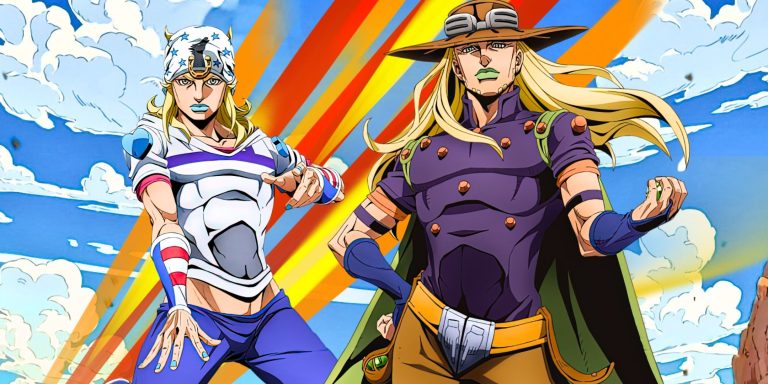
At the center of this sun-scorched odyssey is the most meticulously realized dynamic Araki has ever penned. The symbiotic partnership between Johnny Joestar and Gyro Zeppeli transcends the traditional shonen mentor-pupil archetype, operating instead as a shared therapeutic excavation of broken souls.
The Paraplegic Prodigy’s Dark Determination
Unlike Jonathan Joestar’s peerless chivalry or Jotaro Kujo’s stoic righteousness, Johnny Joestar enters the narrative as an embittered, fallen icon. Paralyzed from the waist down following a senseless, ego-driven tragedy, Johnny is defined by grief, spite, and what Araki famously terms “Dark Determination”—a terrifyingly pragmatic willingness to sacrifice morality for redemption. Johnny’s journey is unique in manga history: his growth is not an ascent toward righteous heroism, but an arduous clawing from negative to zero. When he witnesses Gyro’s mysterious kinetic spheres, his pursuit of mobility blossoms into a metaphysical pursuit of spiritual agency.
The Spin, the Golden Ratio, and the Zeppeli Redemption
Counterbalancing Johnny’s sullen introspection is Gyro Zeppeli, a disgraced Neapolitan royal executioner whose flippant humor, gold-capped grill, and operatic singing mask a crushing moral burden. Gyro carries the legacy of the Spin—a supernatural martial art rooted in the mathematics of the Golden Rectangle and the Fibonacci sequence. Unlike Hamon (Ripple), which felt tied to martial breathwork, the Spin operates as a cosmic physics engine. As Gyro mentors Johnny, teaching him to master the infinite rotational energy through evolutionary Stand iterations like Tusk, their bond matures into a profound brotherhood forged through mutual survival, shared absurdity, and emotional nakedness rarely afforded to male protagonists in battle manga.
The Technical Frontier: David Production’s Equestrian Nightmare
Why hasn’t Steel Ball Run received an immediate greenlight? The answer lies not in narrative hesitation, but in raw, brutal animation logistics: horses. Within the animation industry, quadrupeds—specifically horses—are widely regarded as the ultimate technical trial. Their complex muscular anatomy, rhythmic skeletal shifts during gallops, and shifting perspective planes make hand-drawn equestrian action notoriously time-consuming and financially prohibitive.
Consider the scale: Steel Ball Run features thousands of competitors charging through mud, water, and debris, often while engaged in close-quarters Stand combat. Renowned industry animators have long pointed to the prohibitive labor costs involved in rendering sustained, multi-angle equestrian combat in traditional 2D. For David Production—a studio lauded for its vibrant color-palette shifts, tactile sound effects, and hyper-stylized fidelity—tackling Part 7 requires an overhaul of their production pipeline.
Industry insiders speculate that the studio must navigate a delicate hybrid balance. The path pioneered by recent high-end productions involves utilizing specialized 3DCG rigs for the horses, blended seamlessly with traditionally drawn riders, detailed textures, and hand-animated Stand effects. If David Production can achieve the visual integration seen in works like Chainsaw Man or Studio Orange’s Trigun Stampede, they may clear the hurdle. If done haphazardly, the visual illusion collapses, along with decades of fan anticipation.
Philosophical Stakes: Funny Valentine and the First Napkin
Beyond the galloping hoofbeats, an adaptation’s success hinges on capturing its extraordinary antagonist: the 23rd President of the United States, Funny Valentine. Armed with his dimension-traversing Stand, Dirty Deeds Done Dirt Cheap (D4C), Valentine redefines the traditional JoJo villain. He is neither driven by Dio’s gleeful sadism nor Kira’s antisocial pathology. Instead, Valentine embodies an unyielding, dangerously messianic patriotism.
His iconic “first napkin” monologue remains one of the sharpest philosophical treatises in pop culture, exploring societal hegemony, authority, and who dictates the moral fabric of civilization. To watch Johnny’s desperate, morally compromised struggle clash against Valentine’s fanatical, self-righteous vision of national prosperity is to witness an ideological duel devoid of easy answers. Translating Valentine’s multi-layered dimensional warfare and moral ambiguity to the screen is the thematic crucible awaiting David Production’s writing room.
The Cultural Reckoning: Why the World Awaits
Online anime subcultures have treated the eventual Steel Ball Run anime as an inevitability, spawning fan animations, orchestral mockups, and voice-acting concepts that routinely garner millions of views across YouTube and TikTok. This is not casual curiosity; it is a profound cultural hunger. In an anime ecosystem increasingly saturated with predictable isekai tropes and uniform high-fantasy formulas, Steel Ball Run stands as an electrifying, uncompromising antidote: a gritty, sun-drenched, high-concept western featuring paraplegic gunslingers, dinosaur-morphing jockeys, golden-ratio mechanics, and geopolitical intrigue.
When the starting pistol finally fires and the trans-continental race kicks off on screen, it will not just mark the return of Araki’s masterwork—it will mark the dawn of an entirely new era for modern television anime. David Production stands before the ultimate hurdle. Now, all eyes are locked on the horizon, waiting for the horses to charge.
Are you holding out for a fully traditional 2D adaptation, or do you think modern 3D hybrids are the only way to do justice to the Steel Ball Run race? Drop your predictions below and tell us which voice actor you think can deliver Gyro’s iconic “Pizza Mozzarella” ballad!