Ever since the cosmic, melancholy reset that closed out JoJo’s Bizarre Adventure: Stone Ocean in late 2022, the international anime community has held a collective, suspended breath. For over a decade, David Production pulled off what critics once considered impossible: adapting Hirohiko Araki’s genre-defying, multi-generational saga with kinetic visual reverence, idiosyncratic color-palette flips, and an unflinching dedication to Araki’s high-fashion absurdity. Yet, all five preceding TV sagas feel like mere preludes to the monolith looming on the horizon: Steel Ball Run.
Currently resting in the stratosphere of MyAnimeList’s top-rated manga of all time—often swapping positions with Kentaro Miura’s Berserk—Steel Ball Run (Part 7) is not just another sequel; it is Araki’s undisputed magnum opus. Moving from the hyper-stylized streets of Naples and prison cells of Florida to the unforgiving dust of a late-19th-century trans-American horse race, this cross-continental epic reinvented the franchise from the ground up. As whispers, trademark filings, and unconfirmed production rumors ripple through the industry, the cultural demand for David Production to pick up the reigns has reached a fever pitch. But bringing this western-supernatural behemoth to the screen presents the studio with its most treacherous technical and artistic frontier yet.
The Seinen Renaissance: How Araki Rebuilt JoJo from the Dust of 1890
To understand the sheer magnitude of the Steel Ball Run hype, one must understand its historical pivot within Araki’s career. Debuting in 2004 in Weekly Shonen Jump before migrating to the monthly seinen magazine Ultra Jump in 2005, Part 7 freed Araki from the grueling weekly deadline grinder. The transition allowed his linework to evolve into something approaching Renaissance anatomical study, drenched in high-fashion silhouette and cinematic grit.
Set in an alternate continuity distinct from the Phantom Blood–Stone Ocean timeline, Steel Ball Run centers on the eponymous cross-country equestrian race: a 4,000-mile, winner-take-all sprint from San Diego Beach to New York City with a staggering $50 million purse. Behind this spectacle lies an audacious blend of historical fiction, occult conspiracies, and cutthroat frontier survivalism. Araki stripped away the safety nets of standard battle manga, trading urban skirmishes for dehydration, hypothermia, ambushes in the Rocky Mountains, and the grim reality of pioneer-era violence.
From Hamon to the Golden Ratio: The Physics of the Spin
While Stands naturally make their return, they are filtered through an entirely different metaphysical discipline: the Spin. A kinetic spiritual successor to the solar-powered Hamon of early JoJo, the Spin is rooted in Renaissance mathematics, Fibonacci sequences, and the Golden Rectangle. Characters harness perpetual rotational energy through specialized steel spheres, using rotational friction to manipulate human anatomy, bend light, and pierce dimensional barriers. This mechanical elegance gives the battles of Part 7 an almost scientific, visceral weight that radically separates it from the punch-ghost showdowns of Stardust Crusaders.
The Dark Horse and the Executioner: Character Psychology at Its Peak
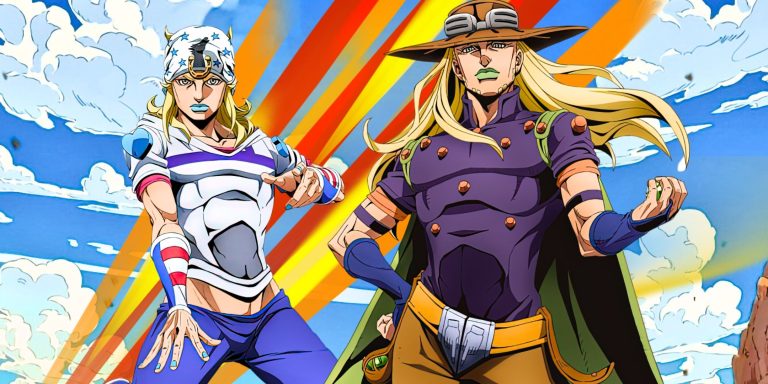
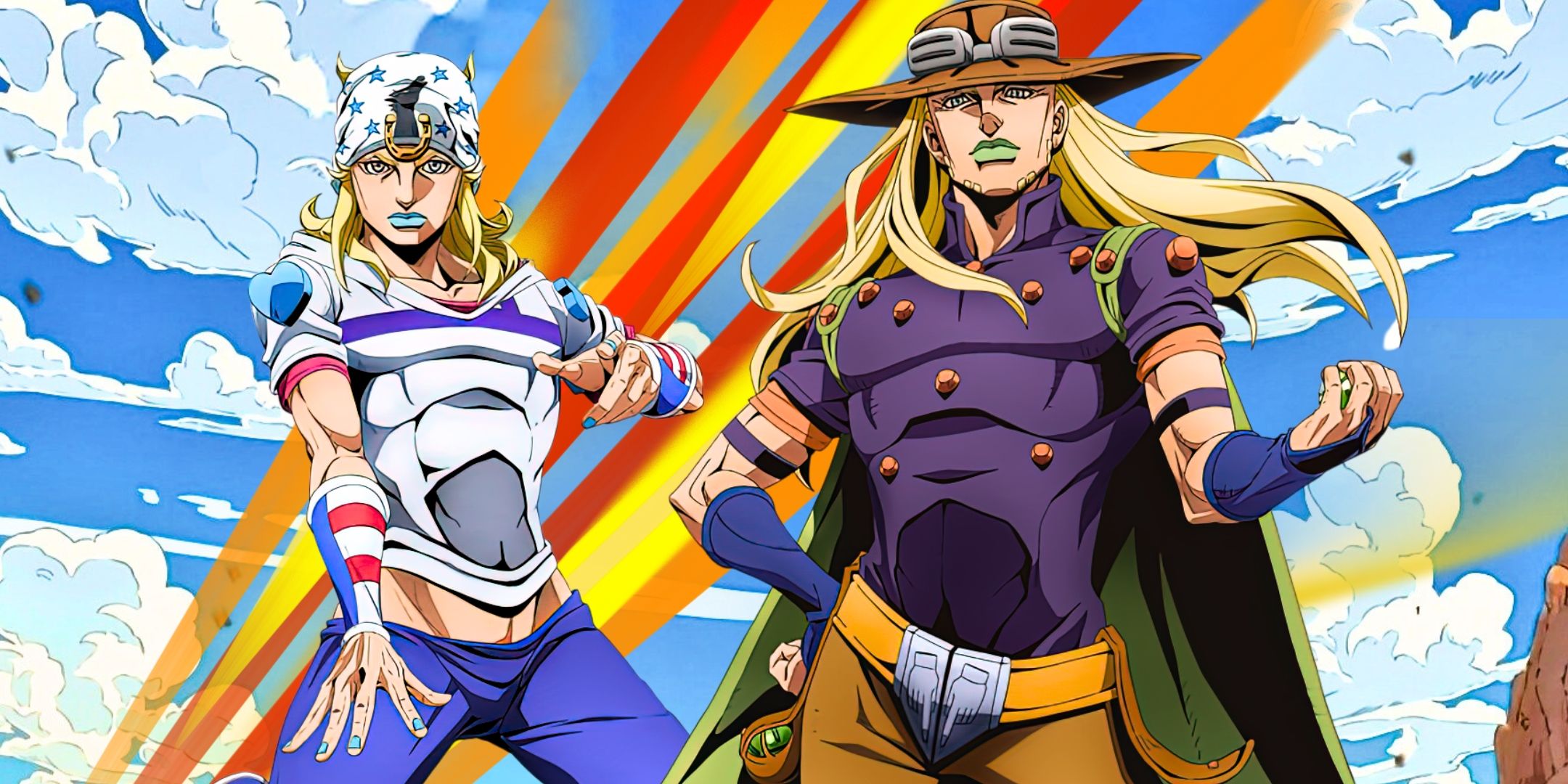
At the beating heart of Steel Ball Run is what many manga historians consider the finest duo dynamic Araki has ever penned: Johnny Joestar and Gyro Zeppeli.
Johnny is a subversion of every traditional shonen protagonist. A former child prodigy jockey paralyzed from the waist down due to his own youthful arrogance, Johnny begins the story not as a beacon of justice, but as a bitter, washed-up shell of a man. He joins the race not for glory or national pride, but out of raw, desperate obsession: after touching Gyro’s spinning steel ball, his legs momentarily twitch. His evolution throughout the race is defined by a ruthless, borderline-antagonistic willingness to kill—what Araki famously characterizes as “dark determination.” Johnny does not seek to become a hero; he simply wants to lift his soul from a negative state back to absolute zero.
Balancing Johnny’s brooding, morally gray intensity is Gyro Zeppeli, a disgraced Neapolitan royal executioner who enters the race on an ideological quest to win clemency for an innocent boy sentenced to death. Gyro is an intoxicating blend of Araki eccentricities: gold-capped teeth carved with the words “GO! GO! ZEPPELI,” a penchant for nonsensical musical compositions about cheese, and an unmatched mastery of the executioner’s Spin. Their camaraderie unfolds with organic warmth through endless campfire banters and mutually life-or-death duels, forging an emotional anchor that makes the inevitable heartbreak of their journey hit harder than any tragedy previously depicted in the franchise.
The 4,000-Mile Technical Nightmare: The Equestrian Animation Hurdle
If Steel Ball Run is universally celebrated as a narrative masterpiece, why hasn’t an anime adaptation already dropped? The answer comes down to four legs, thousands of frames, and the most notorious curse in the Japanese animation pipeline: animating horses.
In traditional 2D animation, quadrupedal motion—specifically the complex, skeletal mechanics of a galloping horse—is notoriously labor-intensive and prohibitively expensive. Even seasoned studios like Wit Studio and MAPPA had to resort to clever camera angles and selective CGI to handle cavalry charges in Attack on Titan and Vinland Saga. In Steel Ball Run, the horses are not peripheral vehicles; they are central characters that must emote, navigate complex terrain, sustain realistic injuries, and maintain high-speed chases across thousands of consecutive scenes.
David Production faces a profound dilemma:
Relying exclusively on full 2D hand-drawn animation for dozens of named horses over an anticipated 36 to 48 episodes would obliterate standard television production schedules and risk crushing crunch for key animators. Conversely, poorly integrated 3D CGI models could completely shatter the tactile, grit-and-sweat aesthetic that fans hold sacrosanct. For an adaptation of Steel Ball Run to succeed, David Production will likely have to pioneer an unprecedented hybrid pipeline—combining sophisticated, cell-shaded 3DCG rigs for base galloping mechanics with hand-drawn, illustrative corrections and Araki-style crosshatching on top.
Manifest Destiny and Sacred Relics: Funny Valentine’s Sovereign Threat
No analysis of Steel Ball Run is complete without acknowledging its geopolitical backdrop and its towering antagonist: the 23rd President of the United States, Funny Valentine. Possessing the mind-bending Stand known as D4C (Dirty Deeds Done Dirt Cheap), Valentine can move seamlessly between parallel realities by pressing himself between two objects.
Driven by an unyielding, zealous belief in American exceptionalism, Valentine’s objective is to assemble the scattered mummified remains of a supernatural figure (heavily implied to be Jesus Christ) hidden across the continent. Whoever controls the Saint’s Corpse will grant their homeland absolute prosperity while diverting all misfortune to the rest of the world. Valentine’s philosophy—summed up in his iconic monologue about “taking the first napkin”—elevates him above common anime villainy into a terrifying portrait of patriotic fundamentalism. The clash between Johnny’s individualistic pursuit of redemption and Valentine’s collectivist, imperialist ambition yields one of the most intellectually thrilling climaxes in modern manga.
The Horizon Ahead: Will David Production Answer the Call?
David Production has proven time and again that their reverence for Hirohiko Araki’s work runs deeper than mere contractual obligation. Their adaptations are love letters constructed by fans, for fans. Yet, taking on Steel Ball Run is the studio’s Mount Everest. It demands immense budget allocations, technical reinvention, and a visual fidelity worthy of the manga’s storied legacy.
The buzz surrounding Part 7 is not fleeting fan impatience; it is the collective recognition that when this adaptation finally crosses the starting line, it has the potential to redefine what high-tier prestige anime looks like for an entire decade. Until the official greenlight echoes out from Warner Bros. Japan, fans will continue studying the Golden Ratio, polishing their steel spheres, and waiting for the starting gun to fire.
Are you hoping for pure hand-drawn grit or cutting-edge hybrid CGI for the horses of Steel Ball Run? What voice actor could possibly capture Gyro Zeppeli’s operatic absurdity? Let your voice be heard in the comments below, and stay tuned to Wibux.com for breaking updates on the next frontier of JoJo’s Bizarre Adventure!