

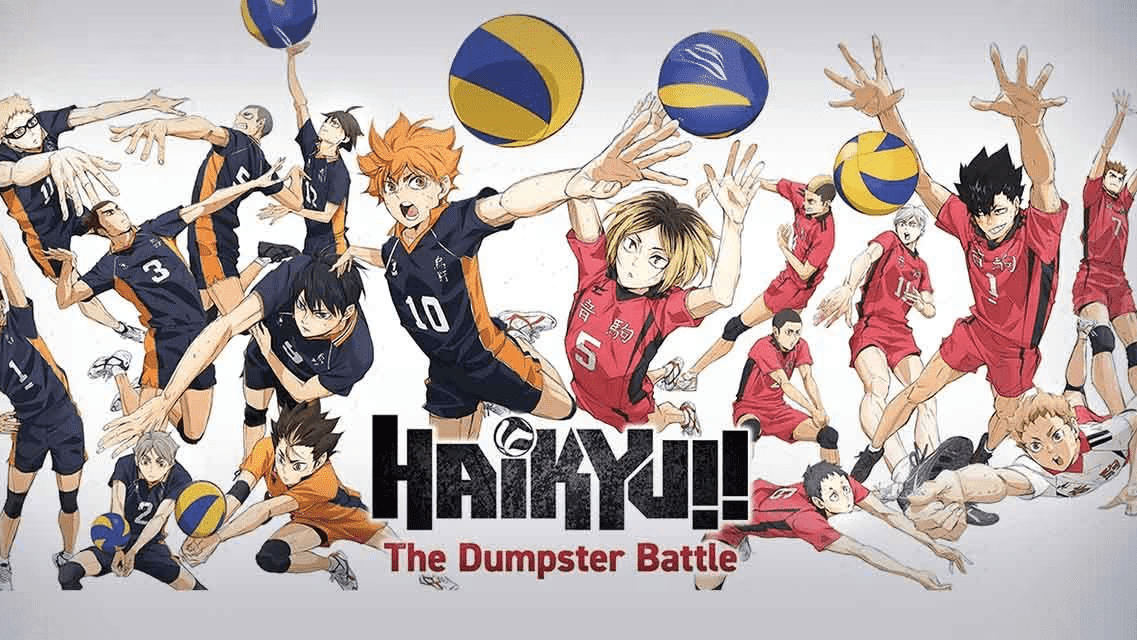
For nearly a decade, the promise of the “Battle at the Garbage Dump” lingered over the sports anime landscape like an unresolved myth. Ever since Shoyo Hinata and Kenma Kozume exchanged quiet, curious glances over a chain-link fence in suburban Tokyo back in 2014, Haikyu!! fans knew that this specific clash carried an emotional gravitas distinct from any tournament bracket. Now, after shattering box-office records across Japan and dominating worldwide theatrical runs, Haikyu!! The Dumpster Battle (Gekijōban Haikyu!! Gomi Suteba no Kessen) has officially touched down on global streaming platforms. The verdict is not merely that it lives up to the monumental hype—it cements Karasuno versus Nekoma as the definitive sports anime rivalry of the modern era.
Where most shonen athletics narratives build their foundational tension upon personal animosity, revenge, or existential stakes, The Dumpster Battle is a masterclass in affectionate warfare. There are no villains here. There is only an eight-year cinematic promise, a ticking clock on high school careers, and the agonizing truth that, unlike their countless practice matches across the hot summer training camps, this game has no “one more set.”
A Rivalry Carved in History: The Match With No Second Chances
To understand why this match hits with such ferocious emotional resonance, one has to look past the scoreboard and examine the generational tapestry Haruichi Furudate wove into the hardwood. The rivalry between Karasuno and Nekoma didn’t begin with Hinata and Kenma, nor did it begin with Tobio Kageyama and Tetsuro Kuroo. It began decades earlier in the weathered memories of former coaches Ikkei Ukai and Yasufumi Nekomata—two men who chased an official national match against each other for a lifetime, only to pass that unrealized dream down to their grandsons and protégés.
When the whistle blows at the Tokyo Metropolitan Gymnasium, the weight of that legacy is palpable. Yet, director Susumu Mitsunaka treats this historic weight not as a somber obligation, but as an electric, celebratory dance. In the tournament arc, every elimination match carries the grim threat of a senior’s athletic mortality. With Nekoma, however, the anxiety transforms into a desperate, beautiful desire to prolong the rally. Karasuno’s wild, airborne offense—a chaotic flurry of minus-tempo tosses and synchronized attacks—crashes against Nekoma’s impenetrable floor defense like waves breaking against a cliff. It is an ideological duel between perpetual evolution and absolute persistence.
The Architect vs. The Monster: Kenma’s Suffocating Trap
At the center of this theatrical sprint lies the psychological chess match between Karasuno’s boundless decoy, Shoyo Hinata, and Nekoma’s apathetic brain, Kenma Kozume. If Hinata is the sun around which Karasuno orbits, Kenma is the eclipse that methodically snuffs him out. The Dumpster Battle allocates an extraordinary amount of its 85-minute runtime to Kenma’s interiority, framing volleyball not as a romantic passion, but as an intricate, suffocating algorithm.
The Deconstruction of Karasuno’s Engine
Kenma does not attempt to physically overpower Hinata; he starves him. By weaponizing directional serving and manipulating Karasuno’s passing lanes, Nekoma systematically denies Hinata his launchpad. Watching Hinata’s runway slowly shrink is one of the most agonizing sequences Production I.G has ever committed to celluloid. The visual metaphor of a crow locked inside an iron birdcage isn’t just poetic flair—it translates the sheer claustrophobia of elite athletic containment.
Yet, the narrative brilliance of Furudate’s writing lies in Hinata’s retaliation. Rather than overcoming the cage through a superhuman power-up, Hinata and Kageyama solve the problem with technical adaptation: the high, floating open toss. By trading blinding velocity for soaring height, Hinata doesn’t just break the cage—he climbs above the ceiling, jumping purely for the unadulterated joy of flight. The film brilliantly frames this breakthrough not as an act of defiance, but as an invitation to play, dragging Kenma into an arena of uncalculated, raw exertion.
Cinematic Transcendence: The Visceral Genius of Production I.G
Condensing an entire 33-chapter manga match into an 85-minute feature film was met with justified skepticism from purists. How could a production house possibly honor the agonizing micro-adjustments of a three-set war without gutting its pacing? The answer lies in Susumu Mitsunaka’s kinetic, relentless direction and the god-tier animation pedigree of Production I.G’s athletic unit.
The First-Person Sequence That Redefined Sports Direction
Nothing in modern anime history prepares the viewer for the final rally of the third set. As the players reach the threshold of physical collapse, the camera plunges directly into Kenma’s first-person perspective. The screen blurs with sweat, heavy breath rattles through the sound design, the court stretches and bends under sheer exhaustion, and the ball feels unbearably heavy. The viewer does not watch the play; they endure it.
By trapping the audience inside Kenma’s oxygen-deprived field of vision, the film strips away the romantic glamour of athletics and lays bare its brutal, kinetic truth. Every dig from Morisuke Yaku, every desperation dive from Yu Nishinoya, and every lung-burning rotation lands with physical, concussive force. It is arguably the most immersive, visually daring three minutes of sports animation produced in the 21st century.
“Kuro, Thank You for Teaching Me Volleyball”: The Heartbeat of the Dumpster
For all of its blistering rotational speed, the true triumph of The Dumpster Battle belongs to its character resolutions. The bond between Kuroo and Kenma has always been the emotional anchor of Nekoma High. Kuroo, the boisterous captain who dragged his introverted neighbor out of a dark bedroom to bump volleyballs on concrete, spent years hoping Kenma would find meaning in the game.
Throughout four television seasons, Kenma’s defining trait was detached indifference. He played volleyball because he was good at it, because his friends were there, and because it was simply a task to complete. But as the match slips away on a tragically unceremonious anticlimax—a ball slipping through sweat-slicked fingers rather than an earth-shattering spike—the silence of the court gives way to the single most devastating moment in the franchise.
Kenma looks up at Kuroo, gasping for air, clutching his knees, and delivers the line that shatters the fandom’s collective tear ducts: “Kuro, thank you for teaching me volleyball. It’s fun.” It is a moment of pure, transcendent sportsmanship that recontextualizes the entire film. Karasuno wins the scoreboard, but Kuroo wins his brother’s heart. In that quiet exchange, the score ceases to matter; the game itself is the victory.
The Verdict: The Gold Standard for Modern Anime Adaptations
As Haikyu!! The Dumpster Battle settles into its streaming era, it stands tall not just as a triumphant capstone to a decade-long sports narrative, but as an artistic benchmark for theatrical anime adaptations. While some fans may still lament the loss of incidental side-character dialogue from the manga, the cinematic focus gained from trimming the fat turns this encounter into a sleek, emotionally devastating freight train.
It honors the foundational thesis of sports: that competing against someone at their absolute peak is the highest form of respect. As Karasuno advances to the quarter-finals to face Korai Hoshiumi and the defensive iron wall of Kamomedai in the upcoming finale, The Dumpster Battle leaves an indelible footprint on our collective conscience. It reminds us why we fell in love with a group of fictional boys chasing a leather ball across an orange court—because for an hour and a half, Production I.G makes you feel like volleyball is the only thing that matters in the universe.
Over to you, Wibux readers: Did Kenma’s POV sequence leave you as breathless as it did us? Do you think the movie format did justice to the manga’s pacing, or would you have preferred a full television cour? Drop your thoughts, analysis, and favorite moments in the comments below!