

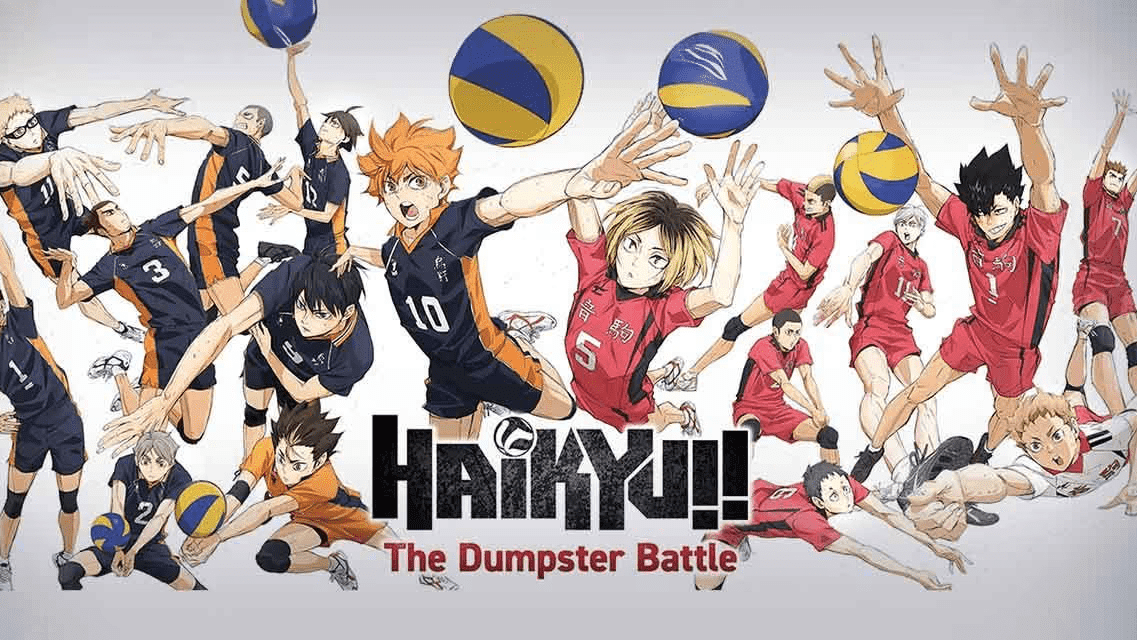
Few matchups in anime history carry the sheer emotional, narrative, and historical gravity of Karasuno High versus Nekoma High. Whispered about across decades of generational rivalry—sparked by the legendary rivalry of former coaches Ikkei Ukai and Yasufumi Nekomata—the promised clash at the Tokyo Orange Court was never just a game. It was a mythology waiting to be fulfilled. Now, following a thunderous, record-breaking theatrical run that crossed the 10-billion-yen milestone in Japan, Haikyu!! The Dumpster Battle has officially hit global streaming platforms, inviting fans worldwide to bear witness to what might be the definitive pinnacle of modern sports anime storytelling.
For fans who grew up alongside Shoyo Hinata and Tobio Kageyama, this isn’t merely another tournament fixture on the path to a national championship. It is the convergence of everything Haruichi Furudate painstakingly crafted over eight years of serialization: a clash where animosity is discarded entirely in favor of an agonizing, beautiful love letter to the sport itself. Directed by returning maestro Susumu Mitsunaka, the film operates not just as a cinematic spectacle, but as an existential thesis on passion, youth, and the heartbreaking finality of the game.
The Match Without a “Next Time”: Redefining Shonen Stakes
Shonen sports narratives traditionally manufacture tension through clear-cut antagonists or the existential terror of sudden-death elimination. Think of Karasuno’s harrowing clashes against the domineering force of Ushijima Wakatoshi or the calculated vengeance against Toru Oikawa’s Aoba Johsai. In those battles, Karasuno fought to survive; defeat meant stagnation, while victory meant asserting their right to exist among the volleyball elite.
The “Battle at the Garbage Dump” operates on an entirely different emotional frequency. Karasuno and Nekoma do not harbor malice toward one another. Instead, they share mutual reverence. From their impromptu practice matches in early seasons to the grueling summer training camps in Tokyo, these two squads built one another from the ground up. Nekoma polished Karasuno’s jagged offensive edges; Karasuno forced Nekoma’s ironclad defense to evolve beyond its mechanical limits.
The tragedy—and ultimate beauty—of this clash lies in its absolute finality. In practice games, no matter who collapsed onto the hardwood floor, someone would invariably yell: “One more set!” But on the national stage, under the merciless glare of television broadcast lights, there is no “next time.” For the third-years like Tetsuro Kuroo, Morisuke Yaku, Daichi Sawamura, and Asahi Azumane, defeat marks the end of their high school sporting lives. This emotional undercurrent elevates every dig, every block, and every spike into a desperate plea against the dying of the light.
Kenma Kozume’s Digital Cage: The Psychological Chess Match
While the match is an ensemble showcase, its narrative and thematic axis spins entirely around Nekoma’s brain: the brilliant, chronically detached setter, Kenma Kozume. Kenma represents the antithesis of the typical shonen protagonist. He does not play for passion, glory, or athletic validation; he plays because it is simply something he happens to do, approaching each point like a challenging tactical puzzle game to be solved and discarded.
Clipping the Crow’s Wings
Kenma’s strategy against Karasuno’s explosive “freak quick” is an absolute masterclass in psychological warfare. Understanding that Hinata’s true threat lies not in his height, but in his boundless, instinctual momentum, Kenma slowly suffocates him. By strategically placing roll shots, angling hits toward boundary lines, and manipulating Karasuno’s receive formations, Kenma systematically deprives Hinata of his runway.
The visual metaphor Mitsunaka deploys here is suffocating: Hinata is repeatedly framed within narrowing corridors, shadows cast across his face, his wings physically clipped by an invisible digital cage. Hinata isn’t just stopped at the net—he is neutralized mentally, forced into stationary jumps that strip him of his vertical supremacy. For two-thirds of the film, Nekoma achieves the impossible: they make the volleyball court feel genuinely claustrophobic.
The Breakthrough and the Elusive “Tanoshii”
Yet, true to the core philosophy of Haikyu!!, starvation breeds evolution. Hinata’s escape from the cage—orchestrated through Kageyama’s audacious four-meter high open set that grants Hinata the space to jump out of the shadows—serves as the catalyst for Kenma’s personal metamorphosis. The relentless, irrepressible hunger of the little giant forces Kenma past the boundary of intellectual curiosity into visceral, exhausting engagement. When Kenma finally looks up from the sweat-drenched floor and admits, “Tanoshii” (It’s fun), the entire franchise achieves its emotional zenith. Kuroo’s years-long endeavor to share his love for the game with his introverted best friend is realized in that single, exhausted gasp.
Production I.G’s Kinetic Triumph: Mitsunaka’s Visual Language
The return of director Susumu Mitsunaka, who helmed the anime’s critically lauded first three seasons, was widely anticipated, but the visual direction here supersedes expectations. Following the visually inconsistent fourth season, Production I.G pulled out all cinematic stops, prioritizing raw, kinetic dynamism over rigid, static model perfection.
The crowning achievement of the film—and perhaps the year in anime animation—arrives in its climatic rally: a breathless, unedited first-person sequence shot entirely from Kenma Kozume’s perspective. As the rally stretches on past human endurance, the audience is plunged directly behind Kenma’s eyes. We see his sweaty, disheveled bangs clinging to his forehead; the camera swivels frantically, struggling to track the blisteringly fast ball; the audio mixes heavy, choked breathing over the rhythmic squeaking of rubber soles on hardwood.
It is an overwhelming, visceral sequence that conveys the sheer, punishing physical reality of professional sports. You do not just watch the rally unfold from a detached broadcast perspective; you experience the burning in Kenma’s lungs, the sweat stinging his eyes, and the sheer terror of Karasuno’s synchronized assault descending on him like a murder of crows.
Why The Dumpster Battle Is Sports Anime Perfection
What solidifies The Dumpster Battle as an immortal classic of the sports genre is its structural elegance. It abandons prolonged flashback sequences that interrupt momentum, choosing instead to thread character history directly into the flow of the rally. Every dig performed by Yaku or Nishinoya carries the visual echo of their endless hours in gym basements. Every block coordinated by Kuroo and Kei Tsukishima acts as a dialogue between master and apprentice.
The end of the match is famously anti-climactic by design: a sweaty ball slipping through Kenma’s exhausted fingers. No dramatic block, no line-painting service ace—just gravity, exhaustion, and human error ending a dream. The post-game exchange between the two teams, highlighted by Kuroo thanking his mentor Nekomata for teaching him volleyball, strips away all competitive friction, leaving only pristine gratitude in its wake.
Haikyu!! The Dumpster Battle proves that sports anime does not require superpowered abilities or melodrama to grip the soul. By honoring its characters’ humanity, technical authenticity, and psychological intricacies, the film turns a standard third-round tournament clash into an unforgettable monument of cinematic storytelling.
Now that the film is available globally on streaming, where does the Karasuno vs. Nekoma showdown rank among your all-time favorite anime battles? Did Kenma’s first-person sequence live up to the hype, or are you bracing yourself for the impending emotional devastation of the Kamomedai match? Let us know your thoughts in the comments below!