
When Sucker Punch Productions unveiled Ghost of Yōtei, the collective pulse of the gaming sphere spiked. Rather than chaining themselves to the safe harbor of Jin Sakai’s lingering legend, the Bellevue studio made a daring ludonarrative pivot: vaulting forward over three centuries to 1603, setting their sights on the untamed northern frontier of Ezo (modern-day Hokkaido), and handing the scabbard to a fierce new protagonist named Atsu. At the epicenter of this seismic transition lies Mount Yōtei—a silent, snow-crested monolith watching over an era where the samurai mythos was violently transforming. By ditching the structured, clan-bound battlegrounds of Tsushima for an anarchic wilderness, Sucker Punch is doing far more than swapping biomes; they are dismantling and reconstructing the mechanics of cinematic swordplay from the edge of the blade outward.
The Frontier Shift: Stripping Away the Samurai Aristocracy
Jin Sakai’s tragedy was rooted in the agony of breaking a sacred, generational code—the deliberate sacrifice of his noble identity to become a shadow in the dirt. But in Ezo at the dawn of the Edo period, that aristocratic social contract simply does not exist. Ezo sat far beyond the bureaucratic reach of the newly minted Tokugawa Shogunate. It was an untamed, lawless territory populated by rugged outlaws, indigenous Ainu communities, desperate ronin, and opportunistic mercenaries. Atsu, therefore, does not carry the spiritual baggage of a high-born lord weeping over his family’s honor; she moves through this frozen world with the sharp, ruthless pragmatism of an apex survivalist.
This tonal recalibration bleeds directly into the gameplay architecture. Where Ghost of Tsushima balanced its combat around rigid, historical stances designed to dismantle specific Mongol weapon archetypes, Ghost of Yōtei embraces a lethal, improvisational chaos. Combat encounters here are less like choreographed court duels and more akin to the visceral, dirt-and-blood brawls championed by mid-century chambara cinema and Sergio Leone spaghetti westerns. Atsu is not fighting to uphold a dynasty—she is fighting to survive an unforgiving expanse where every encounter can be terminated with a single, brutal miscalculation.
Twin Blades and Black Powder: Deconstructing Atsu’s Arsenal
The gameplay tease presented a radical shake-up of the player’s mechanical toolkit. Gone is the singular reliance on the Sakai family katana. In its place stands an evolved combat framework defined by multi-weapon agility, asymmetric loadouts, and the disruptive introduction of gunpowder.
Dual-Wielding Lethality: The Nito-Ryū Evolution
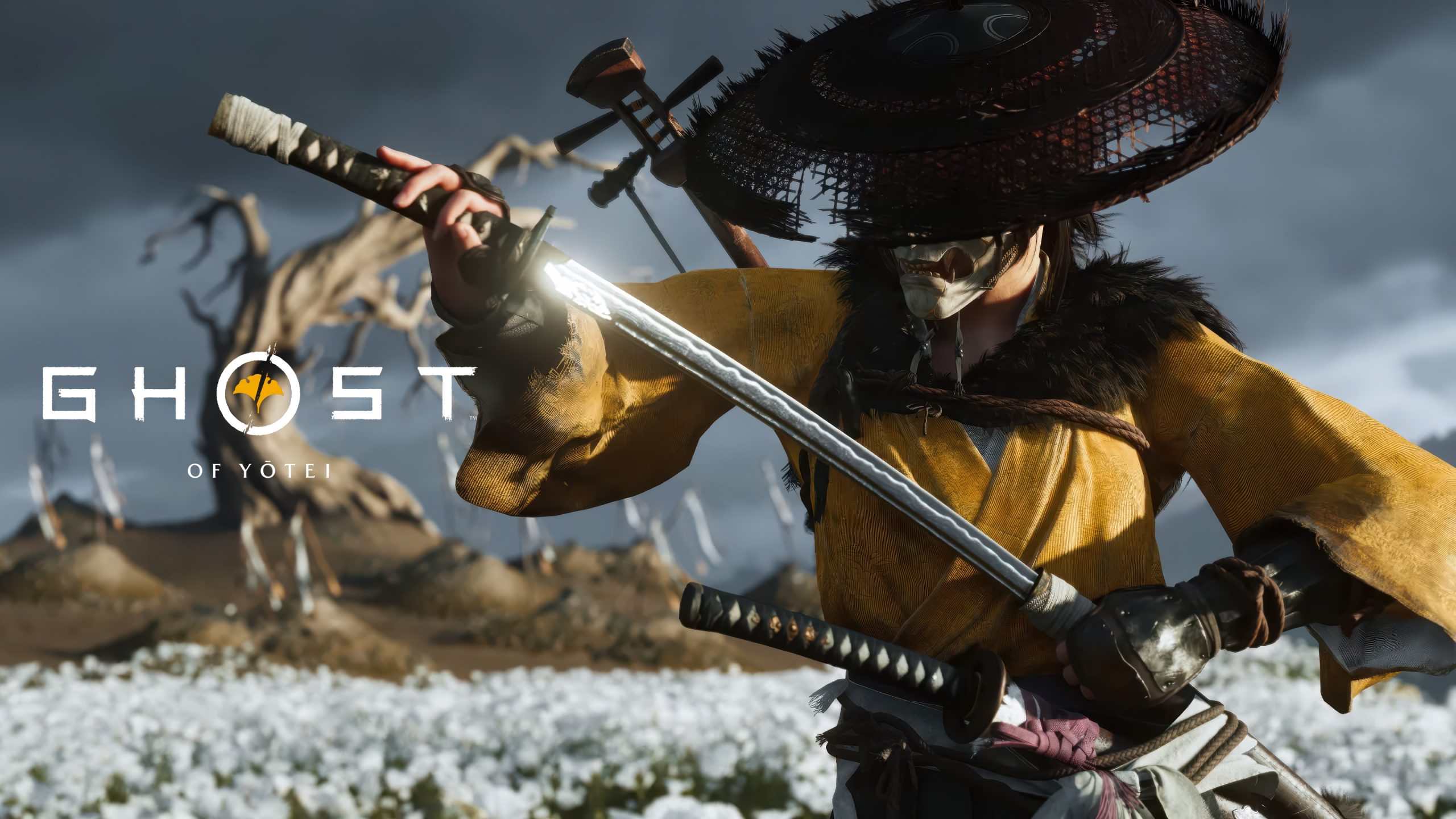
The visual of Atsu drawing twin blades isn’t mere rule-of-cool posturing; it signals a fundamental overhaul of Sucker Punch’s stagger and parry systems. Drawing clear inspiration from the legendary dual-sword techniques popularized by Miyamoto Musashi during this exact historical epoch, Atsu’s nito-ryū stance introduces a bifurcated attack rhythm. Players must coordinate simultaneous offensive pressure and defensive deflection:
One blade maintains relentless crowd-control against surging raiders, while the second acts as an opportunistic scalpel waiting for micro-openings in enemy guard postures. Early mechanical analysis suggests that dual-wielding alters parry windows, rewarding precise timing with devastating counter-ripostes that carve through multiple targets in a single fluid arc, rather than locking the camera into one-on-one skirmishes.
The Matchlock Paradigm: Parrying the Bullet
Perhaps the most electrifying revelation is the integration of the tanegashima (matchlock firearm) alongside traditional weaponry. In the 1600s, firearms had irreversibly transformed Japanese warfare, and Ghost of Yōtei embraces their presence with kinetic bravado. The frontier combat sandbox is no longer exclusively melee-focused; players face roving bands of marksmen capable of breaking defenses from afar.
Rather than treating the gun purely as a secondary stealth gadget, Sucker Punch seamlessly weaves firearms into the flow of active combat. Atsu can dynamically switch from mid-combo sword slashes directly into point-blank black-powder discharges, blowing through armored opponents before chaining back into an evasive dodge. More intriguingly, leaks and gameplay breakdowns point toward high-risk, frame-perfect firearm deflections—allowing players to parry or redirect incoming ballistic fire through precise blade manipulation, fundamentally redefining spatial awareness in combat arenas.
Animation Pedigree: The Physics of Snow and Steel
What cemented Ghost of Tsushima as a modern classic was its animation fluidity, but Ghost of Yōtei pushes this visual language into absolute hyper-realism courtesy of the PlayStation 5’s dedicated architecture. The kinetic weight of Atsu’s movements reflects the sheer hostility of her environment. Footing matters. In deep alpine snowdrifts, dodge maneuvers become heavier, demanding deliberate spatial management; on slick, frozen lakebeds, balance shifts, allowing for faster slide-attacks at the expense of recovery time.
The micro-animations on display elevate the tactile thrill of each clash. Sucker Punch has clearly spent years obsessing over weapon friction, blade-binding physics, and kinetic follow-through. When Atsu locks swords with an enemy, you can see the flex of tempered steel and the desperate shift in center-of-gravity before an execution stroke is dealt. Blood splatters dynamically stain the untrammeled snow, while the particulate simulation of drifting volcanic ash from Mount Yōtei catches the ambient moonlight, creating a hyper-stylized stage for every execution.
Beyond the Guiding Wind: Atmospheric Evolution on PS5
The beloved “Guiding Wind” navigation system was a triumphant answer to the cluttered mini-maps of modern open-world game design, and Ghost of Yōtei looks to expand that organic philosophy through environmental biome diversity. The rugged ecosystem surrounding Mount Yōtei alternates between biting tundra, dense coniferous woodlands, boiling geothermal springs, and sweeping floral lowlands.
Leveraging the PS5’s Tempest 3D Audio and advanced DualSense haptics, the environment itself becomes an extension of the combat radar. Players can feel the sub-surface vibration of distant cavalry through the controller grips, while the directional crunch of packed ice alerts them to flankers long before visual prompts appear on screen. The dynamic weather system is not just cosmetic; blinding blizzards dynamically alter enemy sightlines, allowing Atsu to slip through encampments like a vengeful specter, using the whiteout as both a shroud and a weapon.
Fandom Friction and the Inevitable Ghost Legacy
As with any sequel that boldly retires a beloved protagonist, Atsu’s introduction triggered pockets of debate across the gaming community. Yet, the overwhelming critical and narrative consensus recognizes the genius of this evolutionary leap. Jin Sakai’s arc reached a poetic, definitive conclusion; to drag him north would have cheapened his sacrifice and turned the franchise into a serialized anime trope.
By framing the “Ghost” not as an individual person, but as a recurring, mythological archetype that rises whenever Japanese society fractures and the innocent are left unprotected, Sucker Punch has forged an anthology format with limitless storytelling potential. Atsu represents a raw, unpolished, and thoroughly dangerous evolution of that myth—a ronin born of a lawless age who fights with neither the blessing of a lord nor the comfort of an ancestral estate.
Verdict: The Dawn of a Darker, Sharper Legend
Ghost of Yōtei isn’t playing defense. By marrying complex dual-weapon choreography with explosive matchlock lethality, setting the stakes in an untamed historical frontier, and grounding the narrative in the fiercely expressive journey of Atsu, Sucker Punch is crafting a game that promises to surpass its predecessor in both mechanical depth and cinematic swagger. Feudal Japan has never looked this perilous—nor has the blade ever felt this sharp.
Are you ready to trade the bamboo groves of Tsushima for the frozen slopes of Mount Yōtei? Which weapon combinations are you itching to master when Atsu’s journey begins? Drop your combat theories and loadout wishlists in the comments below!