

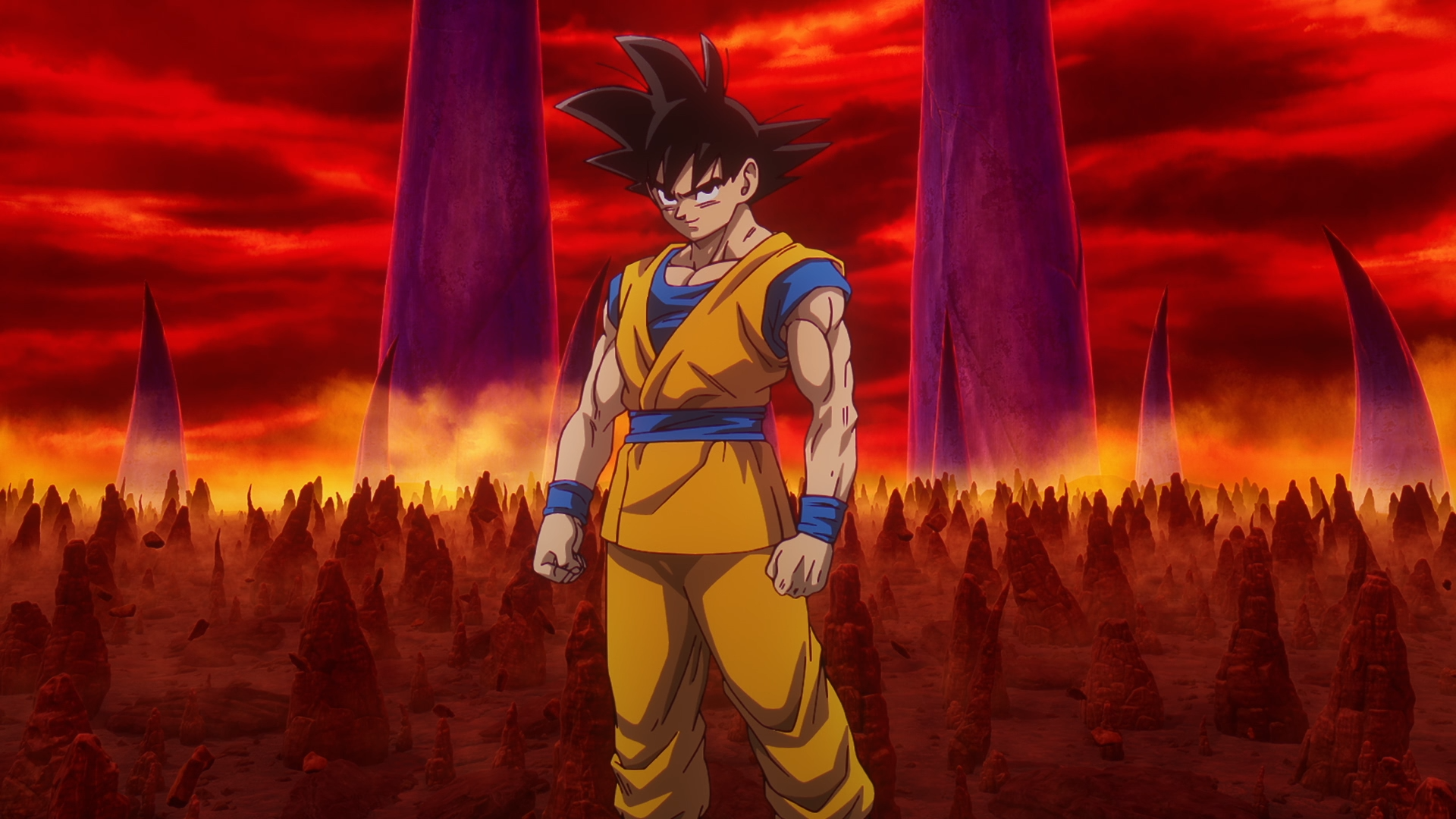
When the opening chords of Dragon Ball Daima struck during its worldwide premiere, the anime community collectively held its breath. This wasn’t merely the launch of another serialized shonen adventure or a routine franchise continuation designed to shift Bandai Namco merchandise. It was something infinitely more profound, coated in a bittersweet resonance: the final, fully realized creative vision of Akira Toriyama. Premiering in the celebratory wake of the franchise’s 40th anniversary, Daima does not merely coast on nostalgia. Instead, it radically recalibrates the entire narrative DNA of Dragon Ball, pivoting away from the multiversal, god-tier escalation of Dragon Ball Super to deliver an intimate, whimsical, yet astonishingly kinetic descent into uncharted lore.
For years, the fandom argued over power levels, divine auras, and hair-color transformations. Yet Toriyama’s parting gift boldly ignores the arms race, taking Goku and company back to the fundamentals: curiosity, high-stakes martial arts, and the lingering mysteries hidden in the obscure margins of his fictional universe. The premiere episode wastes zero time establishing its tone, serving as both a narrative bridge and an aggressive artistic statement that proves the master’s touch was as sharp at the end as it was when a young monkey boy first met an ambitious girl with a radar in 1984.
The Ghost in the Machine: Toriyama’s Uncompromising Lore Expansion
The standout revelation of Daima’s premiere is how heavily it leans into connective tissue that long-time fans have obsessively debated for decades: the Demon Realm (Makai). While non-canon video games like Super Dragon Ball Heroes and Dragon Ball Online previously dipped their toes into demonic dimensions, Toriyama completely rewrites the taxonomy of this subterranean universe with signature narrative flair.
The episode brilliantly contextualizes its catalyst around the immediate fallout of the Majin Buu saga. Rather than introducing a world-ending entity capable of obliterating galaxies with a stray finger flick, the story introduces King Gomah and his subservient, schemer-in-chief Degesu. These aren’t cosmic tyrants; they are opportunistic bureaucratic usurpers panicking over the vacuum left by Dabura’s destruction. Gomah watching archival footage of the Earthlings conquering Buu via a mystical surveillance orb is a stroke of Toriyama comedy blended with existential dread—a grounded, charmingly petty inciting incident.
Unraveling the Mysteries of Makai
Toriyama’s fingerprints are all over the environmental and anthropological designs of the Demon Realm. By segmenting this world into distinct strata—complete with gas-filled atmospheric barriers, eccentric space-faring fauna, and indigenous populations possessing pointed ears and occult tech—the premiere constructs a rich fantasy geography. It answers dangling lore threads regarding the origins of the Glind (the Core People/Shinjin) while reaffirming that Toriyama was never just a gag-manga artist who stumbled into action; he was an exceptional worldbuilder whose simplicity belied an immense imaginative engine.
Shrinking the Stakes to Expand the Wonder: De-aging Done Right
When the initial teaser for Dragon Ball Daima revealed Goku, Vegeta, and the Z-Fighters transformed into miniature versions of themselves, the immediate, cynical reaction was to draw parallels to 1996’s polarizing Dragon Ball GT. The premiere firmly dispels that skepticism. Where GT used the Black Star Dragon Balls as a hasty plot device to isolate Goku, Daima treats the regression as an intentional magical quarantine orchestrated by Gomah to neutralize Earth’s greatest defense force.
More importantly, the mechanical execution of this physical regression re-establishes physical vulnerability. In the post-Tournament of Power landscape, Goku and Vegeta had achieved forms that rivaled the architecture of reality itself. By stripping away their towering stature, their muscle mass, and their immediate access to absurd Ki reserves, Daima restores a long-lost element: genuine environmental tension. When child Goku shadowboxes to gauge his suddenly shortened reach, we aren’t looking at a weak hero; we are looking at a master martial artist forced to fundamentally rethink his spatial mechanics.
The psychological ripple effect is immediate. Goku doesn’t panic; he grins. It is the purest distillation of his character since the 23rd Tenkaichi Budokai. The return of the Nyoibo (the iconic Power Pole) is not mere fan service—it is an absolute mechanical necessity. Goku needs the staff because his limbs no longer offer the reach needed to dictate spacing against larger foes. It’s a masterclass in using narrative limitations to heighten tactile excitement.
Visual Spectacle and Kinetic Precision: Toei Animation’s Prestige Production
If the narrative sets a strong baseline, the audiovisual execution of Daima elevates it to prestige television. Directed by veteran series director Yoshitaka Yashima alongside Aya Komaki (celebrated for her visionary work on One Piece‘s Wano Country arc), the premiere avoids the flat digital sheen and inconsistent character models that plagued the early runs of Dragon Ball Super.
Working alongside legendary character designer Katsuyoshi Nakatsuru, the production pipeline leans heavily into tactile, weight-driven animation. The premiere’s pacing is patient, spending time establishing spatial geography, the mechanical quirks of Demon Realm aircraft, and the subtle comedic timing between characters before unleashing dynamic movement.
The Sakuga Revival: Martial Arts Over Laser Shows
The combat sequences displayed throughout the premiere return to the franchise’s traditional roots: clear staging, crisp silhouette clarity, and heavy impact frames. Rather than obscuring character exchanges behind layers of neon compositing, particle effects, and blinding auras, the visual style prioritizes choreography. We see the distribution of weight in every stance, the pivot of ankles on cracked terrain, and the crunch of physical contact. It’s a breath of fresh air that feels indebted to classic 1980s Hong Kong cinema—the exact genre that inspired Toriyama to pick up his brush four decades ago.
Bridging Eras: The 40-Year Heritage of the Son Goku Legacy
What makes Dragon Ball Daima‘s premiere truly special is its thematic dialogue with its own audience. The extended prologue serves as a glorious love letter to the original serialization, recreating pivotal milestones from the Saiyan, Namek, Android, and Buu sagas with modern production values, yet retaining the authentic aesthetic signatures of the 1990s. It acknowledges the emotional investment of multiple generations of fans who grew up watching Goku transform from an eccentric mountain boy into a god.
Yet, the series refuses to become trapped in a museum of its own making. The introduction of Glorio, the brooding, gun-toting pilot from the Demon Realm, alongside the mysterious Majin princess Panzy, immediately injects fresh blood into the ensemble cast. The tone strikes a golden balance: it possesses the fairytale whimsy of early Dragon Ball, the narrative consequence of Dragon Ball Z, and the modern cinematic polish of Dragon Ball Super: Broly.
The Final Journey of a Legend: The Verdict on Daima’s Premiere
The premiere of Dragon Ball Daima is, unequivocally, a triumphant victory lap for Akira Toriyama. It reminds us that at its core, this franchise was never strictly about which color Goku’s hair turned when he was pushed past his limits; it was about the thrill of the unknown, the joy of adventure, and the unyielding drive to test oneself against the universe. In taking our heroes to the strange, menacing, and quirky landscapes of the Demon Realm, Toriyama left us with one last, sprawling quest—a reminder of why the world fell in love with his universe in the first place.
Daima is not a nostalgic footnote. It is a stunning, beautifully crafted celebration of a storytelling titan who changed pop culture forever. As Goku takes his first steps into the Makai realm with his trusty staff in hand, the path ahead feels thrillingly, delightfully uncharted.
What were your favorite moments from the premiere of Dragon Ball Daima? Did the return to traditional martial arts choreography hit the mark, or are you missing the sheer scale of Dragon Ball Super? Drop your thoughts, theories, and power-scaling breakdowns in the comments below, and stay tuned to Wibux.com for weekly episodic breakdowns!