

Dragon Ball Daima Premiere Breakdown: Akira Toriyama’s Final Masterpiece Takes Goku to the Mysterious Demon Realm
There’s a weight to Dragon Ball Daima that no other entry in the franchise has ever carried. When Akira Toriyama first announced this project — his eyes bright with the unmistakable spark of a creator who still had stories burning inside him — nobody could have predicted it would become his final love letter to the universe he built over four decades ago. With Toriyama’s passing in March 2024, every frame of Daima has transformed from an anniversary celebration into something far more profound: a farewell from the mind that reshaped global pop culture, delivered through the medium he loved most. And what a farewell it is.
Dragon Ball Daima premiered in October 2024 to immediate critical and fan acclaim, marking the 40th anniversary of the original Dragon Ball manga’s serialization in Weekly Shōnen Jump. But this isn’t a nostalgia-fueled victory lap. It’s a bold, lore-expanding adventure that shrinks its heroes down to size — literally — while simultaneously expanding the Dragon Ball cosmos in ways fans have dreamed about for decades. The Demon Realm, long whispered about in supplementary materials and brief manga references, finally takes center stage. And it’s magnificent.
The Mini Transformation: A Stroke of Genius, Not Gimmickry
Let’s address the elephant — or rather, the fun-sized Saiyan — in the room. When the first trailers revealed that Goku, Vegeta, and the rest of the Z-Fighters would be transformed into child-like versions of themselves via a wish on the Dragon Balls, the internet collectively raised an eyebrow. Memories of the divisive Dragon Ball GT and its controversial “kid Goku” decision flickered through the fandom’s collective consciousness. Was Toriyama really going back to that well?
The answer, as it turns out, is both yes and gloriously no. Where GT‘s de-aging felt like a network mandate designed to recapture the original series’ youthful energy, Daima‘s “mini” concept is woven directly into the narrative’s DNA. The transformation isn’t just cosmetic — it’s a deliberate power nerf orchestrated by a conspiracy within the Demon Realm, stripping our heroes of their godly transformations and forcing them back to fundamentals. Toriyama, ever the contrarian genius, understood something crucial: Dragon Ball is at its best when Goku is the underdog. By miniaturizing the cast, Daima strips away the power-scaling arms race that had begun to suffocate Super and returns to the series’ martial arts roots — where cleverness, grit, and adventure matter more than who can scream the loudest.
There’s also an undeniable visual charm to seeing these characters rendered small. The character designs, personally crafted by Toriyama himself, radiate with the playful energy of his earliest Dragon Ball work. Mini Vegeta’s indignant fury at his diminished stature is comedy gold. Mini Piccolo’s stoic attempts to maintain dignity are pitch-perfect. And Goku? He’s having the time of his life, because of course he is. He’s Goku.
The Demon Realm Unveiled: Four Decades of Lore Finally Realized
From Footnotes to Full Canvas
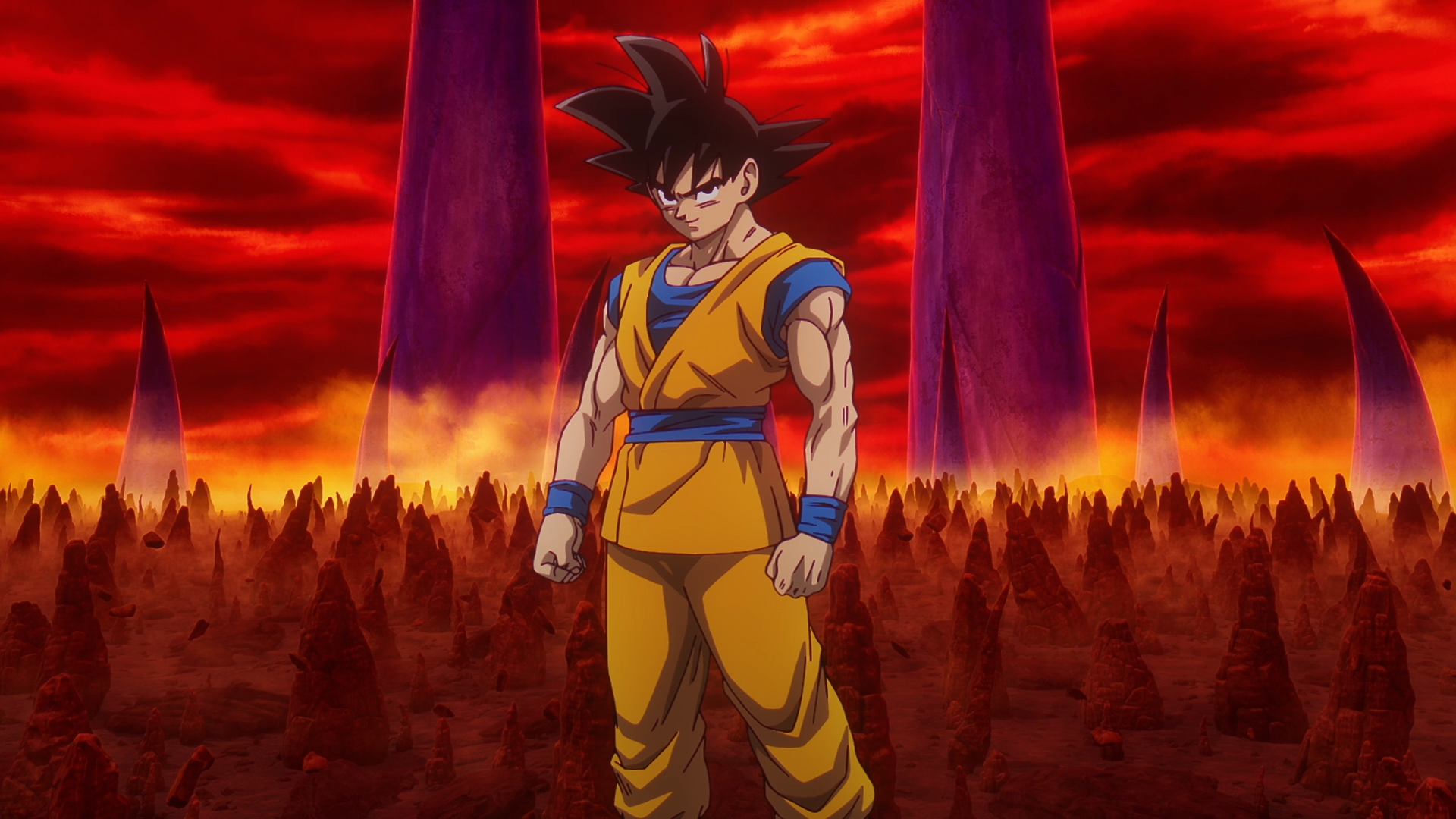
For hardcore Dragon Ball scholars, the Demon Realm — Makai — has always been the franchise’s most tantalizing unexplored territory. Referenced obliquely through characters like Dabura (the Demon King who appeared during the Buu Saga) and Mechikabura (from Dragon Ball Heroes), the Demon Realm existed as a shadow dimension that Toriyama never fully fleshed out in the mainline canon. Daima changes everything.
The world-building on display here is staggering. The Demon Realm isn’t simply a hellscape — it’s a fully realized parallel civilization with its own political hierarchies, ecosystems, and power structures. Toriyama and the writing team have constructed a world that feels simultaneously alien and unmistakably Dragon Ball: whimsical yet dangerous, colorful yet menacing. There are sprawling demon cities with architecture that blends organic and mechanical elements, vast wilderness zones teeming with creatures that would feel at home in Toriyama’s Dr. Slump, and a layered social order that gives the story genuine political intrigue — a rarity for the franchise.
New Characters That Actually Matter
Central to Daima‘s success is its new cast, particularly Glorio, the enigmatic Demon Realm warrior who becomes Goku’s guide through this unfamiliar world, and Panzy, a young demon girl whose quest intertwines with our heroes’. These aren’t throwaway additions. Toriyama gave them the same careful attention he once lavished on Bulma, Krillin, and Piccolo — characters with distinct personalities, clear motivations, and genuine emotional stakes. The villainous Supreme Kai Gomah and his scheming subordinate Degesu add layers of bureaucratic villainy that feel fresh for the franchise, proving that not every antagonist needs to be a universe-destroying powerhouse to be compelling.
Toei Animation’s Finest Hour: Choreography That Honors the Legacy
If the story is Toriyama’s heart, then the animation is Toei’s soul poured onto the screen. Dragon Ball Daima represents a quantum leap in production quality for the studio, and it’s not even close. The martial arts choreography — directed with meticulous attention to spatial awareness, impact, and rhythm — recalls the best moments of early Dragon Ball and Dragon Ball Z while incorporating modern animation techniques that make every punch land with visceral weight.
Gone are the static beam struggles and recycled animation banks that plagued portions of Super. In their place, we get fluid, hand-to-hand combat sequences that emphasize technique over raw power. The smaller character models actually benefit the action tremendously — there’s a kinetic, almost Naruto-esque agility to the fight scenes that feels like a natural evolution of the franchise’s combat language. Key animators have delivered sakuga moments that have already gone viral across social media, with particular praise directed at the series’ dynamic camera work and the way it uses the Demon Realm’s fantastical environments as interactive stages for battle.
The musical score, composed by Mokoto Nagatomo, deserves special mention. It blends orchestral grandeur with electronic textures and traditional Japanese instrumentation, creating an auditory identity that distinguishes Daima from every previous Dragon Ball series while still evoking the franchise’s emotional core.
Honoring 40 Years: The Emotional Undercurrent of a Final Work
It’s impossible to watch Dragon Ball Daima without feeling the bittersweet reality of its creation. Toriyama was deeply, personally involved in this project — writing the story, designing the characters, overseeing the world-building — in a way he hadn’t been since the original manga’s serialization. In interviews before his passing, he described Daima as the project that reignited his passion for Dragon Ball, a chance to tell the kind of adventure story he’d always wanted to tell but never had the opportunity to explore.
That passion is evident in every episode. There’s a sense of wonder permeating Daima that the franchise hasn’t possessed since young Goku first set out with Bulma to find the Dragon Balls. The pacing is deliberate, favoring exploration and character interaction over relentless escalation. Goku’s wide-eyed curiosity about the Demon Realm mirrors the audience’s own discovery, and Toriyama’s trademark humor — absurdist, warm, perfectly timed — is present in abundance. It feels like a creator returning to his roots not out of obligation, but out of genuine love.
The community response has been overwhelmingly emotional. Social media has been flooded with tributes connecting Daima‘s themes of transformation, resilience, and adventure to Toriyama’s own legacy. Fan artists, cosplayers, and content creators have embraced the series with a fervor that transcends typical seasonal anime hype. This isn’t just another Dragon Ball show — it’s a cultural moment.
The Verdict: A Legacy Cemented in Gold
Dragon Ball Daima is that rarest of achievements: a late-career work that doesn’t just coast on nostalgia but actively enriches everything that came before it. It expands the lore in meaningful ways, delivers action that rivals the franchise’s peak moments, introduces characters worth caring about, and — most importantly — captures the spirit of adventure that made Dragon Ball a global phenomenon in the first place.
Akira Toriyama once said that he never expected Dragon Ball to become what it became. He was just a guy from Nagoya who liked drawing funny characters and cool fights. Daima reminds us that beneath all the power levels, transformations, and cosmic stakes, that’s exactly what Dragon Ball has always been — and exactly why it endures.
If you haven’t started Dragon Ball Daima yet, you owe it to yourself — and to Toriyama’s extraordinary legacy — to begin. Share your thoughts with us on social media, and stay tuned to Wibux.com for weekly episode breakdowns, lore deep-dives, and community spotlights as this remarkable series continues to unfold.