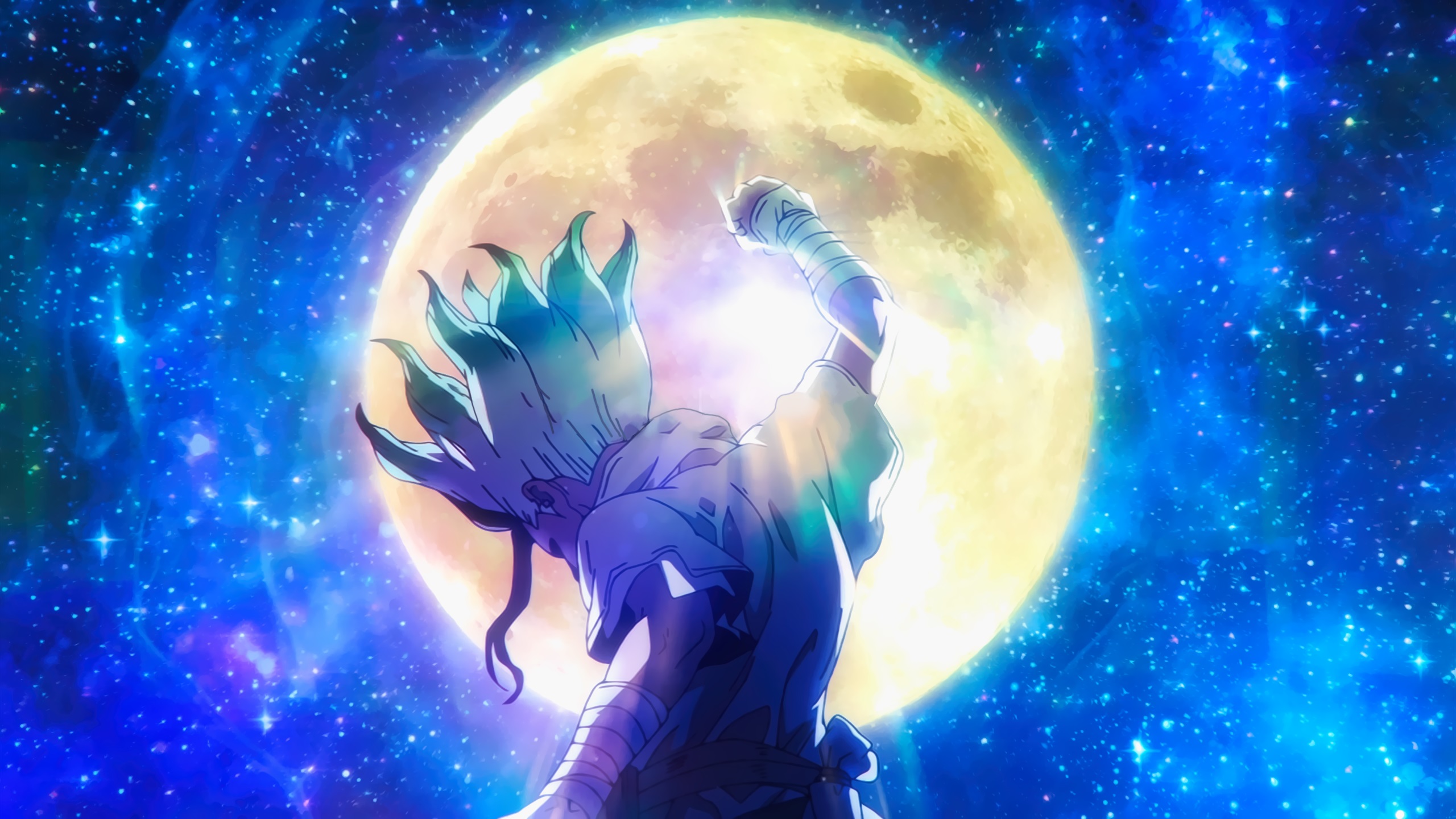
When Riichiro Inagaki and Boichi first serialized Dr. STONE in the pages of Weekly Shonen Jump back in 2017, the premise felt almost brazenly contrarian. In a landscape dominated by supernatural curses, demonic blades, and hereditary chakra reserves, here was a shonen narrative asserting that humanity’s ultimate superpower was not divine providence or esoteric martial arts, but empirical observation, metallurgy, and stubborn, repeatable labor. Now, as TMS Entertainment prepares to cross the ultimate threshold with Dr. STONE: Science Future, the fourth and final season of the anime adaptation, that modest ethos of turning flint into fire has metastasized into something staggeringly grand: a full-blown lunar expedition to solve an existential cosmic horror.
The stakes have long since eclipsed the tribal skirmishes of the Ishigami Village or the kinetic warfare against Tsukasa’s primitive empire. Science Future represents the convergence of humanity’s entire technological lineage, concentrated into a single, razor-thin parabolic trajectory pointed squarely at the Moon. For Senku Ishigami, this is more than an engineering milestone; it is the definitive reckoning with Why-Man, the enigmatic entity whose synthetic broadcast has hung over human civilization like an executioner’s blade for over 3,700 years.
The Transcontinental Supply Chain: Industrializing the Stone World
Before any astronaut can plant a boot into lunar regolith, Science Future must first illustrate the staggering logistics of modern rocketry. Where lesser narratives would bridge the gap between locomotive engines and spacecraft via an off-screen montage, Inagaki’s narrative design revels in the tedious, sweat-soaked supply chain. The final season’s preparatory arcs demand nothing less than the systematic economic globalization of a primitive Earth.
To construct a multi-stage rocket capable of escaping Earth’s gravitational well, the Kingdom of Science must scour the continents for rare-earth elements, petrochemical precursors, and industrial-grade manufacturing nodes. Viewers will witness a hyper-accelerated industrial revolution spanning North America, South America, and beyond. This is not merely an artistic globe-trot; it is an ideological assertion. Science is not a solitary genius working in a vacuum—it is an interconnected, global enterprise where agriculture feeds miners, miners fuel smelters, and smelters supply engineers. The anime’s presentation of these logistical triumphs transforms macroeconomic planning into pulse-pounding shonen set pieces, reminding audiences that Senku’s greatest attribute has always been his ability to delegate faith into human collaboration.
The South American Crucible and the Petrification Origin
Central to this global traversal is the expedition into the heart of South America—the ground-zero epicenter from which the original petrification wave radiated millennia ago. It is here that the tone of Science Future takes a distinct pivot into geopolitical tension and atmospheric dread. The discovery of mountain-sized deposits of spent Medusa devices shifts the series from optimistic survivalism into the realm of speculative archaeology, forcing the characters—and the audience—to confront the terrifying industrial scale of their unseen enemy.
From Clay to Liquid Oxygen: TMS Entertainment’s Pacing Gamble
The monumental narrative scope of the manga’s concluding arcs presents TMS Entertainment with its most precarious directorial challenge to date. Covering the North American resource wars, the South American convergence, the Medusa reverse-engineering, and the culminating lunar mission requires a delicate editorial hand. There is an inherent danger of compressing Inagaki’s exhaustive blueprints and Boichi’s hyper-detailed, kinetic double-page spreads into rushed animated shorthand.
However, early production insights and the deliberate structuring of Science Future into a multi-cour rollout suggest the studio understands the assignment. The visceral visual dichotomy that has defined the series—pairing Boichi’s exaggerated, muscular character dynamism with meticulously accurate mechanical draftsmanship—must reach its apex during the construction of the Saturn V-style launch vehicle. Every weld, circuit board, and drop of refined fuel carries the physical weight of human mortality. TMS Entertainment’s veteran animators are tasked with translating static diagrams of computational core memory and rocket telemetry into visually compelling cinema, relying heavily on kinetic direction and Tatsuya Kato’s triumphant, brass-heavy orchestral score to make the laws of thermodynamics feel heroic.
The Voice in the Static: Confronting Why-Man and the Morality of Immortality
At the zenith of this saga sits Why-Man, one of modern shonen’s most chilling and philosophically complex antagonists. First introduced as an anomalous, rhythmic Morse code transmission cutting through the Kingdom of Science’s primitive vacuum-tube radio, Why-Man’s subsequent mimicry of Senku’s own synthesized voice transformed an ambient mystery into a psychological siege. The repeated, mechanical query—“WHY? DO YOU WANT TO DIE?”—reframes the entire premise of the series.
Without veering into structural spoilers, the ultimate confrontation on the lunar surface subverts the classic shonen beat-’em-up climax. Why-Man is not a conventional conqueror seeking dominion, nor a megalomaniac drunk on absolute power. Instead, the entity’s revelation unearths profound thematic inquiries regarding the price of consciousness, the biological mandate of self-preservation, and the paradoxical cruelty of forced immortality.
In this confrontation, Senku’s scientific rationale meets an existential ideology that views the human condition through an utterly alien utilitarian lens. The petrification beam, previously viewed as an apocalyptic atrocity, is interrogated under a new philosophical light: Was it an act of hostility, or a disastrously misunderstood attempt at synthetic benevolence? Senku’s response to this question is the ideological crown of Dr. STONE, demonstrating that a life stripped of struggle, curiosity, and physical vulnerability is not life at all, but mere geological persistence.
The Lunar Trio: Humanity’s Final Three-Man Cell
When the rocket finally breaches the upper atmosphere, the physical burden of this millennia-spanning conflict falls upon a handpicked trio of astronauts. The narrative configuration of this crew speaks directly to the sociological pillars Senku has championed since awakening in chapter one:
First, the intellect—the unwavering empirical mind capable of calculating drift and processing unprecedented anomalies in real-time. Second, the pilot—embodied by Ryusui Nanami, whose unabashed greed and desire for sensory experience make him the undisputed master of vehicular navigation. And finally, the blade—the physical vanguard necessary to safeguard the scientific core against physical disruption. This trinity reflects the broader human endeavor: curiosity to chart the course, hunger to cross the horizon, and strength to defend the frontier.
Moreover, the journey to the Moon carries immense, suffocating emotional resonance. Floating above the silent blue sphere, Senku’s mission becomes a communion with his late adoptive father, Byakuya Ishigami, and the deceased crew of the International Space Station. Byakuya left behind a legacy forged in phonograph needles and platinum dust, waiting thousands of years for his son to catch up. When the Kingdom of Science’s lunar lander touches down, it closes a 3,700-year generational loop, proving that love, like science, is an accumulative force capable of surviving the death of the universe.
Ten Billion Percent Catharsis: The Scientific Legacy
As Dr. STONE: Science Future heads toward its broadcast horizon, the series stands as a rare, unified vision in an industry prone to fractured adaptations and thematic compromises. By refusing to resort to magical deus ex machinas, Inagaki and Boichi crafted a narrative that demands its characters earn every single volt, calorie, and kilometer per second. The final season promises not just an answer to an ancient cosmic riddle, but a triumphant defense of human curiosity in the face of absolute despair.
When the final countdown echoes across the petrified remnants of Earth, it will not just be Senku and his comrades launching into the vacuum—it will be the entirety of human history strapped to the back of a chemical thruster, demanding to know the truth behind its own silence.
Are you ten billion percent ready for the final frontier? How do you think TMS Entertainment will handle the emotional weight of Why-Man’s revelation? Drop your theories and countdown reactions in the comments below, and keep your transceivers locked to Wibux.com for exhaustive episode breakdowns and character retrospectives.