

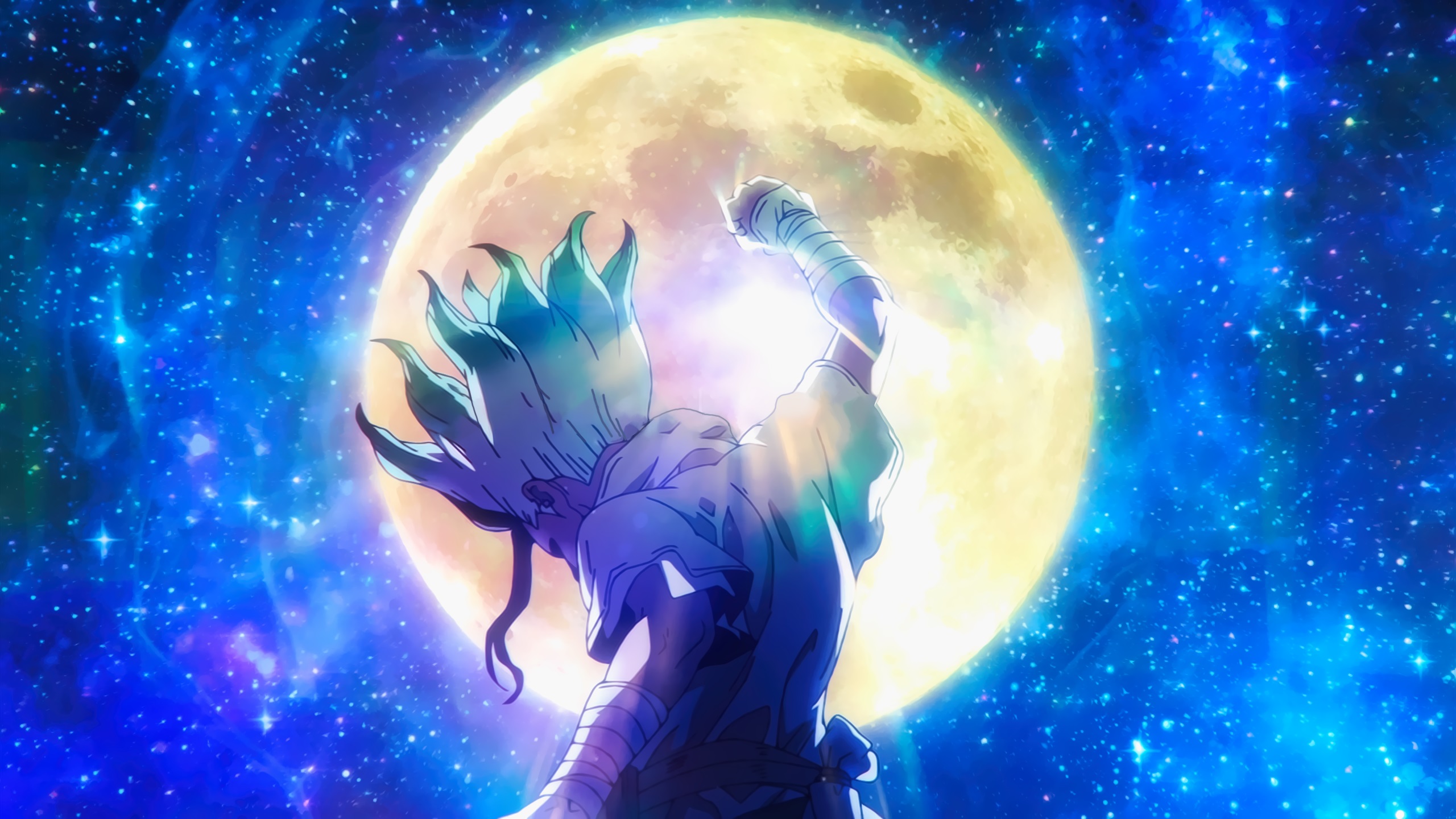
When Senku Ishigami first woke from petrification in 5738 AD, his primary weapon against an overgrown, feral Earth was not an enchanted blade or an ancestral lineage of mystical power; it was a handful of nitric acid and an unyielding faith in the periodic table. Over three critically acclaimed seasons, TMS Entertainment has meticulously chronicled this stone-age renaissance, charting humanity’s journey from stone spears to cell phones, steam engines, and transoceanic shipping. Yet, nothing in Riichiro Inagaki and Boichi’s visionary franchise quite prepares audiences for the sheer existential velocity of its endgame. With the confirmation of Dr. STONE: Science Future—the fourth and final season slated to adapt the manga’s sprawling final stretch across multiple cours—the Kingdom of Science is abandoning terra firma entirely. The trajectory is set: Senku is going to the moon, and humanity is finally going to hold court with the architect of its three-millennium-long silence: the enigmatic entity known as Why-Man.
The Apollo Trajectory: Building an Interstellar Engine from Scratch
The transition from domestic survival to high-stakes space exploration is, on paper, an absurd narrative leap. Yet, what separates Dr. STONE from virtually every other speculative shonen in contemporary anime is its fanatical commitment to logistical causality. Season 4 does not handwave the monumental task of space travel. Instead, Science Future operates as a hyper-accelerated love letter to the Apollo program, framing the journey to the lunar surface not as a miraculous feat of anime logic, but as an excruciating, step-by-step technological pyramid.
To launch a rocket, Senku cannot merely harvest local Japanese flora. The impending narrative requires the complete re-globalization of humanity. From establishing the resource-rich hubs of the Americas for agriculture and fuel, to securing precision manufacturing plants, the narrative turns global infrastructure into a dramatic vehicle. Every microchip, every bolt of high-tensile alloy, and every drop of synthetic rocket propellant must be accounted for. The upcoming season promises to showcase this sprawling industrial mobilization with the kinetic, punchy pacing that director Shinya Iino and the studio have perfected. It transforms logistical planning—ordinarily the dry domain of textbooks—into an intoxicating battle against thermodynamic limits and the ruthless ticking of the clock.
Unmasking the Void: The Chilling Enigma of Why-Man
Every great shonen requires an antagonist capable of testing the core ideological thesis of its protagonist. Tsukasa tested Senku’s utilitarian ethics; Senku’s encounter with Hyoga tested his definition of human worth; the Petrification Kingdom of Treasure Island tested his ability to out-engineer weaponized superstition. But Why-Man operates on a tier of dread fundamentally distinct from anything previously encountered in the series.
First introduced as a chilling, rhythmic Morse-code transmission intercepting the Kingdom of Science’s crude communications—broadcasting a ceaseless, mechanized question: “WHY?”—Why-Man represents cosmic horror filtered through the lens of hard science fiction. The entity does not operate with emotional malice. It is an algorithmic, unrelenting pressure hanging over the exosphere, wielding the Petrification Devices (the Medusa mechanisms) like scalpel blades capable of freezing an entire biosphere in an instant.
The Clash of Empirical Ideologies
What makes the impending moon confrontation so narratively potent is its subversion of traditional shonen tropes. Senku cannot simply punch Why-Man harder; you cannot intimidate a radio signal or bludgeon an existential threat. The conflict demands investigation, deductive reasoning, and ultimate scientific inquiry. Why-Man’s origins cut directly to the root of the series’ inciting incident: Why petrify humanity? Was the petrification a catastrophic act of war, an authoritarian intervention, or a perverse, twisted gift of immortality? As Senku, Ryusui, and their select lunar crew breach orbit, the series shifts into a profound ideological inquiry about the nature of intelligence, survival, and the evolutionary drive of conscious life.
Psychological Pressures: The Lunar Triumvirate and Generational Weight
The mission to the moon is functionally a suicide mission—or, at best, a gambit where the margin for error is calculated in fractions of a millimeter. The selection of the three-person crew to make the descent onto the lunar regolith serves as a masterclass in character dynamics:
Senku Ishigami: For Senku, this is not merely an engineering problem; it is the ultimate fulfillment of a promise made over three thousand years ago to his adoptive father, Byakuya Ishigami. Byakuya left the records and platinum on Treasure Island precisely because he trusted that his son’s mind would one day reach the stars. Watching Senku step toward the exosphere carries an emotional weight that few modern anime protagonists can match. He is not a chosen savior; he is a surrogate executor of two million years of accumulated human curiosity.
Ryusui Nanami: The embodiment of human greed transformed into noble ambition, Ryusui provides the indomitable pilot instincts required for atmospheric escape. His philosophy—that “desire is justice”—finds its ultimate stage in space exploration, the single greatest expenditure of resources in human history.
Kohaku: Representing the physical zenith of the Stone World, Kohaku’s inclusion provides both vital martial defense against the unknown and a poetic visual contrast: a huntress descended from stone-age survivorship, suited in cutting-edge pressurized space gear, setting foot on the silent dust of another celestial body.
TMS Entertainment’s Monumental Production Task
Adapting the final arcs of Boichi’s source material presents an immense logistical challenge for TMS Entertainment. Boichi’s illustration style reached legendary status in the latter half of the manga, characterized by hyper-dense crosshatching, mathematically precise mechanical blueprints, and jaw-dropping double-page spreads depicting planetary scale. The anime’s production team must balance this visual maximalism with fluid, readable television animation.
Early indicators suggest that Science Future is being budgeted and paced with deliberate reverence. Rather than compressing the remaining material into an unceremonious single cour, a multi-cour rollout gives the intricate build-up of the lunar spacecraft the narrative breathing room it demands. The sound design, particularly the orchestration of Tatsuya Kato, Hiroaki Tsutsumi, and Yuki Kanesaka, faces the thrilling prospect of transitioning from rustic, folk-infused stone-age melodies to the cold, reverb-heavy synthesizer scores of orbital descent.
The Radical Optimism of Humanity’s Greatest Story
At a time when popular media frequently leans into cynicism, apocalyptic fatalism, and the inevitable collapse of civilization, Dr. STONE remains an unapologetic bastion of radical scientific optimism. The impending conclusion of Science Future does not celebrate weapons of mass destruction or imperial conquest; it celebrates the cooperative labor of human beings refusing to stay buried in the dark.
Every failure along Senku’s path has been framed as an essential step toward discovery. The confrontation on the moon with Why-Man is poised to be more than just a fireworks display of animation—it is the thematic capstone to one of the most intellectually invigorating anime adaptations of the modern era. When the final rocket engines ignite, Dr. STONE will ask its audience to look not downward at the earth they have broken, but upward at the stars they are capable of reaching.
How do you feel about the Kingdom of Science finally taking to the stars? Do you think the anime adaptation will do justice to Boichi’s jaw-dropping double-page spreads, or will Why-Man’s ultimate reveal spark heated debate across the fandom? Drop your theories and countdowns in the comments below!