When the universe collapsed and reset at the breathless climax of Stone Ocean, David Production did not just conclude the generational tragedy of the Joestar bloodline; they stood at the precipice of anime’s ultimate white whale. For manga readers, the transition from Part 6 to Part 7 is not merely a sequential shift—it is an aesthetic, philosophical, and structural renaissance. Widely hailed as Hirohiko Araki’s undisputed magnum opus, JoJo’s Bizarre Adventure: Part 7: Steel Ball Run has transcended its medium, lingering on top of global rating charts as a peerless fusion of historical fiction, supernatural suspense, and existential grit. Now, as speculative chatter, cryptic trademark registrations, and insider rumblings reverberate through production circles, the anime community finds itself gripped by a singular, persistent question: Is David Production finally ready to saddle up?
The Horizon of a New Universe: Araki’s Western-Supernatural Canvas
To understand the immense gravity of the Steel Ball Run discourse, one must understand how Araki fundamentally broke his own mold. Serialized initially in Weekly Shonen Jump before migrating to the monthly, creator-friendly pastures of Ultra Jump in 2005, Part 7 freed Araki from the grueling weekly grind. The result was transformative: expansive panelling, painterly cross-hatching, and an unprecedented level of anatomical and thematic maturity.
Set across the wind-swept, hostile topography of 1890s America, the narrative tracks a grueling, coast-to-coast cross-country horse race boasting a monumental $50 million grand prize. Yet behind the dust and the corporate vanity of promoter Steven Steel lies a terrifying geopolitical conspiracy centered around the dispersed relics of a divine Saint. By merging historical Americana—homesteads, steam engines, and raw frontier lawlessness—with bizarre, reality-bending Stand warfare, Araki crafted an epic that feels less like serialized shonen and more like Cormac McCarthy directing an operatic anime epic.
Johnny Joestar and Gyro Zeppeli: Flawed Deconstructions of the Hero Archetype
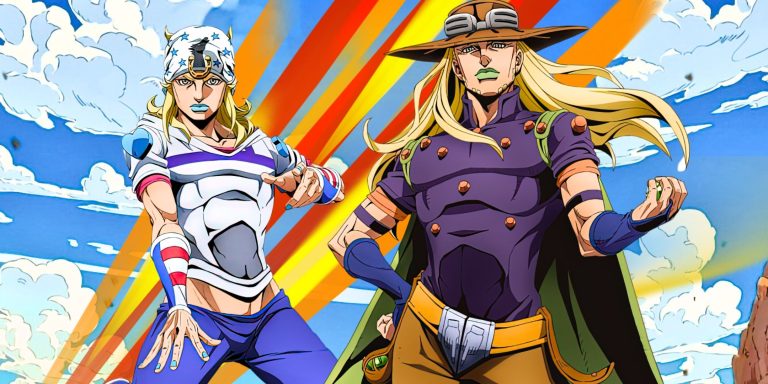
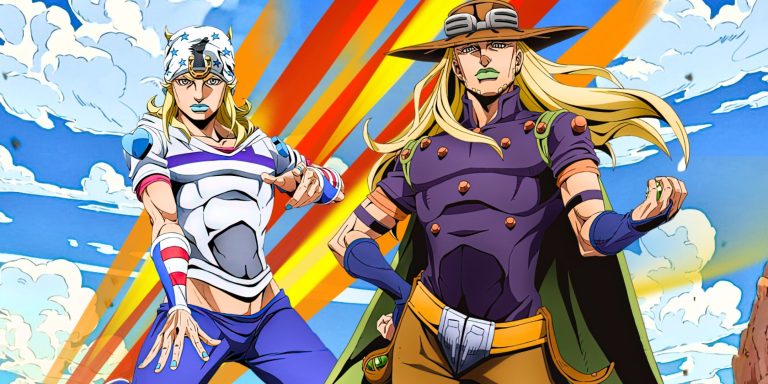
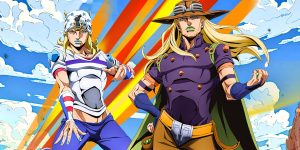
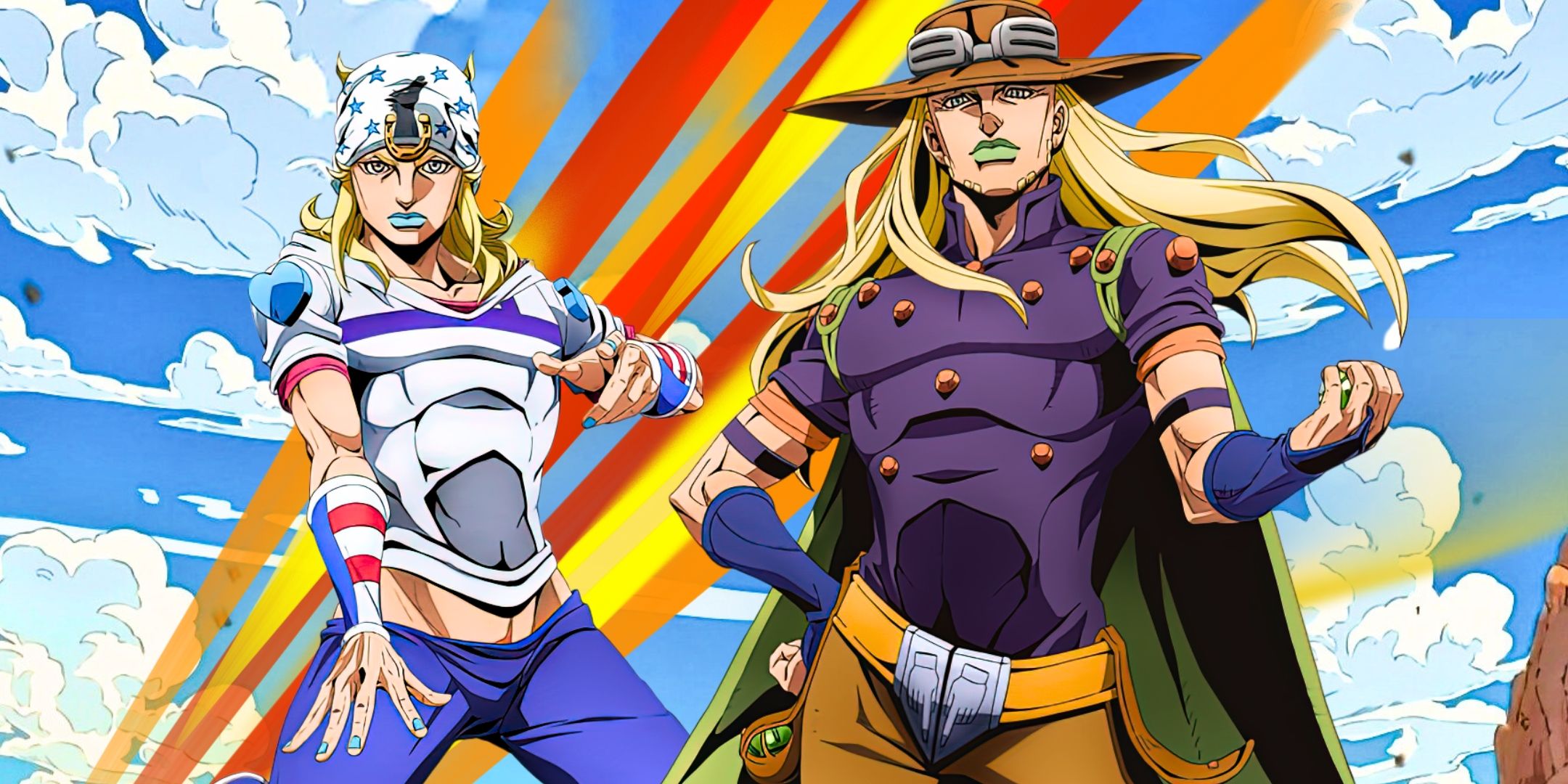
At the beating heart of this frontier Odyssey is the complex dynamic between two broken men riding for redemption. Unlike the chivalrous Jonathan or the stoic Jotaro, Johnny Joestar is arguably the most morally compromised, psychologically layered protagonist in the entire JoJo canon. Paralyzed from the waist down due to his own juvenile arrogance as an elite equestrian prodigy, Johnny begins the story stripped of his pride, dignity, and purpose. He is not driven by an altruistic crusade to save the world; he is driven by what Araki explicitly terms “dark determination”—an obsessive, terrifying hunger to regain the use of his legs, regardless of who or what stands in his path.
Enter Gyro Zeppeli: a flamboyant yet haunted Neapolitan executioner who enters the race on behalf of an innocent boy condemned to death. Gyro is the ideological antithesis and necessary counterweight to Johnny. Radiating chaotic charm, armed with mystical steel spheres and gold-plated teeth that spell out his worldview, Gyro becomes Johnny’s mentor, brother-in-arms, and moral compass through an unforgiving wilderness.
The Golden Ratio and the Metaphysics of Spin
Nowhere is Araki’s thematic maturity more evident than in the mechanics of the Spin. Moving away from the biological respiration of Hamon and refining the metaphysical rules of Stands, Part 7 introduces the Spin as an ancient, rotational discipline tied to the Golden Ratio of Fibonacci mathematics. When channeled through Gyro’s spherical tools or manifested through Johnny’s evolving Stand, Tusk, the Spin serves as both an offensive weapon and a narrative metaphor: an infinite, self-perpetuating pursuit of balance in a chaotic, hostile world.
The Technical Everest: David Production’s Equestrian Nightmare
If Steel Ball Run is universally beloved, why has David Production hesitated to pull the trigger? The answer lies in the harsh realities of the animation pipeline. In the animation industry, horses are notorious as one of the most mechanically demanding subjects to render in traditional 2D. Capturing the muscular contraction of four independently galloping legs, shifting weight distributions, foreshortening perspectives, and fluid camera tracking during high-speed horse chases requires an exorbitant amount of technical skill, time, and budget.
Industry observers have long speculated that any faithful adaptation will require a revolutionary synthesis of hand-drawn character artistry and bleeding-edge 3DCG modeling. David Production demonstrated brilliant hybrid experimentation during their work on Cells at Work!, Fire Force, and the stylistic Stand battles of previous JoJo arcs. Furthermore, Kamikaze Douga’s groundbreaking 3D CGI opening sequences across earlier JoJo seasons showcase the exact kinetic energy and stylistic flair needed for the dusty stampedes of the San Diego coastline. The studio’s prolonged silence is not a lack of interest; it is the cautious calibration of an artistic studio facing the most technologically intimidating mountain of their career.
The Valentine Factor: Patriotic Absolutism and Modern Relevance
A masterclass narrative demands an equally iconic antagonist, and Steel Ball Run delivers in the form of Funny Valentine, the 23rd President of the United States. Valentine is neither a cackling megalomaniac like Dio Brando nor a paranoid serial killer like Yoshikage Kira. Instead, he is a manifestation of hyper-nationalistic absolutism. Armed with his dimension-hopping Stand, Dirty Deeds Done Dirt Cheap (D4C), Valentine seeks the Saint’s Corpse not for selfish hedonism, but to insulate his homeland from all future global suffering—even if it means redirecting calamity outward toward the rest of the world.
Valentine’s ideological confrontation with Johnny Joestar—crystallized in his unforgettable “first napkin” philosophy regarding political authority—elevates Part 7 into sophisticated political discourse. In a contemporary media landscape hungry for morally gray conflicts and high-stakes philosophical clashes, Valentine’s twisted altruism positions him to dominate anime discussions worldwide the second his boots hit the animated screen.
The Distribution Dilemma: Rebuilding the Weekly JoJo Phenomenon
Beyond the animation boards, the strategic release model for Part 7 remains a fiery point of contention among enthusiasts. The fractured, batch-release distribution of Stone Ocean on Netflix undeniably stunted the series’ cultural footprint, depriving fans of the weekly communal dissection, meme iterations, and viral trending topics that made Stardust Crusaders and Golden Wind global phenomena. For Steel Ball Run to claim its rightful throne, the production committee must pivot back to appointment viewing. The episodic tension of each race stage—from the treacherous Devil’s Palm to the showdown in Philadelphia—is intrinsically engineered for a weekly rollout that allows suspense, hype, and collective theorycrafting to simmer.
Hirohiko Araki’s trans-American race is not merely another chapter in an eccentric franchise; it is the pinnacle of his visionary career. Whenever David Production finally sounds the starting pistol, JoJo’s Bizarre Adventure: Steel Ball Run will not just adapt a manga—it will embark on a historic race to redefine what modern prestige anime can achieve.
What are your expectations for the potential Steel Ball Run anime? Do you want to see a hybrid 3D/2D visual pipeline, and who is your dream voice cast for Gyro Zeppeli? Jump into the comments below and let your voice be heard across the finish line!