Ever since the cosmic, melancholy notes of Jolyne Cujoh’s battle against destiny echoed through the finale of Stone Ocean, the global anime community has collectively held its breath. The reboot of the universe wasn’t merely the poetic conclusion of the multi-generational Joestar bloodline against the vampiric specter of DIO; it paved the highway for what is near-universally regarded as Hirohiko Araki’s crowning artistic triumph: JoJo’s Bizarre Adventure Part 7: Steel Ball Run. On message boards, social media timelines, and festival show floors, the whisper has metastasized into an unrelenting roar: when is David Production finally going to mount up?
The cultural gravity of Steel Ball Run is unprecedented within the modern anime zeitgeist. Part 7 represents more than just another sequential chapter in a storied franchise; it is a seismic stylistic evolution. Shifting from the muscular urban brawls of 1980s Cairo and suburban Japanese murder mysteries to the sprawling, sun-bleached expanse of 1890s North America, Steel Ball Run is a genre-defying odyssey that blends historical fiction, hyper-kinetic racing, and cosmic body horror. As anticipation mounts, both fans and industry insiders recognize that adapting this masterpiece represents the most audacious gamble David Production has ever confronted.
A Trans-American Crucible: Why Steel Ball Run Stands as Araki’s Magnum Opus
To understand the electric buzz surrounding an adaptation, one must first confront the literary pivot that occurred during the manga’s serialization. Initially serialized in 2004 within Weekly Shonen Jump, the title subtly concealed its lineage under the standalone moniker Steel Ball Run before transitioning into the pages of the monthly seinen publication Ultra Jump in 2005. That editorial migration liberated Araki. Unshackled from weekly deadlines and the demographic guardrails of shonen storytelling, his pencil deepened into something profoundly mature, morally ambiguous, and artistically opulent.
The premise is deceptively cinematic: a 6,000-kilometer cross-country horse race from San Diego Beach to New York City, carrying a grand prize of fifty million dollars. Orchestrated by the eccentric philanthropist Steven Steel, the event attracts the world’s most ferocious outlaws, disgraced aristocrats, and supernatural operatives. Yet beneath the dust and gunpowder lies an esoteric quest involving the search for the scattered, mummified relics of the Holy Corpse—an artifact capable of directing global fortune toward whichever sovereign nation controls it.
By transplanting his foundational themes of fate, human resolve, and generational legacies into a brutal, Sergio Leone-inspired American frontier, Araki achieved narrative perfection. It is a historical epic disguised as a battle shonen, an intricate geopolitical chess match, and a profoundly intimate character study that outstrips its predecessors in sheer emotional and thematic scale.
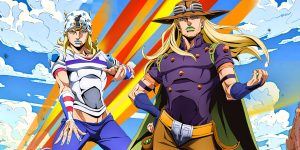
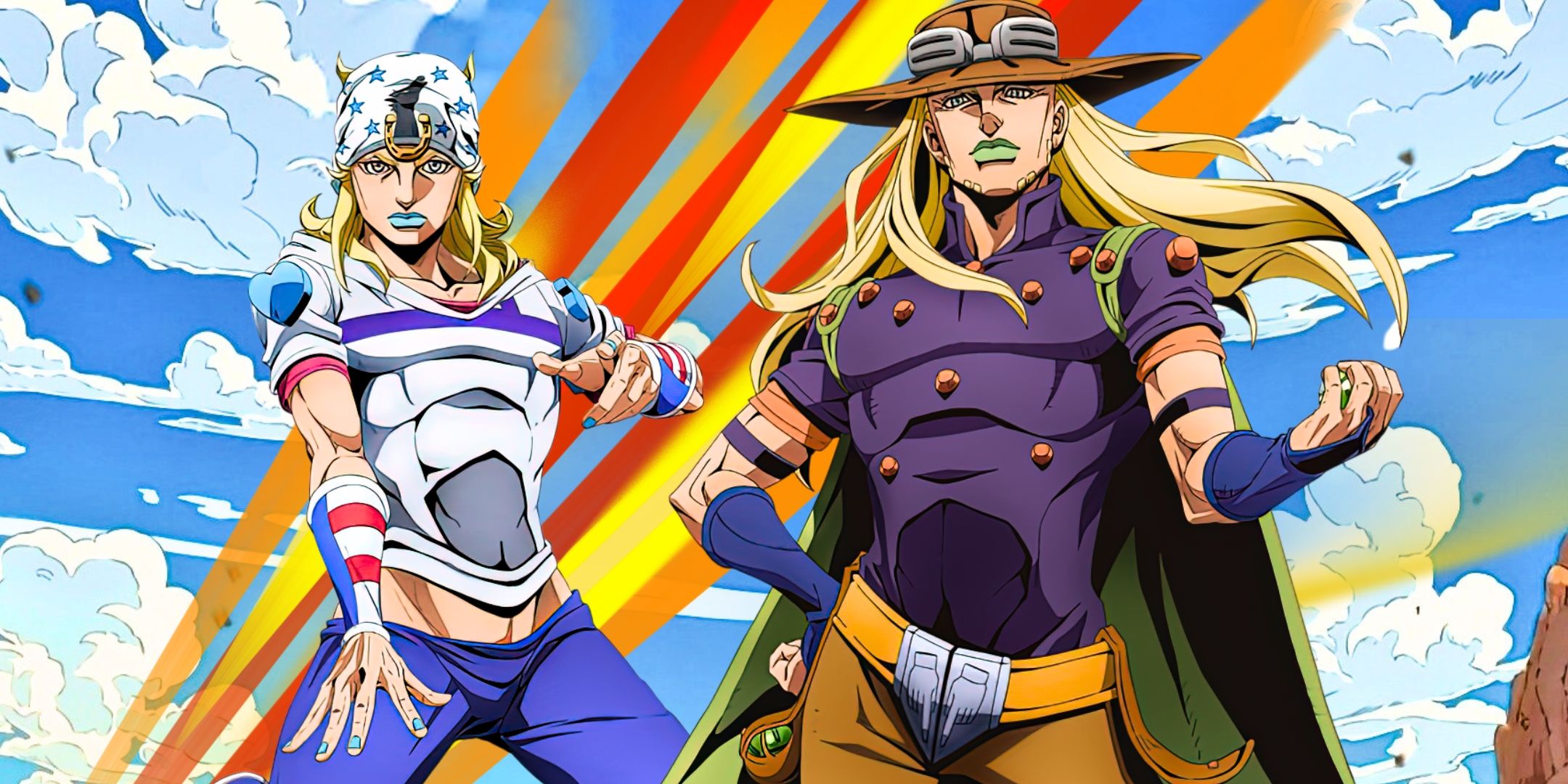
The Broken Jockey and the Executioner: Deconstructing Johnny and Gyro
The “Dark Determination” of Johnny Joestar
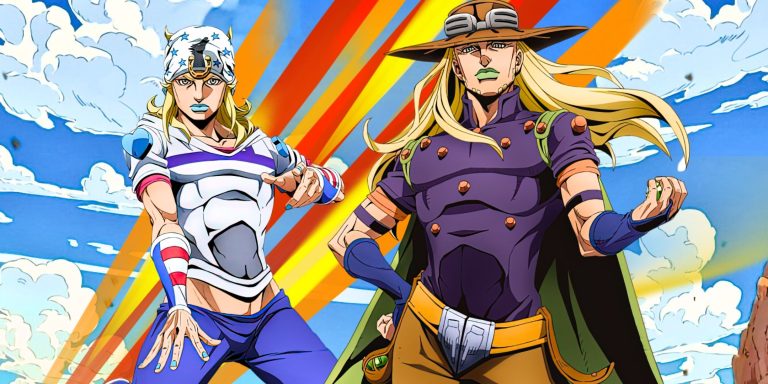
At the beating heart of this cross-continental crucible lies the antithesis of the archetypal shonen protagonist: Johnny Joestar. A former prodigy jockey whose meteoric arrogance cost him both his fame and the use of his legs, Johnny begins the race not out of nobility, patriotism, or the desire to save the world, but from sheer, desperate selfishness. He is cynical, plagued by survivor’s guilt, and emotionally crippled long before his physical paralysis took hold.
Araki frequently touches upon Johnny’s “dark determination”—an ocular glint representing an unflinching willingness to kill or sacrifice anything in pursuit of recovery. Johnny is not Jonathan Joestar’s virtuous gentleman; he is a broken boy clawing his way back to “zero” from “negative.” His journey across the American plains is a harrowing, step-by-step reclamation of bodily autonomy and personal grace, rendering him perhaps the most complex protagonist Araki has ever penned.
Gyro Zeppeli and the Burden of Execution
Counterbalancing Johnny’s venomous desperation is Gyro Zeppeli, a flamboyant, gold-toothed Neapolitan executioner armed with mystical spinning steel spheres and a shockingly juvenile sense of humor. Gyro enters the Steel Ball Run to secure the amnesty of an innocent child sentenced to death by the royal Neapolitan court. Despite his surface-level bravura and absurd musical interludes, Gyro is a man crushed beneath the weight of state-sanctioned execution, family tradition, and religious duty.
The kinetic chemistry between Johnny and Gyro forms the emotional backbone of the entire narrative. Their campfire dialogues, philosophical debates, and escalating loyalty transition the story from a cold survivalist race into an unforgettable buddy-cop odyssey. Gyro serves as Johnny’s mentor, big brother, and moral compass, teaching him that the pursuit of true maturity requires surrendering one’s ego to the universe’s natural order.
The Physics of Miracles: Sacred Geometry, The Spin, and Tusk
Part 7 marks a fascinating mechanical evolution in Araki’s supernatural taxonomy. While Stands remain a fixture of the universe, they take a backseat during the story’s initial acts to introduce an ancient, natural energy: The Spin.
Unlike Hamon (Ripple), which relied on respiratory biology, the Spin is grounded in sacred geometry and mathematical harmony. Passed down through generations of Zeppeli executioners and medical practitioners, the technique harnesses the Golden Ratio—the divine spiral found ubiquitously throughout nature, from nautilus shells to planetary rotations. By channeling this perpetual kinetic momentum into rotating steel spheres, practitioners can manipulate flesh, bend trajectory, and disrupt human nervous systems with microscopic precision.
When Johnny merges this mathematical discipline with his evolving Stand, Tusk, the power ceiling shatters. Tusk’s progression—from firing destructive, spinning fingernail bullets in Act 1 to tearing through dimensional barriers and achieving infinite rotational gravity in Act 4—mirrors Johnny’s own psychological repair. The Spin re-contextualizes the series’ supernatural battles, replacing the sensory overload of high-frequency punches with surgical, high-stakes duels governed by physics, momentum, and spiritual enlightenment.
The Equestrian Nightmare: David Production’s Formidable Technical Hurdle
If the narrative acclaim of Steel Ball Run is undisputed, why has it taken so long for an anime adaptation to materialize? The answer comes down to a notorious industry terror: equine animation.
The Problem with Animating the Gallop
In traditional, hand-drawn 2D animation, four-legged animals—particularly horses—are universally acknowledged as one of the most grueling, time-consuming subjects to illustrate. Unlike a human biped whose anatomy can be stylized or partially obscured, a galloping horse demands intricate muscle articulation, precise skeletal shifts, mane physics, and weight distribution across every single frame. Now multiply that anatomical nightmare by hundreds of horses sprinting simultaneously across dynamic, tracking desert panoramas, and the scope of the production becomes terrifying.
Previous anime adaptations that attempted ambitious cavalry sequences have frequently buckled under the strain, turning to jarring, low-framerate 3D CGI models that alienate audiences. For David Production—a studio celebrated for its artisan approach to line weight, idiosyncratic hand-drawn sound effects, and color-palette shifts—cutting corners on Steel Ball Run’s central race sequences would be an unforgivable aesthetic compromise.
A Hybrid Evolution
The delay in greenlighting Part 7 likely isn’t a symptom of disinterest, but of rigorous pre-production experimentation. For David Production to honor Araki’s increasingly intricate cross-hatching and hyper-detailed linework, the studio must engineer a groundbreaking hybrid pipeline. We are likely looking at bespoke, high-end cel-shaded 3D horse rigs developed in tandem with meticulously crafted 2D character overlays—a pipeline akin to what Orange achieved with Trigun Stampede or MAPPA’s technical breakthroughs on Chainsaw Man.
The Road to San Diego: Final Verdict and What Comes Next
The discourse surrounding JoJo’s Bizarre Adventure: Steel Ball Run is no longer a question of if, but how and when. As David Production clears its production slate and the anime industry continues to embrace hyper-prestige prestige adaptations with elongated production cycles, Part 7 looms as the definitive frontier.
Furthermore, distribution will play a critical role in its reception. Following the divisive, disjointed batch-release model that Netflix implemented for Stone Ocean—which severely compromised the weekly communal discourse that made Stardust Crusaders and Golden Wind global cultural phenomena—both Warner Bros. Japan and fans are quietly yearning for a return to the classic weekly episodic format. A continental race of this magnitude deserves to be experienced leg by leg, town by town, duel by duel.
Steel Ball Run is Hirohiko Araki at the absolute zenith of his powers: a western myth of breathtaking scope, an unflinching examination of human vulnerability, and an ode to the golden spirals that govern our lives. When that starting gun finally fires, anime history will be written once again. Until then, we keep our eyes on the horizon, waiting for the green-lipped executioner and the paralyzed jockey to ride into view.
Are you prepared for the longest race of your life? How do you think David Production should balance 2D and 3D equestrian animation? Let your voice be heard in the comments below!