Ever since the bittersweet, existential chords of Jolyne Cujoh’s journey faded into the reset universe of Stone Ocean, the anime community has occupied a state of feverish, suspended animation. For over a decade, David Production pulled off what was once deemed impossible: adapting Hirohiko Araki’s notoriously eccentric, color-shifting, genre-defying generational saga with uncompromising fidelity. Yet, all six prior parts—monumental as they were—now feel like a mere prologue to the mountaintop that looms ahead. We have arrived at the precipice of JoJo’s Bizarre Adventure: Steel Ball Run.
Universally lauded as Araki’s magnum opus and consistently hovering near the apex of MyAnimeList’s all-time highest-rated manga, Steel Ball Run (Part 7) is not simply the next chapter in the JoJo lineage. It is a seismic paradigm shift. Transitioning the franchise from the kinetic melodramatics of Weekly Shonen Jump into the prestige, atmospheric storytelling of monthly seinen publication, Steel Ball Run revitalized Araki’s creative spirit. Today, as industry whispers intensify and production timelines align, the buzz surrounding its eventual anime realization has evolved from idle fan fantasy into an industry-defining inevitability.
The Seinen Metamorphosis: Araki’s Trans-American Odyssey
To understand the sheer magnitude of the Steel Ball Run anticipation, one must understand how thoroughly it subverts everything that came before it. Set in an alternate timeline in 1890, the narrative drops viewers onto the sun-baked sands of San Diego Beach for the start of the titular race: a grueling, 6,000-kilometer cross-country equestrian trek to New York City with a staggering $50 million prize on the line.
What begins as a rip-roaring historical western rapidly warps into a high-stakes supernatural thriller. Behind the spectacle orchestrated by promoter Stephen Steel lies a clandestine geopolitical conspiracy orchestrated by the United States President, Funny Valentine. The true prize scattered across the continental frontier is not gold, but the mummified, miraculous fragments of the Saint’s Corpse—relics granting godlike Stand abilities to those deemed worthy.
When Araki made the leap to Ultra Jump during the manga’s serialization, the shackles of demographic censorship dissolved. Steel Ball Run allowed the mangaka to explore visceral violence, profound moral grayness, and psychological trauma with unprecedented nuance. The American wilderness serves not just as a backdrop, but as a liminal canvas of desolation, survival, and greed, presenting a narrative complexity that will demand David Production’s most mature artistic direction yet.
Johnny and Gyro: A Dual Study in Broken Men and Golden Spirals
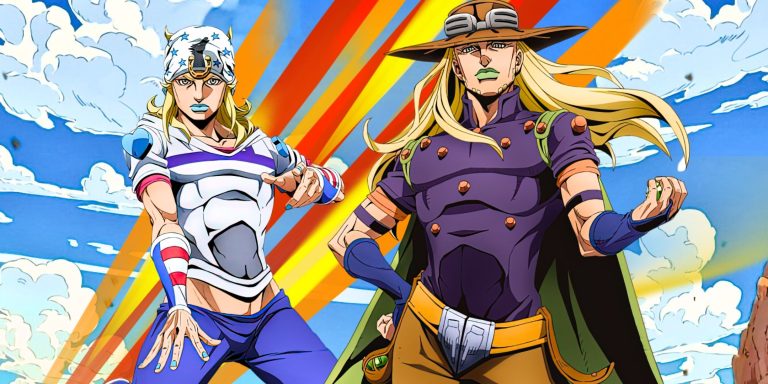
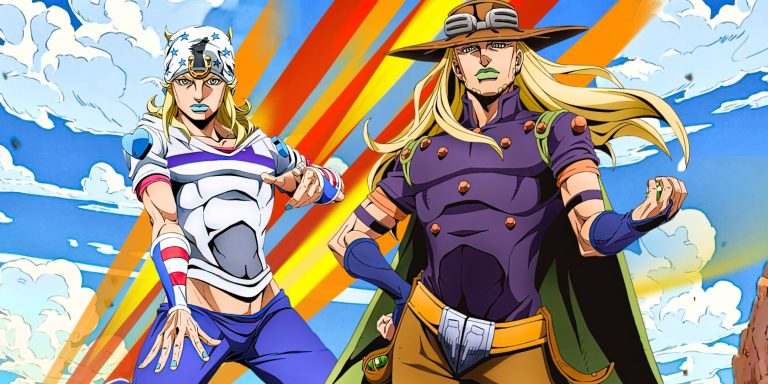
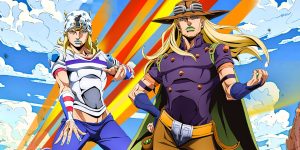
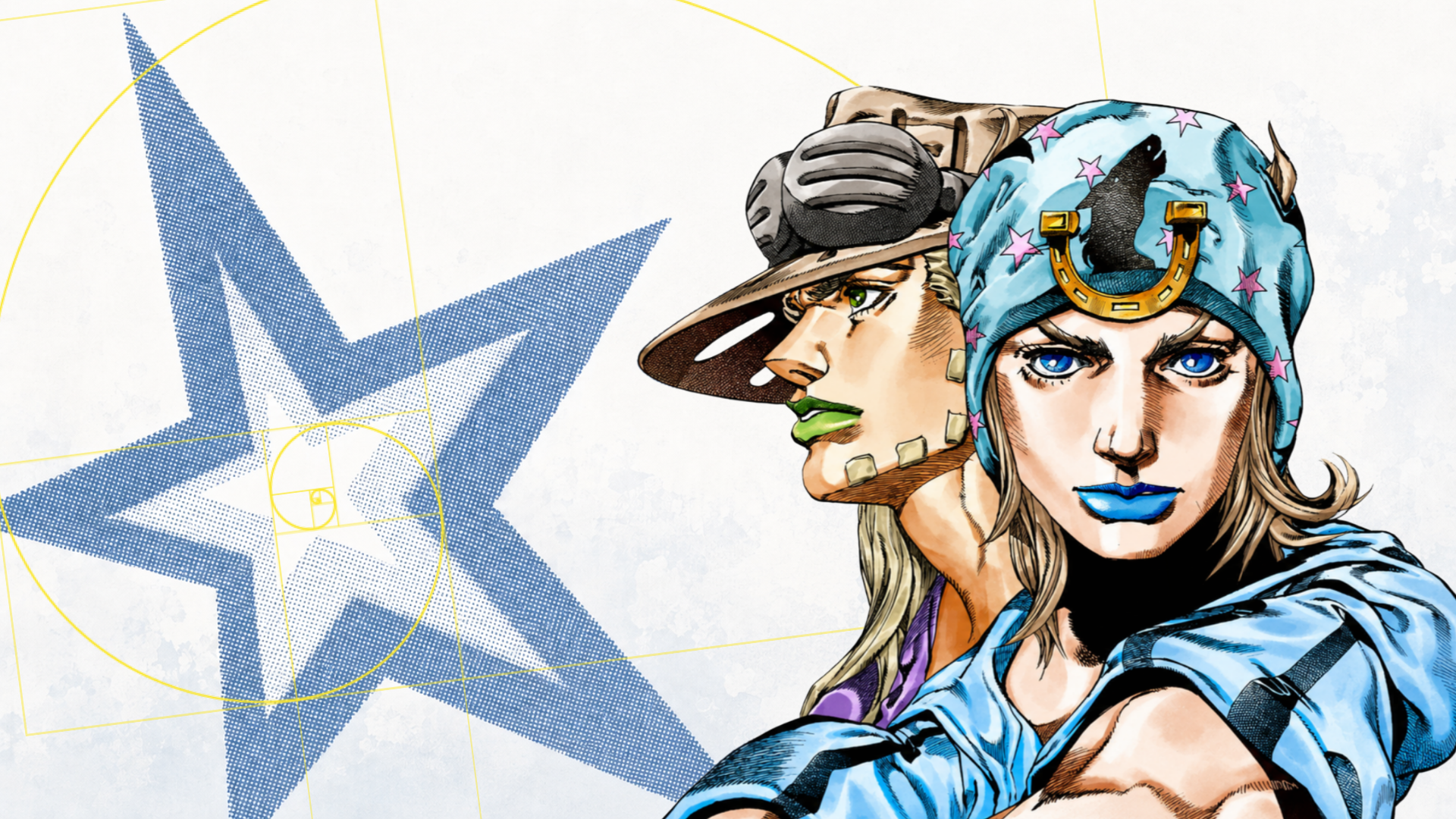
At the beating heart of this cross-country sprint is arguably the finest dynamic duo in modern graphic fiction: Johnny Joestar and Gyro Zeppeli. Far from the classic archetypes of the noble Jonathan or the effortlessly cool Jotaro, Johnny is an inherently flawed, deeply traumatized protagonist. A former prodigy jockey struck down by arrogance, Johnny begins the story as a paraplegic stripped of his prestige, family, and purpose.
Johnny’s journey is not a standard hero’s quest to save the world; it is an agonizing, microscopic climb from “negative to zero.” His character is defined by what the narrative describes as “dark determination”—an unblinking, pitiless willingness to do whatever it takes to regain the use of his legs and reclaim his humanity. This moral ambiguity makes him one of the most compelling figures in anime history, requiring a nuanced vocal performance that balances pathetic vulnerability with terrifying resolve.
Counterbalancing Johnny’s brooding desperation is Gyro Zeppeli, a disgraced Neapolitan executioner’s son armed with steel balls, gold-plated grillz, and an enigmatic code of honor. Gyro is the mentor, the comedic foil, and the spiritual anchor. Their relationship develops with an organic warmth seldom captured in action series, transitioning from hesitant rivals to brothers forged in gunpowder and campfire banter.
The Geometry of the Spin: Beyond the Stand Paradigm
Narratively and visually, Steel Ball Run revolutionizes Araki’s power systems by sidelining traditional Stands in favor of the Spin. Rooted in Renaissance mathematics and the mystical Golden Ratio (1:1.618), the Spin is an ancient kinetic art that harnesses parabolic rotational energy. Watching David Production translate this concept onto the screen promises to be an absolute visual feast: visualizing the natural geometry of nautilus shells, spiral galaxies, and whirlwind-infused steel spheres cutting through three-dimensional space with reality-bending torque.
The Equestrian Nightmare: David Production’s Technical Frontier
Why has the adaptation taken so long? The answer can be summed up in a single word: horses. In the animation industry, horses are notorious as career-ending logistical nightmares. Quadrupedal locomotion demands an exhaustive understanding of shifting muscle anatomy, weight distribution, dynamic skeletal movement, and kinetic foreshortening. Drawing a single running horse in fluid 2D animation is an arduous endeavor; animating dozens of them jostling across varying terrains at blistering speeds over multiple cours is an unfathomable challenge.
David Production, celebrated for their stylized hyper-detailed key frames and bold line work in series like JoJo and Fire Force, faces their greatest trial yet. The industry expectation is that the studio will likely employ sophisticated hybrid techniques. By utilizing cutting-edge Cel-Shaded 3DCG models for the horses—akin to the techniques perfected by Studio Orange (Trigun Stampede) or MAPPA’s cinematic crowd sequences—blended seamlessly with meticulously hand-drawn riders, the studio can bypass mechanical burnout while preserving the raw visceral impact of Araki’s cross-hatching.
Furthermore, the western setting demands a dramatic shift in audio-visual identity. Gone are the candy-colored neon urban scapes of Morioh or the baroque architectural grandeur of Rome. David Production will need to lean into dusty, cinematic wide-angle shots, Chiaroscuro lighting, Ennio Morricone-inspired brass instrumentation, and ambient environmental sound design to truly capture the isolation of the frontier.
The Cultural Mirage: Casting Legacies and Community Hunger
The anticipation surrounding Part 7 is unique because it borders on mythic. For years, the global fandom has traded memes about the “unadaptable” nature of Steel Ball Run, treating the prospect with equal parts reverence and trepidation. Every corporate trademark filing by Shueisha, every David Production recruitment call for 3D animators, and every anniversary event sends shockwaves through social media algorithms.
A massive point of discussion remains the voice cast. In the video games JoJo’s Bizarre Adventure: All-Star Battle R and Eyes of Heaven, Johnny Joestar was masterfully voiced by Yuki Kaji, while Gyro was brought to life by Shinichiro Miki. However, historical precedent looms large: David Production has consistently recast game actors for their anime counterparts (such as replacing Hiroshi Kamiya with Daisuke Ono for Jotaro Kujo). Whether the studio retains these legacy icons or introduces fresh talent to define this new continuity remains one of the community’s hottest debates.
The Horizon of an Era
JoJo’s Bizarre Adventure: Steel Ball Run is more than just a television season on a production slate; it is a cultural event waiting to detonate. It represents an author at the absolute summit of his artistic maturity, executed in a genre that anime seldom explores with such supernatural ambition. Whenever David Production finally unveils that inaugural teaser—whether it opens with the deafening crack of a starter pistol or the gentle clinking of a green steel ball—it will mark the beginning of a transformative era in modern anime.
The race across America is calling, and the anime world is more than ready to ride.
Now it’s your turn: Do you think David Production should use 3D CGI for the race sequences, or hold out for traditional 2D animation? Who would you cast as Johnny and Gyro? Sound off in the comments below!