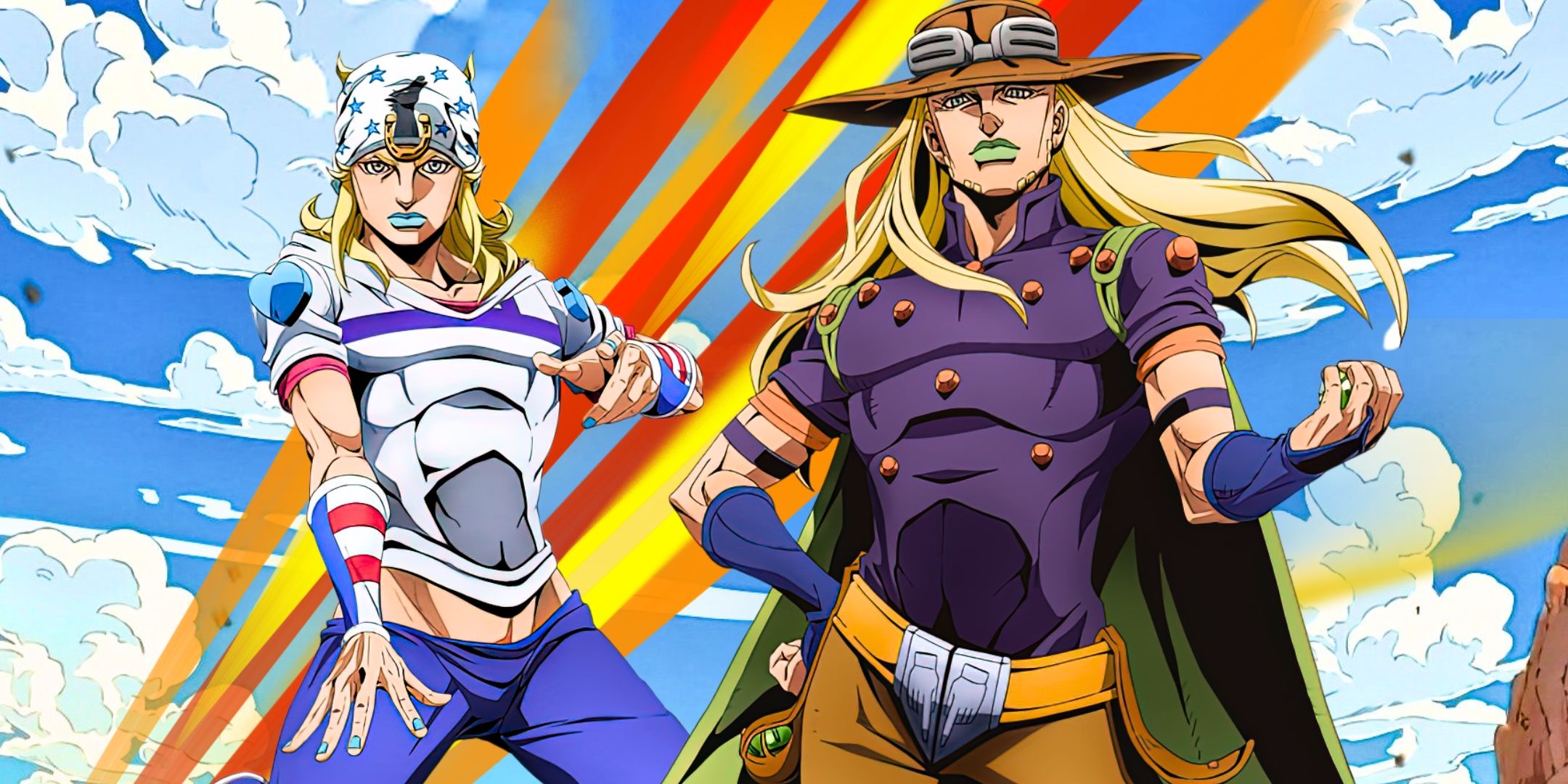
For more than a decade, David Production pulled off what was long considered an industry impossibility: translating Hirohiko Araki’s labyrinthine, high-fashion, hyper-stylized manga epic, JoJo’s Bizarre Adventure, into a cohesive, culturally transcendent anime juggernaut. From the Victorian melodrama of Phantom Blood to the mind-bending, reality-collapsing crescendo of Stone Ocean, the Tokyo-based studio has treated Araki’s legacy with devotional fidelity. Yet, as the cosmic dust settled on Jolyne Cujoh’s tragic yet liberating finale in late 2022, an electric, almost anxious hush fell over the global anime landscape. Every fan, critic, and industry observer knew what was waiting on the horizon: Steel Ball Run.
Widely regarded not just as Araki’s magnum opus, but as one of the single greatest sequential art narratives ever committed to paper, Steel Ball Run (Part 7) sits at the summit of modern manga discourse. The buzz surrounding its inevitable anime adaptation has reached a fever pitch. Whispers of pre-production, debates over voice casting, and genuine technical dread over its ambitious scope dominate anime forums and social media threads. To understand why Steel Ball Run is the ultimate white whale for David Production, one must look at how Araki completely dismantled his own mythos to rebuild it from the saddle up.
A Cosmic Reset: The Seinen Metamorphosis of Steel Ball Run
When Steel Ball Run first began serialization in 2004, it masqueraded as an ambiguous, standalone American period piece before formally declaring itself as the seventh installment of JoJo’s Bizarre Adventure. Crucially, in 2005, the series migrated from the weekly grind of Weekly Shonen Jump to the monthly pages of Ultra Jump. That editorial shift did not merely alter the release schedule—it detonated the narrative boundaries of Araki’s universe.
Unshackled from shonen conventions, Araki embraced a mature, seinen sensibility. The gritty, dust-choked American frontier of 1890 became the canvas for a grueling 6,000-kilometer cross-country horse race spanning from San Diego to New York City. The prize? Fifty million dollars. But beneath the veneer of historical sports drama lies a deeply conspiratorial, supernatural pilgrimage involving biblical relics, political intrigue, and existential body horror. The shift to a monthly format granted Araki the breathing room to draw sweeping, cross-hatched landscapes reminiscent of Western cinematic classics like Sergio Leone’s Once Upon a Time in the West, paired with Renaissance anatomical precision. For David Production, capturing this tonal metamorphosis demands a level of artistic maturity far exceeding anything required in the vibrant, suburban confines of Diamond is Unbreakable or the neon mafia alleys of Golden Wind.
Johnny Joestar and Gyro Zeppeli: Flawed Humanity and the Geometry of “The Spin”
Subverting the Joestar Paradigm
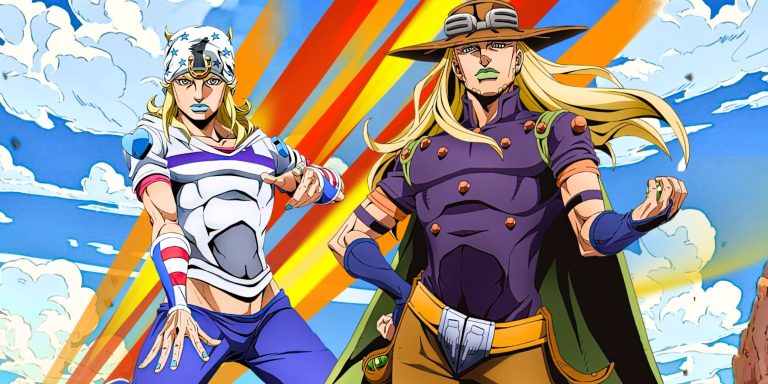
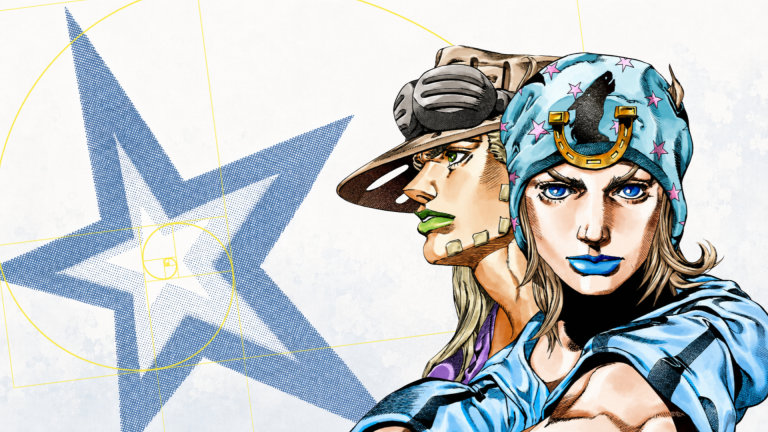
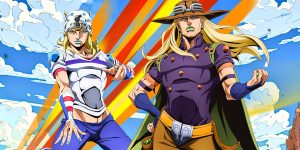
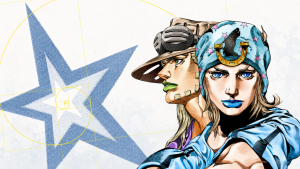
At the beating heart of Steel Ball Run is an unexpected, profoundly moving dynamic that stands as Araki’s finest character writing: Johnny Joestar and Gyro Zeppeli. Unlike Jonathan’s stoic chivalry, Jotaro’s cool detachment, or Giorno’s messianic resolve, Johnny Joestar begins the story as a broken man. A former equestrian prodigy struck down in his prime by hubris and paralyzed from the waist down, Johnny is bitter, self-pitying, and relentlessly desperate. He is not driven by an altruistic quest to save the world; he is a man clawing through the mud just to reach “zero” from “negative.”
Enter Gyro Zeppeli, a disgraced Neapolitan executioner’s son armed with steel spheres and razor-sharp bravado. Their relationship transcends the traditional shonen mentor-pupil archetype, evolving into an intensely nuanced brotherhood forged through campfire camaraderie, absurdity (including Gyro’s unforgettable musical musings on European cheeses), and shared trauma. They act as mirrors to one another’s psychological vulnerabilities, ground by the reality that their journey through the American wilderness is a process of painful self-resurrection.
The Transcendence of the Golden Ratio
Mechanically, Steel Ball Run redefines combat by taking a radical detour from standard Stand battles. Araki introduces The Spin (Kaiten), an ancient Zeppeli family discipline rooted in the Fibonacci sequence and the mathematical perfection of the Golden Rectangle. Stands still exist, but they are synthesized through Johnny’s evolving supernatural manifestation, Tusk, which matures across distinct ACTs in tandem with Johnny’s psychological healing. Animating the physical mathematics of The Spin—from the rotational energy warping the cellular fabric of Johnny’s nails to Gyro’s dimensional manipulation—presents an avant-garde visual challenge that demands kinetic, visionary storyboarding.
The Equestrian Crucible: David Production’s Technical Everest
If David Production has hesitated to deliver a premiere date for Steel Ball Run, the reason can be summarized in a single word: horses. Ask any veteran animator about the most punishing, labor-intensive subjects to animate in traditional 2D hand-drawn media, and horses consistently top the list. Capturing the anatomical dynamism of a galloping steed—the rippling musculature, shifting weight, complex quadrupedal gait cycles, and perspective-bending stampedes—is an animator’s nightmare.
Now, multiply that challenge by dozens of competitors tearing across varied topographies, from the blinding salt flats of Utah to the claustrophobic blizzards of the Rocky Mountains. Past anime adaptations that relied heavily on 3D computer graphics for equestrian sequences—such as segments of Attack on Titan or Berserk—frequently drew harsh criticism for uninspired, floaty assets that severed immersion. David Production faces a monumental decision:
Will they pioneer an ambitious, hyper-stylized hybrid pipeline using advanced cel-shaded 3DCG models meticulously blended with Araki’s thick line art, or will they marshal a legendary freelance brigade of master 2D key animators? The recent technical masterclasses seen in Fire Force and the luminous aesthetic polish of their Urusei Yatsura reboot prove David Production possesses elite talent. Still, Steel Ball Run demands an unprecedented synthesis of cutting-edge tech and grueling hand-drawn craftsmanship.
The Corpus, The President, and Moral Ambiguity
No discussion of Part 7’s cinematic weight is complete without addressing its thematic antagonist: Funny Valentine. The 23rd President of the United States is arguably Araki’s most compelling, ideologically formidable villain. Armed with the reality-splitting Stand Dirty Deeds Done Dirt Cheap (D4C), Valentine does not operate on petty malice. He is fueled by fanatic patriotism—a radical utilitarianism determined to claim the fragments of the Holy Corpse to guarantee America’s prosperity at the direct expense of the rest of the world.
This moral relativism turns Steel Ball Run into an interrogation of the American Dream, empire-building, and destiny. Supported by a lethal roster of competitors—including the predatory Diego “Dio” Brando and his prehistoric Stand Scary Monsters—every single encounter across the continent feels less like a monster-of-the-week altercation and more like a high-stakes survival thriller.
Riding Toward the Horizon: Why Patience Is a Virtue
The ferocious hunger for Steel Ball Run is a testament to its singular place in pop-culture history. It is the pinnacle of Araki’s career: a trans-genre tour de force that seamlessly welds a spaghetti Western aesthetic to existential cosmic mechanics and emotionally resonant character writing. For David Production, taking the time to tackle the horse-heavy production pipeline, craft the visual identity of The Spin, and cast the perfect voices to carry Johnny and Gyro’s odyssey is not a delay—it is an absolute necessity.
When the starting gun finally fires and the opening notes of a brand-new, Western-infused soundtrack echo across the frontier, it won’t just be another seasonal anime debut. It will be the grand arrival of anime’s next transcendent masterpiece. The long ride through the desert will be brutal, but the destination promises to redefine modern anime adaptation forever.
Now it’s your turn, Wibux readers: How should David Production approach animating the race’s infamous equestrian battles? Who is your dream voice casting pick for Gyro Zeppeli and Funny Valentine? Drop your theories and hot takes in the comments below!