

For the better part of the past decade, the fantasy anime landscape has suffered beneath the weight of its own fluorescent user interfaces. Between the monotonous parade of isekai protagonists checking their numerical stat screens and fantasy worlds constructed out of video-game shorthand, modern anime has largely forgotten how to evoke genuine wonder. The supernatural has been reduced to spreadsheets, skill trees, and overpowered incantations delivered with all the artistic tactile weight of a mobile gacha roll. Enter Witch Hat Atelier (Tongari Boushi no Atelier)—the visual messiah fantasy purists have spent years praying for.
When Kodansha and Bug Films officially revealed the long-anticipated anime adaptation of Kamome Shirahama’s magnum opus, the collective intake of breath across the global anime community was audible. This is not simply another popular manga receiving a seasonal greenlight; it is the cinematic translation of what is widely considered the most exquisitely drawn fantasy manga of the 21st century. With visionary director Ayumu Watanabe at the helm and musical maestro Yuka Kitamura composing, the premiere represents a watershed moment. Witch Hat Atelier is poised to remind the medium what fantasy looks like when it is treated not as a set of mechanical game systems, but as an artisanal, breathtaking miracle.
The Death of the Stat Screen: Magic as Tactile Craftsmanship
To understand why the adaptation of Witch Hat Atelier is such an explosive cultural event, one must first deconstruct Shirahama’s fundamental reinvention of the magic system. In the world of the Atelier, magic is not an innate genetic gift, nor is it fueled by shouting Latin-adjacent gibberish at the sky. It is draftsmanship. Spells are physical, intricate glyphs drawn with specialized silverwood ink and metal nibs, relying on the cold precision of keystones, cyclic rings, and kinetic arrowheads.
If an artist’s hand slips by a millimeter, the spell alters completely. If a circle remains unclosed, the magic refuses to ignite. This brilliant conceptual shift bridges the gap between high fantasy and blue-collar artisanal labor. Magic within Shirahama’s world carries the same tactile weight as carpentry, tailoring, or bookbinding. It demands patience, steady breathing, clean rulers, and ink-stained fingertips.
The Ink-Stained Geometry of Sigils
By framing spellcasting as an illustrative medium, Shirahama subtly pays homage to the very act of creating manga itself. When the young protagonist, Coco, spends hours hunched over a wooden drafting table erasing flawed lines, her struggle mirrors that of any creative fighting to manifest beauty out of a blank canvas. This grounding mechanic strips away the cheap power-scaling tropes that infect modern shonen and isekai. Victory in Witch Hat Atelier is rarely about who can conjure the biggest fireball; it is about who understands physics, spatial geometry, and compassion well enough to solve a crisis with a ruler and an inkwell.
The Impossible Assignment: Translating Shirahama’s Linework to Screen
For years, manga aficionados insisted that Witch Hat Atelier was inherently “unadaptable.” Shirahama, an illustrator whose portfolio includes variant covers for Marvel and DC Comics, draws with the decadent sensibilities of the late 19th-century Art Nouveau movement. Her pages evoke the copperplate etchings of Albrecht Dürer, the flowing organic forms of Alphonse Mucha, and the dreamlike sensibilities of Jean Giraud (Moebius). Every panel is an ornate tapestry of micro-crosshatching, dynamic panel borders shaped like gothic cathedral windows, and cloth physics that feel almost three-dimensional.
The monumental burden of translating this dense, woodcut-adjacent aesthetic into 24-frames-per-second animation has fallen upon Bug Films. While still a relatively young studio, Bug Films proved its kinetic mettle with Zom 100: Bucket List of the Dead, demonstrating a fearless approach to bold color palettes and non-traditional compositing. However, the true linchpin of the production is director Ayumu Watanabe. Having previously directed the visually transcendent Children of the Sea and the masterfully paced Summer Time Rendering, Watanabe possesses the exact pedigree required to balance quiet, poetic majesty with visceral cinematic scale.
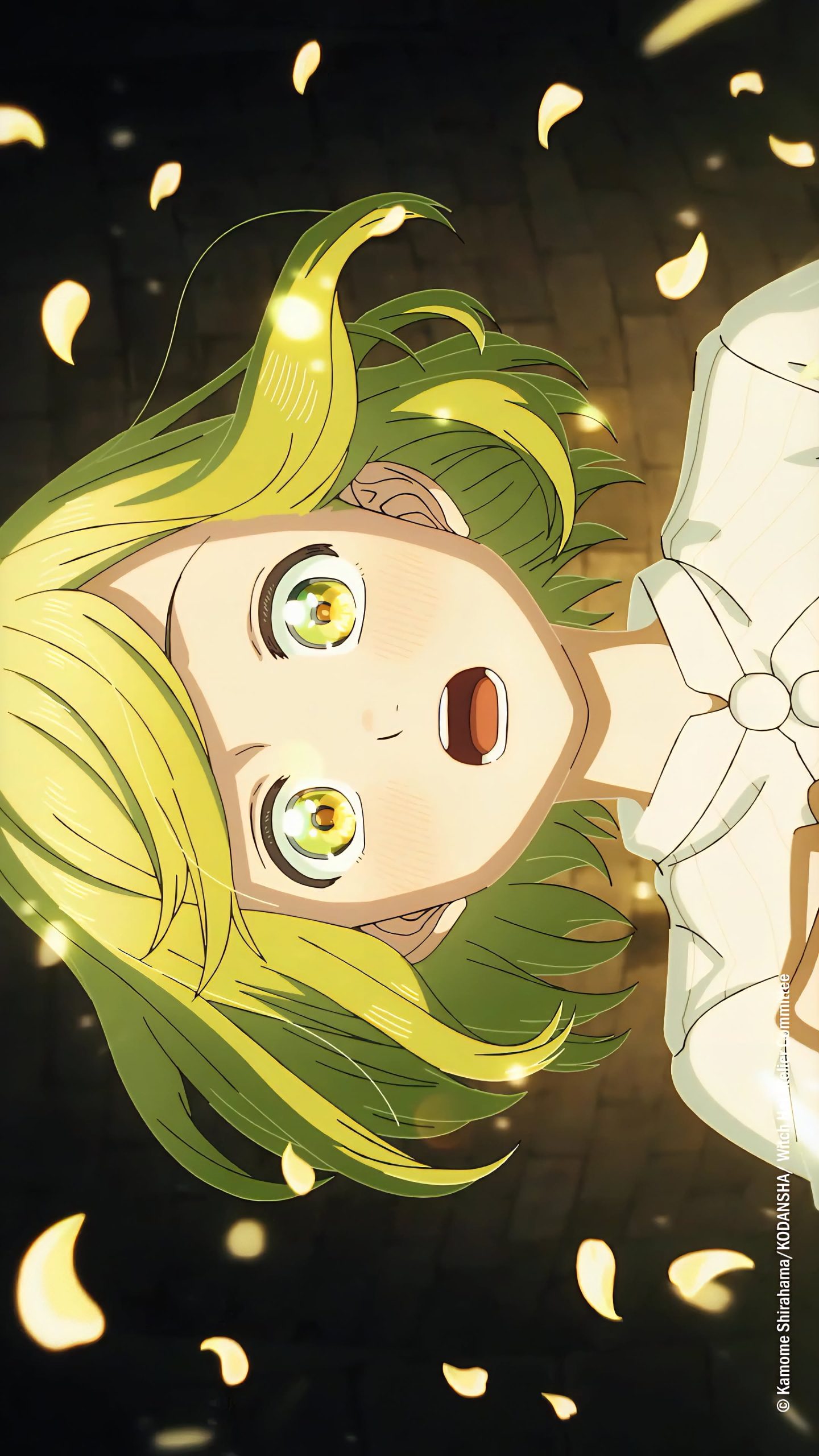
The early visual materials show a production that refuses to cut corners with flat digital sheen. Instead, the team has embraced a soft, textured approach that mimics the tooth of watercolor paper, utilizing dynamic line-weight filters that preserve the hand-crafted personality of Shirahama’s pen. It is a flex of modern compositing techniques designed to serve classical illustration—a synthesis that promises to stand beside Studio Ghibli’s peak output.
Coco’s Tragedy: Wonder, Guilt, and the Deconstruction of Innocence
At the beating heart of this sprawling visual masterwork is Coco, a humble seamstress’s daughter whose life is permanently upended by a tragic catastrophe. Unlike typical chosen-one narratives, Coco’s introduction to the world of magic is defined entirely by genuine childlike curiosity curdling into unimaginable trauma. Tricked by a masked, renegade witch into copying forbidden runes, Coco accidentally petrifies her own mother in stone—an inciting incident that imbues her journey with an unbearable, poignant gravity.
Coco’s subsequent apprenticeship under the enigmatic witch Qifrey is not a triumphant hero’s journey; it is an agonizing desperate quest for atonement. Her earnest, sun-drenched optimism is constantly operating in the shadow of deep psychological survivor’s guilt. Every new spell she masters is tainted by the silent, aching realization that if she had only possessed that knowledge hours sooner, her mother would still be breathing.
Qifrey and the Fragility of Mentorship
Her master, Qifrey, subverts the archetype of the warm, patriarchal wizard like Gandalf or Dumbledore. While undeniably gentle, protective, and fiercely nurturing toward Coco and his other apprentices—Agott, Tetia, and Richeh—Qifrey operates with a razor-sharp, Machiavellian edge. Consumed by a personal vendetta against the Brimmed Caps (a radical faction of forbidden magic users), Qifrey views Coco not only as a vulnerable child in need of sanctuary, but as a live wire connecting him to the ghosts of his past. The dynamic between master and student is electric precisely because it oscillates between paternal tenderness and calculated moral ambiguity.
The Great Lie: The Politics of an Artificially Gatekept World
Beneath the fairytale whimsy of cobblestone coastal villages and flying carriages lies one of the most razor-sharp political allegories in modern fantasy. The central conflict of Witch Hat Atelier hinges on a profound systemic lie: anyone can perform magic.
The ruling wizarding elite, terrified by the historical memory of apocalyptic wars fought with unbridled flesh-altering magic, engineered a total societal conspiracy. To prevent humanity from realizing that drawing a spell requires zero divine lineage, witches established a strict oligarchy. They use memory-erasure magic—the Memory Wipe—to violently lobotomize the minds of any uninitiated civilian who witnesses the drawing of a rune. The Pointed Caps (the established order) frame this gatekeeping as benevolent paternalism to protect the common folk from their own destructive impulses. Conversely, the Brimmed Caps reject this secrecy, seeking to democratize magic regardless of the catastrophic collateral damage.
This dynamic elevates the narrative far beyond standard high fantasy. It forces both Coco and the audience to grapple with uncomfortable ethical dilemmas: Is a peace built on state-enforced ignorance and memory mutilation truly just? Or does hoarding knowledge inevitably create a brittle, authoritarian world ripe for revolution?
The Antidote to Modern Fantasy Fatigue
As the premiere draws near, the cultural anticipation for Witch Hat Atelier signals a broader shift in the anime fandom’s appetite. After years of being fed assembly-line content optimized for algorithm engagement, viewers are hungry for storytelling that treats their intelligence with respect and their eyes to unmatched beauty. Shirahama’s narrative does not offer easy answers, nor does it hide behind convenient genre shortcuts.
With its potent intersection of jaw-dropping Art Nouveau aestheticism, psychologically complex characters, and a thematic core that questions the ethics of institutional power, Witch Hat Atelier has all the ingredients to become anime’s next generational milestone. If Bug Films can successfully carry the weight of Shirahama’s majestic linework across its run, we are not just looking at the anime of the season—we are witnessing the birth of a modern classic.
Are you ready to step into Qifrey’s atelier, or do you think the manga’s legendary artwork is simply too detailed for television animation to capture? Let us know your thoughts, theories, and favorite panels in the comments below!