


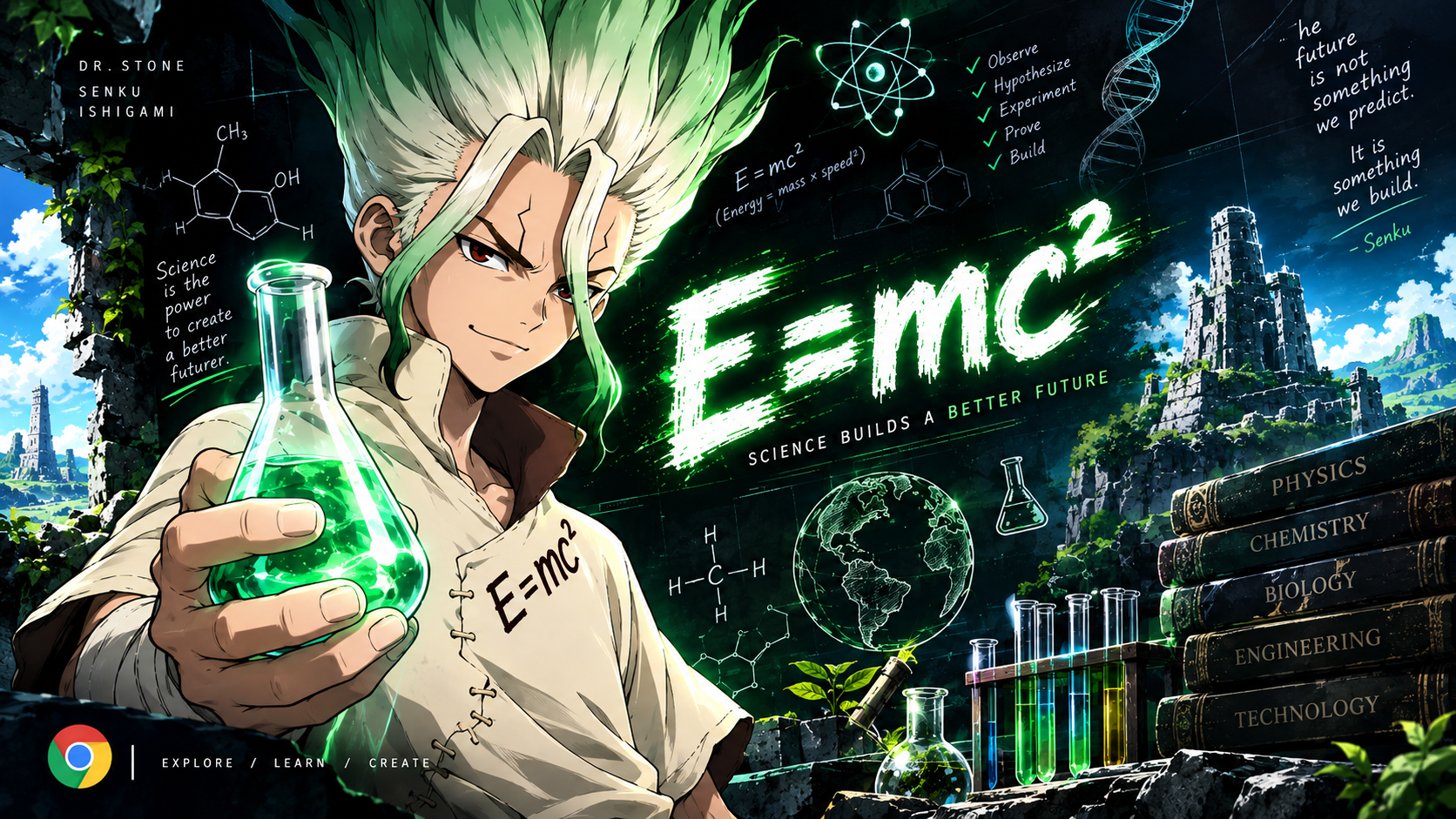
When Riichiro Inagaki and Boichi first introduced anime fandom to a world petrified in stone, few could have anticipated that a scrappy survival story fueled by calcium carbonate and rudimentary black powder would evolve into an interplanetary space odyssey. Yet, here we stand on the precipice of history. With the arrival of Dr. STONE: Science Future—the fourth and climactic final season produced by TMS Entertainment—Senku Ishigami’s Kingdom of Science is preparing for its most audacious gambit yet: a direct voyage to the Moon. In a contemporary shonen landscape dominated by cursed energy, demon slayers, and dark fantasy deconstructions, Dr. STONE remains an exhilarating outlier. It is a work of unyielding techno-optimism, and its final act promises to transform the vacuum of space into an arena of sheer human defiance.
The Great Leap Upward: Logistics of the Lunar Mission
Reaching the Moon is not merely a narrative milestone; it is the ultimate thematic victory lap for a narrative built on the staggering weight of the cumulative human tech tree. In typical Inagaki fashion, the narrative does not hand-wave the monumental logistics of aerospace engineering. The journey to the lunar surface is an agonizing, step-by-step masterclass in scientific iteration. Where other series would invoke magical relics or esoteric power-ups, Senku and his international coalition must forge everything from precision microchips to liquid-fuel propulsion systems out of raw planetary resources.
From Stone Knives to Saturn V: The Unprecedented Scale
The upcoming season showcases a global effort that redefines the scope of the anime. The Kingdom of Science is no longer confined to the lush wilderness of Japan or the agrarian colonies of the Americas. Instead, the final season orchestrates a planetary supply chain, mobilizing the world’s best minds to solve the brutal realities of rocketry: gravitational escape velocity, telemetry, life-support recyclers, and payload mass ratios. Watching Senku, Chrome, and Kaseki bridge thousands of years of technological evolution into a singular launch vehicle captures a visceral sense of wonder rarely matched in modern animation.
Moreover, the mission’s design is uncompromisingly hazardous. The crew configuration—the razor-sharp analytical mind of Senku, the hyper-instinctive navigational genius of Ryusui Nanami, and the unmatched physical prowess of Kohaku—embodies the tripartite foundation of human survival. The stakes are chillingly finite: there are no respawn points, no second chances, and zero room for computational error in the freezing abyss of space.
Decoding the Static: The Enigma and Terror of Why-Man
Hovering over this industrial achievement is the series’ greatest existential threat: Why-Man. Ever since that chilling, synthesized voice hijacked the Kingdom of Science’s crude radio frequencies with a relentless Morse code query—“WHY? WHY? WHY?”—the specter of humanity’s petrifaction has transformed from an ancient tragedy into an active, intelligent malice. Why-Man is not simply a villain with a tragic backstory or a desire for territorial conquest; Why-Man represents the cosmic unknown, an uncanny intelligence broadcasting from the desolate plains of the Moon.
Cosmic Nihilism Meets Radical Rationalism
The psychological tension of this impending confrontation cannot be overstated. Throughout their journey, Senku and his allies have conquered nature’s indifference through rational inquiry. But Why-Man represents an ideological antithesis to human ambition. By weaponizing the Medusa devices to freeze human consciousness across millennia, Why-Man framed petrification not as an assault, but as a twisted form of preservation—an absolute stasis that halts entropy at the cost of life itself.
When Senku touches down on the regolith, the clash will not be resolved through typical shonen slugfests. It will be an epistemological debate between stagnation and progress, between the terror of mortality and the chaotic beauty of human discovery. The ultimate confrontation challenges Senku’s core philosophy: can empirical science answer the question of why consciousness deserves to exist in a cold, indifferent universe?
TMS Entertainment’s Monumental Task: Visualizing the Infinite Dark
Bringing Boichi’s jaw-dropping, kinetic manga artwork to life has always been a high-wire act for TMS Entertainment, but Science Future demands an entirely new visual lexicon. The studio, having demonstrated remarkable consistency across previous seasons, faces the immense challenge of rendering the stark, photorealistic contrast of deep space without losing the expressive, comedic elasticity that defines the franchise.
Translating Boichi’s Hyper-Detailed Line Art into Motion
Boichi’s spreads during the Moon Mission arc are legendary among manga connoisseurs for their obsessive technical draftsmanship—every bolt on the lunar lander, every grain of moon dust, and every reflection on a space suit visor was inked with breathtaking precision. For the production team, capturing this scale across a multi-cour final season is a monumental undertaking. The adaptation must balance the claustrophobic dread of a cramped orbital capsule against the breathtaking, silent panorama of the Earth hanging in the blackness.
Complementing this visual ambition is the return of composers Tatsuya Kato, Hiroaki Tsutsumi, and Yuki Kanesaka. The musical identity of Dr. STONE has brilliantly fused sweeping orchestral suites with Celtic folk and pulsating electronic beats. For the final season, the acoustic palette must evoke the vast emptiness of the cosmos while delivering the soaring emotional crescendo of a mission decades in the making.
The Triumph of Humanism: Dr. STONE’s Lasting Cultural Legacy
As we brace for the final cour, the broader cultural resonance of Dr. STONE comes sharply into focus. In a media landscape saturated with chosen-one prophecies and inherited bloodlines, Senku Ishigami stands out as an anti-chosen one. He possesses no supernatural lineage; his supreme asset is an unyielding reverence for the collective memory of human achievement. When Senku builds, he does so on the shoulders of the billions of anonymous thinkers, artisans, and dreamers who preceded him.
A Cathartic Convergence Decades in the Making
The lunar mission is also a profoundly personal pilgrimage. Fans have never forgotten Byakuya Ishigami—Senku’s adoptive father—and the crew of the International Space Station who left behind the glass records, the gold, and the very foundation of the Kingdom of Science from the stars. Byakuya looked down upon a stone-covered Earth with unwavering faith that his son would one day look back up at the cosmos. When the Kingdom of Science finally breaks the atmosphere, it marks the completion of a multi-millennial relay race of paternal love and scientific optimism.
Community anticipation is electric. Fans across social platforms and dedicated anime forums are bracing for an adaptation that promises to stick the landing—a rarity in long-running shonen adaptations. By splitting the finale into a comprehensive, multi-part journey, the production team is signaling that no corner will be cut, no scientific revelation rushed, and no emotional farewell minimized.
The Final Countdown for the Kingdom of Science
Dr. STONE: Science Future is more than just another seasonal finale; it is a monument to the narrative potential of hard-sci-fi shonen. As Senku secures his helmet, checks the telemetry, and ignites the thrusters, the Kingdom of Science prepares to prove that human ingenuity can pierce any darkness, conquer any distance, and answer even the most terrifying questions whispered across the void of space. The rocket is on the launchpad, the calculations are ten billion percent complete, and the stage is set for a masterwork of modern animation.
Are you ready for the final countdown? Will Senku’s science prevail against the cosmic mystery of Why-Man, or will the silence of space consume humanity’s final hope? Share your wildest theories and launch-day expectations in the comments below!