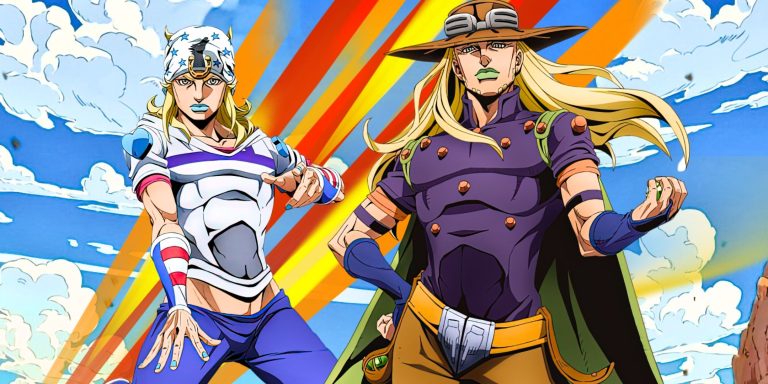
Ever since the melancholic, celestial tones of “What a Wonderful World” closed out the animated adaptation of Stone Ocean, the international anime community has held its collective breath. For casual observers, the conclusion of the original Joestar bloodline’s saga felt like a definitive finale. For the initiated, however, it was merely the prologue to the main event. In forums, Discord servers, and convention halls across the globe, a single whisper has amplified into a deafening roar: Steel Ball Run is coming, and it has the potential to fundamentally redefine the landscape of modern anime.
Serialized between 2004 and 2011, Part 7 of Hirohiko Araki’s long-running epic is rarely discussed merely as another arc in a quirky franchise. Instead, it occupies a hallowed pedestal alongside works like Kentaro Miura’s Berserk and Takehiko Inoue’s Vagabond as one of the highest-rated manga of all time. Moving the narrative to a completely rebooted continuity and trading late-twentieth-century urban backdrops for the vast, unforgiving expanse of 1890s America, Steel Ball Run (SBR) represents Araki’s creative zenith. Yet, as excitement reaches a fever pitch regarding David Production’s eventual adaptation, the studio faces an unprecedented technological and artistic gauntlet. This is not simply another sequel; it is the ultimate test of contemporary anime production.
A Transcontinental Odyssey: The Reinvention of Hirohiko Araki
To understand the sheer magnitude of the anticipation surrounding Steel Ball Run, one must examine its origins. In 2004, Araki made the calculated decision to migrate the series from the frenetic, youth-oriented confines of Weekly Shonen Jump to the monthly seinen pages of Ultra Jump. The artistic liberation was instantaneous. Unshackled from weekly deadlines and content restrictions, Araki transformed a whimsical tale of flamboyant brawlers into a sprawling, hyper-detailed psychological western.
The premise is deceptively direct: an eccentric philanthropist organizes the Steel Ball Run race, a grueling, 6,000-kilometer cross-country trek from San Diego Beach to New York City, boasting a staggering $50 million grand prize. Tens of thousands of contestants flock to the starting line—jockeys, outlaws, monarchs, and mystics—each seeking wealth, glory, or salvation. However, this period-accurate sporting spectacle soon unfurls into a labyrinthine cosmic conspiracy involving interdimensional espionage, severed holy relics, and cold-blooded political maneuvering. By synthesizing classic American mythos, Sergio Leone’s dusty cinematics, and unbridled body horror, Araki crafted an odyssey that feels both historically grounded and wildly surreal.
Johnny and Gyro: Deconstructing the JoJo Dynamic
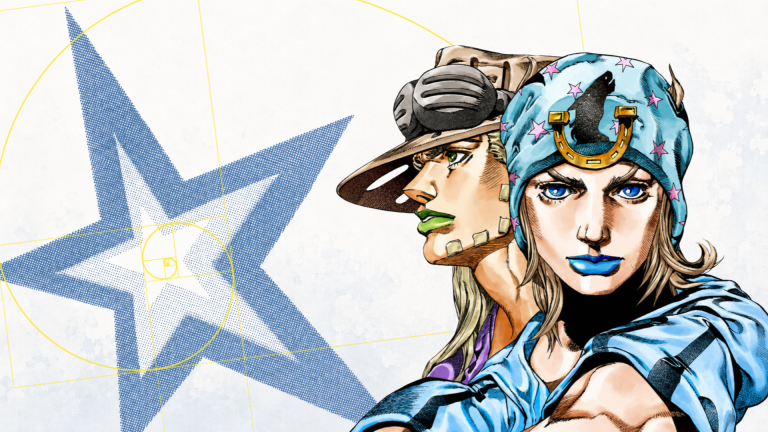
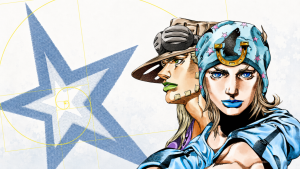
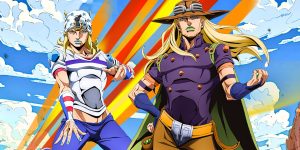
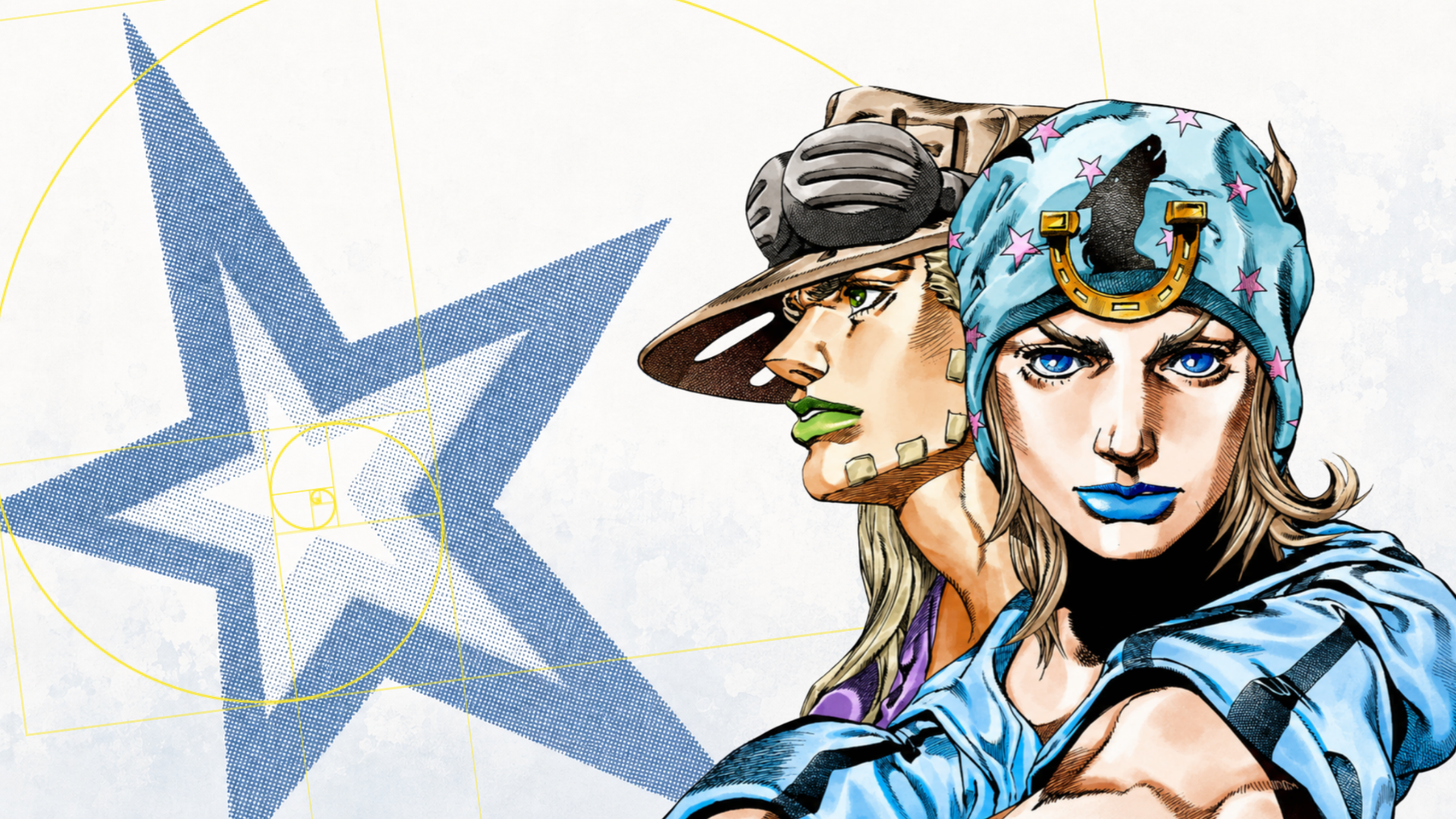
At the beating heart of this trans-American trek lies what is arguably the most nuanced, emotionally resonant partnership in sequential art: Johnny Joestar and Gyro Zeppeli. Prior JoJo pairings often operated on archetypal dynamics—the stoic warrior and his flamboyant peer, or the reckless youth guided by an aging mentor. Part 7 completely tears down these conventions.
Johnny Joestar’s Dark Determination
In Johnny, Araki presents his most unconventional protagonist. A former horse-racing prodigy whose career and mobility were ripped away by an act of his own juvenile hubris, Johnny begins the story not as a paragon of virtue, but as a bitter, paraplegic outcast rotting on the sidelines of society. He does not join the race to save the world, rescue a damsel, or claim political power; he enters because catching a fleeting glimpse of Gyro Zeppeli’s mystic abilities temporarily restored sensation to his legs.
Johnny’s journey is not a hero’s ascent from zero to a hundred—it is a desperate, violent clawing from negative to zero. He possesses what characters within the narrative recognize as the terrifying glint of “Dark Determination”: a willingness to commit cold, remorseless violence if it means reclaiming his humanity. This moral ambiguity makes him a breathtakingly modern protagonist for an anime medium increasingly hungry for complex anti-heroes.
Gyro Zeppeli’s Golden Eccentricity
Counterbalancing Johnny’s brooding, razor-sharp desperation is Gyro Zeppeli, a disgraced Neapolitan royal executioner who operates under a razor-thin veneer of absurdist theatrics and golden teeth engraved with “GO! GO! ZEPPELI.” Gyro enters the race to win royal clemency for an innocent boy sentenced to death back home. Despite his slapstick jokes about cheese and terrible musical compositions, Gyro acts as the moral anchor and metaphysical instructor of the journey. Their dynamic evolves organically through campfire dialogues, quiet mundane hardships, and battlefield traumas, forging a bond that feels uniquely raw, deeply fraternal, and tragically destined for heartache.
The Mechanics of the Spin: Beyond the Stand Paradigm
While Stands naturally return in Part 7, they no longer represent the sole zenith of combat. In their place stands the “Spin,” an ancient, forgotten martial discipline cultivated by the Zeppeli family. Grounded in the mathematical reality of the Fibonacci Sequence and the Golden Ratio, the Spin harnesses kinetic, rotational energy through specially forged steel spheres, transforming basic geometry into a lethal, flesh-twisting weapon.
This conceptual evolution completely alters the tactical rhythm of the franchise’s battles. Johnny’s Stand, Tusk, does not arrive fully formed with godlike supremacy; it manifests as a pathetic, worm-like creature that evolves through distinct “Acts” in tandem with Johnny’s physical mastery of the Spin and psychological maturation. By the time combat escalates to the dimensional-tearing anomalies of Tusk ACT 4, Araki manages to fuse advanced metaphysical theory with visceral, kinetic brutality. Translating this complex visual language—where mathematical golden spirals literally dictate movement, anatomy, and framing—demands a directorial finesse that few modern anime adaptations ever attempt.
The Galloping Nightmare: David Production’s Technical Frontier
Why has the production of Steel Ball Run been treated with such hushed reverence and cautious hesitation? The reality comes down to a brutally pragmatic animator’s maxim: horses are the graveyard of 2D animation.
Quadruped movement—particularly horses galloping at dynamic angles, shifting muscular weight, and maintaining accurate anatomical proportions—is widely recognized as one of the most notoriously labor-intensive tasks in the entire industry. Steel Ball Run does not merely feature a horse in the background; it features dozens of them, locked in high-velocity, close-quarters combat across plains, rivers, and blizzards for hundreds of chapters.
David Production, which has masterfully steered every iteration of the franchise since 2012, finds itself at a pivotal crossroads. A reliance on heavy, unpolished 3D CGI models could completely shatter the organic, hand-drawn grit that defines Araki’s later art style, a pitfall that has alienated fandoms of other high-profile adaptations. Conversely, attempting to animate hundreds of equestrian chase sequences through pure 2D keyframing would cause production schedules and budgets to implode. The eventual adaptation will likely require a revolutionary hybrid approach—meticulously cel-shaded CGI rigs integrated seamlessly with hand-drawn keyframe character work. The industry-wide wait for SBR is not just a question of *when*, but a question of whether the medium’s current pipeline is technologically equipped to survive it.
A Battle for the American Soul
Beyond the logistical nightmare of its horses and the kinetic splendor of its combat, Steel Ball Run endures in public consciousness because of its staggering thematic ambition. It presents an antagonist in the form of Funny Valentine, the 23rd President of the United States, whose reality-shifting Stand Dirty Deeds Done Dirt Cheap (D4C) and unyielding brand of utilitarian patriotism challenge the very definitions of villainy. Valentine’s quest to collect the mummified Corpse Parts of a nameless Saint (strongly implied to be Jesus Christ Himself) forces the audience to confront questions of sacrifice, destiny, imperialism, and the cost of national prosperity.
When David Production officially fires the starter pistol on this production, it will mark more than just the return of a beloved anime property. It will be the grand translation of a masterwork that permanently altered its medium—a gritty, tragic, beautiful reinvention of the American frontier seen through the fractured kaleidoscope of Japan’s most idiosyncratic creative mind.
The hype is not just justified; it is inevitable. The only real question left is whether we, and the animators tasked with rendering it, are ready for the ride. What are your expectations for David Production’s visual approach? Drop your theories, dream voice cast picks, and animation hopes in the comments below, and keep your browsers locked to Wibux.com for breaking updates on the transcontinental race.