

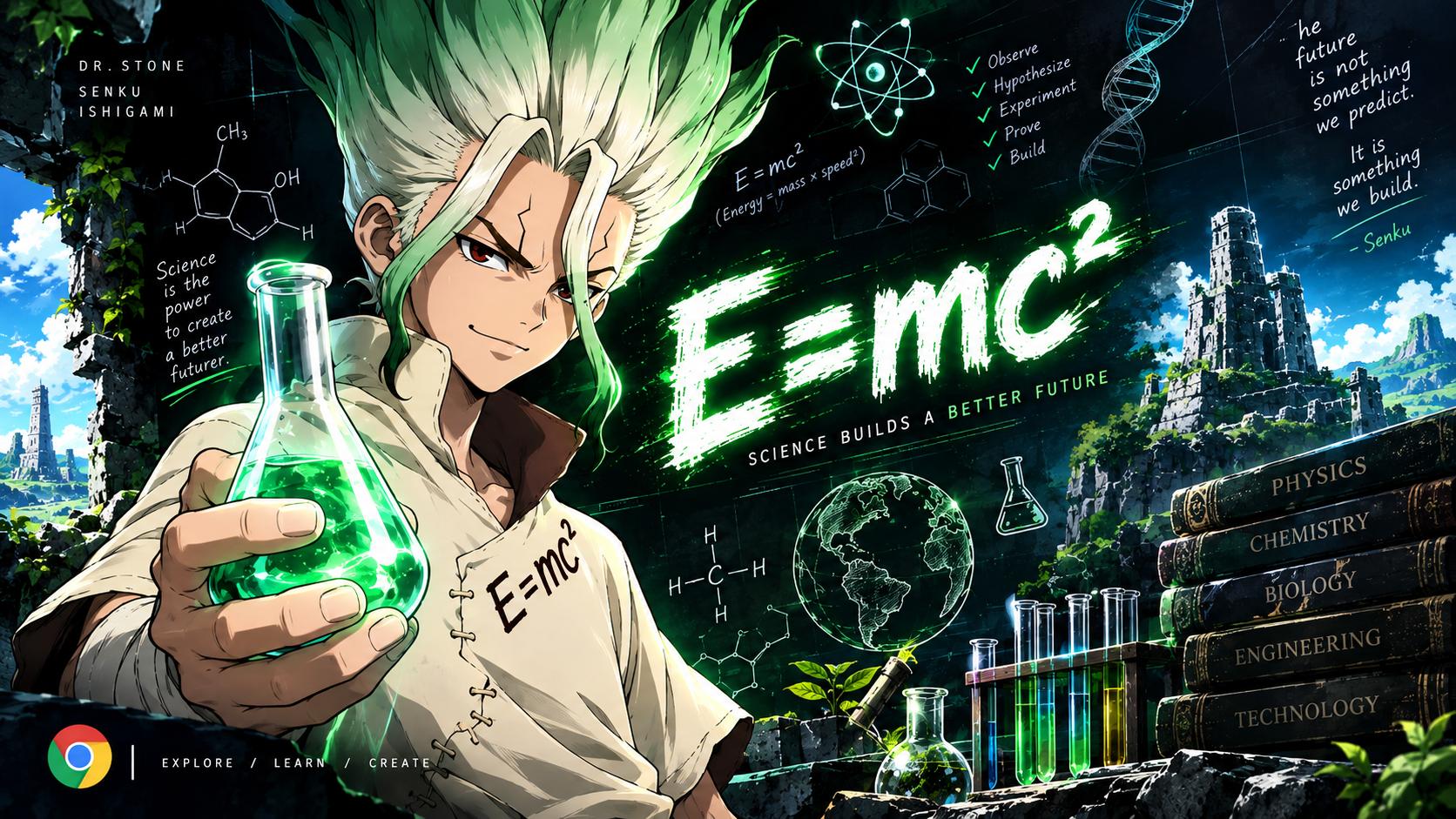
Dr. STONE Science Future: The Grand Finale That Turns Shonen Manga Into a Love Letter to Human Civilization
Few anime series have ever dared to make science itself the protagonist. While the shonen landscape overflows with power scaling debates and transformation sequences, Dr. STONE has spent its entire run arguing something radical: that the most powerful weapon humanity has ever wielded is the scientific method. Now, with Dr. STONE: Science Future — the fourth and final season — TMS Entertainment is preparing to launch Senku Ishigami and the Kingdom of Science on their most audacious mission yet: a journey to the Moon to confront Why-Man, the enigmatic antagonist whose identity and motivations have haunted the series since its earliest arcs. This isn’t just a finale. It’s the culmination of a thesis statement that began with a stone-age campfire and ends among the stars.
For a series that began with a teenager reinventing civilization from scratch using limestone and bat guano, the sheer narrative escalation of a lunar mission feels both impossibly ambitious and perfectly inevitable. Let’s break down everything we know about this final season, what it means for the characters, and why its themes have never been more relevant.
From Stone World to the Stars: The Roadmap to the Moon
The trajectory of Dr. STONE has always been a masterclass in escalation through logic rather than spectacle. Senku didn’t punch his way to progress — he calculated it. Season 1 gave us the reinvention of electricity and antibiotics. Season 2 delivered the Stone Wars. Season 3, Dr. STONE: New World, expanded the scope to global exploration, treasure hunting aboard the Perseus, and the terrifying revelation that Why-Man’s signal originated from the Moon itself. Each phase of the story represented a new epoch of human technological development, compressed into a single lifetime.
Science Future takes this conceit to its logical, breathtaking extreme. Senku and his allies must now build a functional spacecraft — from a civilization that was literally rubble just a few years prior — to reach the lunar surface. The manga source material by Riichiro Inagaki and Boichi dedicates significant page count to the engineering challenges involved: rocket fuel synthesis, life support systems, communication relay networks, and the geopolitical diplomacy required to unite every surviving faction on Earth behind a single, species-defining mission. It’s Apollo 13 meets post-apocalyptic shonen, and it’s glorious.
The Science of Believability
What has always set Dr. STONE apart from its Weekly Shonen Jump peers is its commitment to grounded science. Consulting with real scientists and engineers, Inagaki ensured that Senku’s inventions — while compressed in timeline — follow real chemical and physical principles. The rocket science in this final arc is no exception. The series doesn’t hand-wave its way to the Moon; it earns the launch sequence through dozens of chapters of material science, trial and error, and collaborative problem-solving. For TMS Entertainment, adapting this material means balancing hard science exposition with the emotional momentum of a finale — a challenge that will define the season’s legacy.
Why-Man Unmasked: The Petrification Mystery Reaches Its Climax
The identity and nature of Why-Man represents one of the most carefully constructed mysteries in modern shonen manga. For years, fans theorized endlessly: Was Why-Man an alien intelligence? A rogue AI? A surviving human with godlike technology? The truth, as manga readers already know, is simultaneously simpler and more philosophically devastating than most predictions anticipated.
Without venturing into explicit spoiler territory for anime-only viewers, what can be said is this: Why-Man’s nature forces Senku — and the audience — to reckon with fundamental questions about the purpose of consciousness, the definition of life, and whether eternal preservation is the same as living. The petrification event that turned all of humanity to stone wasn’t random cruelty. It was, from a certain perspective, an act of salvation. This moral complexity elevates the final confrontation far beyond a typical shonen boss fight. There are no energy blasts or power-ups here. The “battle” is ideological, scientific, and deeply human.
Senku vs. Eternity: A Conflict of Philosophies
Senku Ishigami has always been an unusual shonen protagonist. He doesn’t grow stronger through rage or willpower — he grows stronger through knowledge. His confrontation with Why-Man is the ultimate test of that ethos. Where Why-Man offers a kind of immortality through stasis, Senku champions the messy, fragile, gloriously impermanent nature of human progress. It’s a debate between entropy and preservation, between the safety of stone and the danger of being alive. In an era where existential anxieties about AI, climate change, and civilizational collapse dominate public discourse, this thematic framework feels almost prophetic. Dr. STONE doesn’t just entertain — it argues for the value of striving, of failing, of building something even when you know it won’t last forever.
TMS Entertainment’s Animation Legacy and the Weight of a Finale
TMS Entertainment has shepherded Dr. STONE through its entire animated run, and the studio’s track record with the property has been a study in steady improvement. Season 1 established a vibrant, expressive visual identity. The New World arcs introduced more ambitious action choreography and environmental design. For Science Future, the stakes are existential — both narratively and for the studio’s reputation.
Adapting a lunar mission sequence demands a level of visual ambition that few TV anime attempt. The vastness of space, the claustrophobia of a spacecraft interior, the alien stillness of the lunar surface — these are environments that require meticulous art direction and compositing work. Early promotional materials suggest TMS is rising to the occasion, with key visual artwork showcasing Senku in a spacesuit against the Earth-lit lunar horizon, a single image that encapsulates the series’ entire journey from primitive survival to cosmic exploration.
The soundtrack, too, will play a critical role. Composer Tatsuya Katou and the series’ musical collaborators, including artists like BURNOUT SYNDROMES and Fujifabric who have delivered iconic opening themes, must score sequences that carry the emotional weight of humanity’s second chance at reaching the stars. If TMS nails the launch sequence and the lunar landing with the gravitas they deserve, these moments could become iconic in anime history.
Community Reception and the Cultural Moment
The Dr. STONE fandom occupies a unique space in the anime community. It skews slightly older, attracts viewers with STEM backgrounds, and generates fan content that is as likely to be a chemistry tutorial as it is fan art. The announcement of the final season has galvanized this community, with manga readers expressing both excitement and anxiety about how the ending will be adapted.
The manga’s conclusion in 2022 was met with broadly positive reception, though some readers felt the pacing of the final chapters was rushed — a common criticism of Weekly Shonen Jump endings. This presents TMS with both a challenge and an opportunity: the studio has the chance to expand and refine the finale’s pacing, giving key emotional beats more room to breathe. If the anime can smooth out the manga’s final sprint, Science Future could be remembered not just as a faithful adaptation but as the definitive version of the story’s conclusion.
On social media platforms and forums like Reddit’s r/DrStone, speculation about episode counts, potential anime-original additions, and which moments will serve as cliffhangers has reached a fever pitch. The global simulcast model ensures that this finale will be experienced collectively, in real-time, by millions of viewers worldwide — a fitting send-off for a series about the power of collective human effort.
A Farewell to the Kingdom of Science
Dr. STONE: Science Future isn’t just the end of an anime series. It’s the conclusion of one of the most intellectually ambitious narratives in shonen history — a story that trusted its audience to find drama in distillation columns and heroism in hypothesis testing. Senku Ishigami’s journey from a petrified teenager to the leader of a lunar expedition is, at its core, a retelling of the entire arc of human civilization: from stone tools to spacecraft, from superstition to science, from isolation to unity.
As TMS Entertainment prepares to deliver this grand finale, the question isn’t whether the series will stick the landing — it’s whether the anime industry will ever produce anything quite like it again. In a medium that often celebrates the supernatural, Dr. STONE dared to find the miraculous in the natural, and that legacy will endure long after the final episode airs.
Stay locked to Wibux.com for full episode coverage, analysis, and community discussion as Dr. STONE: Science Future launches into its final frontier. The countdown has begun — and as Senku would say, this is exhilarating.