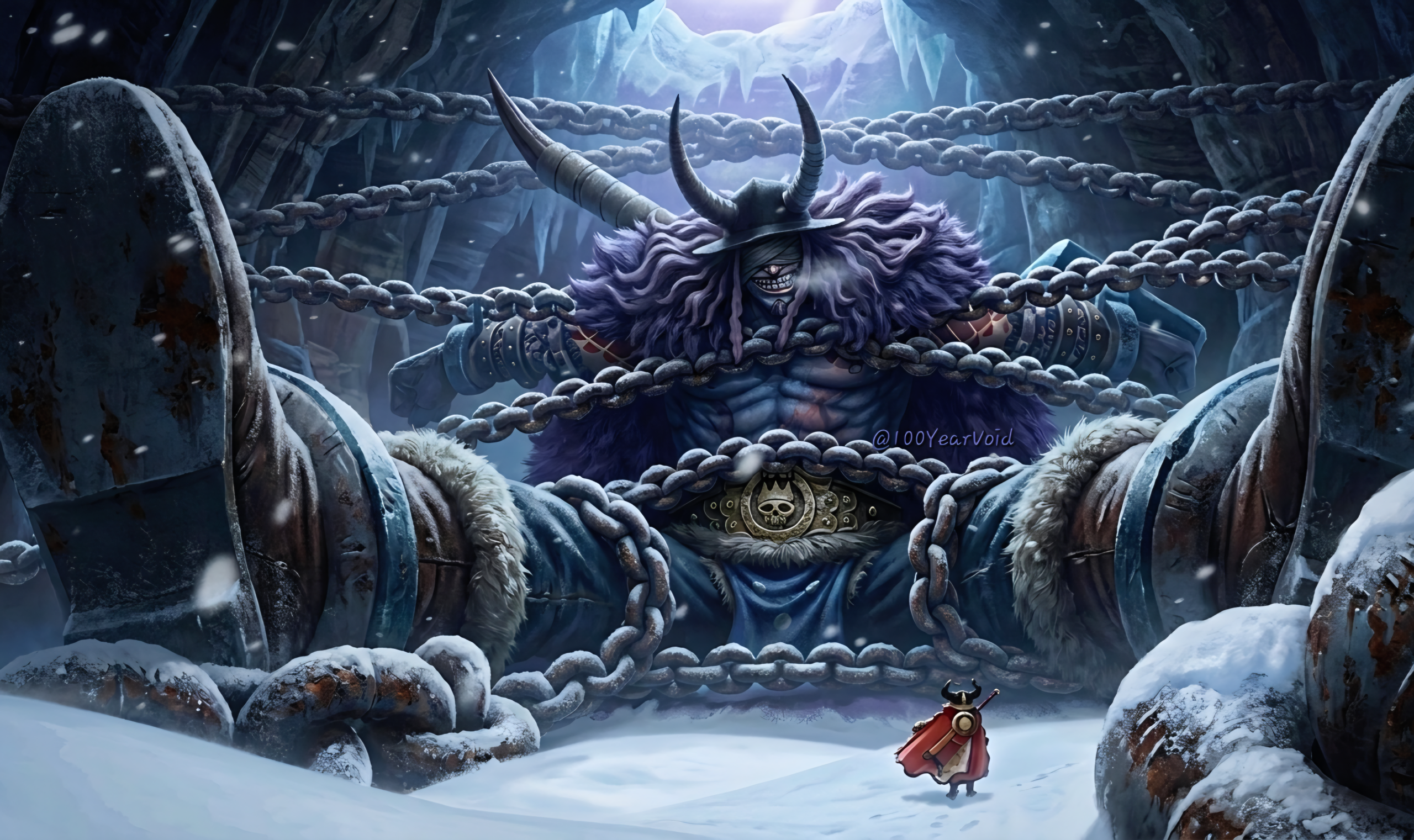
Few artistic milestones in modern sequential storytelling carry the gravitational pull of Eiichiro Oda’s One Piece. Following the seismic revelations of Egghead Island—where Dr. Vegapunk dismantled eight centuries of historical propaganda and broadcasted the grim reality of a slowly drowning world—the narrative has docked at the mythological shores of Elbaf. Yet, as the fandom collectively casts its gaze toward the horizon of Chapter 1200, it has become blindingly clear that the land of war and honor is not merely a nostalgic playground for Usopp’s dreams or a lore-dump repository. It is a powder keg. Beneath the colossal roots of the sacred realm lies an apocalyptic history waiting to be excavated, guarded by a monarch in chains whose imminent release threatens to upend the delicate balance of the Final Saga.
The prevailing theory circulating through deep-lore circles suggests that Chapter 1200 will serve as Oda’s definitive pivot into global cataclysm: a masterclass chapter that unleashes Prince Loki’s divine wrath while exposing the buried war relics of the Void Century, permanently transforming Elbaf into the primary staging ground for the world’s final war.
The Abyssal Roots: Treasure Tree Adam and the Great Kingdom’s Subterranean Armory
For decades, scholars of the Grand Line have known Elbaf as the home of the world’s fiercest warriors, governed by the looming presence of Yggdrasil-inspired forestry. But narrative geography in One Piece is rarely decorative. Just as the Sun Tree Eve funnels light down ten thousand meters to Fish-Man Island, its thematic and ecological twin—Treasure Tree Adam—anchors the geological foundation of Elbaf. However, the subterranean layers beneath this legendary wood have remained deliberately shrouded in secrecy.
With Vegapunk confirming that the Ancient Weapons were engines of planetary terraforming that raised sea levels by two hundred meters during the Void Century, the topographical implications for Elbaf are staggering. High-altitude and colossal landmasses were the only zones spared from the ancient deluge. It stands to mechanical reason that the Great Kingdom, during its desperate twilight against the Twenty Kingdoms, did not merely scatter Poneglyphs; they mothballed weapons of unfathomable scale in the natural bastions of their non-affiliated allies.
Fossilized Technology and the Iron Giant’s Kin
The Iron Giant Emet revealed on Egghead that Void Century technology operated on clean, conceptual energy—specifically, the rhythm and fires of Joy Boy. If the roots of Treasure Tree Adam penetrate into the primordial bedrock below the ocean floor, they likely entomb the remnants of Joy Boy’s lost vanguard: prototype siege engines, naval battlements forged from resilient celestial alloys, and weaponized relics that dwarf even the contemporary Pacifista project. When the Straw Hats descend into Elbaf’s underworld, they will not merely uncover folklore; they will awaken the sleeping armaments of a mechanized, forgotten age that Mary Geoise has spent eight hundred years trying to erase.
Loki’s Unshackled Wrath: Deconstructing the “Cursed Prince” and His Forbidden Fruit
No figure in modern One Piece discourse commands as much speculative intrigue as Prince Loki. Framed early on as an eccentric suitor who sought Lola’s hand in marriage, the post-Egghead reality recontextualized him into something infinitely more dangerous: a regicidal pariah bound in heavy Sea-Prism Stone, despised by his kin, and spoken of in hushed, terrified whispers. Oda’s deliberate invocation of Norse mythology is not accidental here—in the Eddas, Loki is bound with the entrails of his own progeny, awaiting the apocalyptic horn of Heimdall to break his bonds and usher in Ragnarök.
Loki represents the philosophical antithesis to Elbaf’s romanticized warrior code. While Dorry, Brogy, and the older generation adhere to fatalistic concepts of honorable death and divine judgment, Loki’s actions—specifically murdering his father, King Harald, to consume the royal lineage’s legendary “Cursed Devil Fruit”—betray a profound disillusionment with giant traditions.
Mythical Zoan Awakening: The Ragnarök Harbinger
What power warrants the eternal imprisonment of a giant prince? Speculation points toward a Mythical Zoan that embodies unchecked primordial destruction—the black serpent Níðhöggr gnawing at the world tree’s roots, or the sun-devouring wolf Fenrir. When Loki inevitably snaps his restraints in or around Chapter 1200, Oda will showcase a raw, untethered divine wrath that serves as a direct mirror to Luffy’s Sun God Nika. Where Luffy’s Gear 5 represents joyful, liberating, rubbery salvation, Loki’s awakened divinity is bound to be crushing, ancient, and violent—a terrifying reminder of why the ancients feared the “gods” of old.
The Holy Knights Converge: Mary Geoise’s Predatory Eye on Elbaf
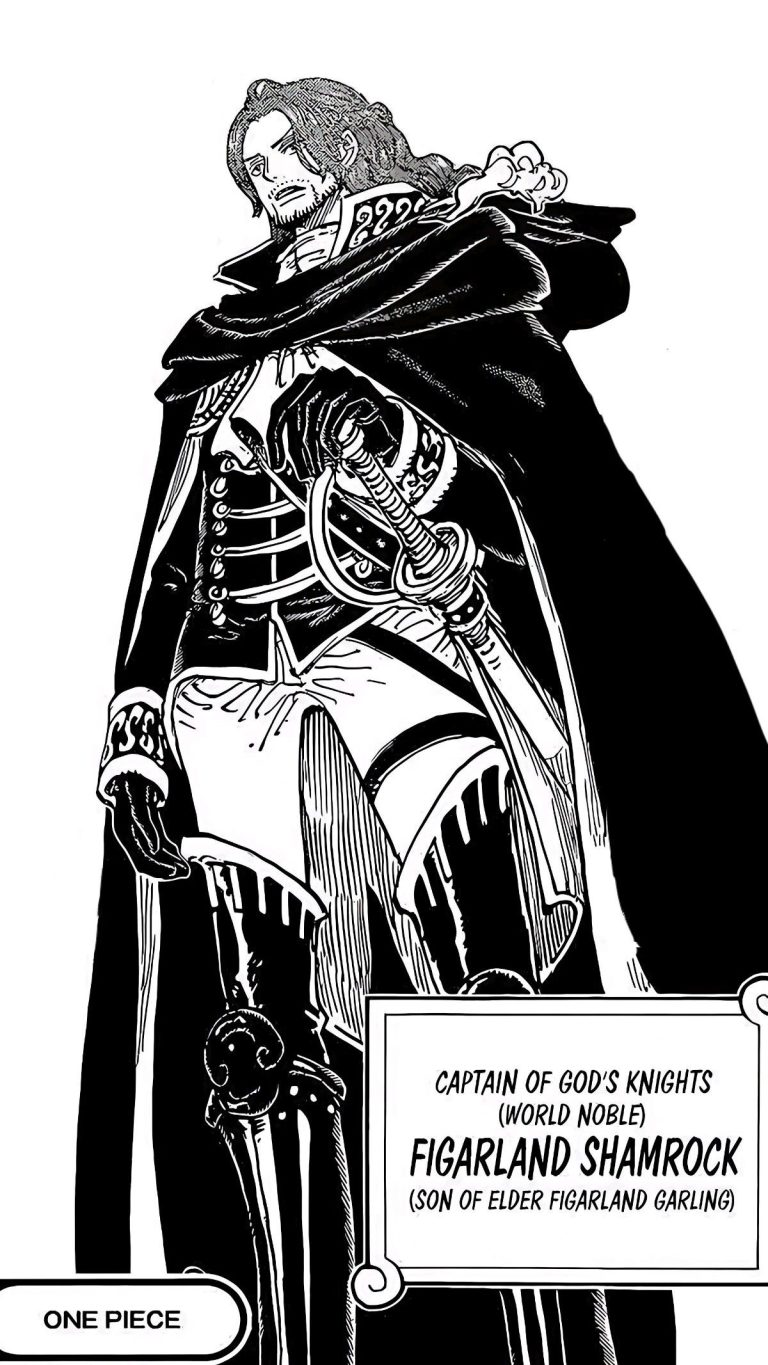
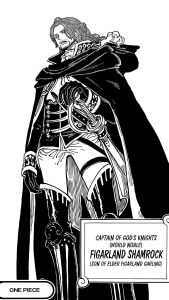
The geopolitical chessboard has shifted irrevocably. With Saint Jaygarcia Saturn executed for his failures and the ruthless Saint Figarland Garling elevated to the Gorosei, the World Government is abandoning the illusion of soft-power diplomacy. The Holy Knights (God’s Knights), long kept in reserve as the Celestial Dragons’ personal strike force, are mobilization-ready. For centuries, Elbaf remained untouchable due to the raw destructive capability of its standing giant army. But with the Mother Flame partially secured and the world sliding toward total oceanic submersion, the World Government cannot afford to let the war relics beneath Elbaf fall into the hands of the Straw Hats or the Red Hair Pirates.
The inevitable arrival of the Holy Knights on Elbaf creates a suffocating three-way conflict. We are no longer dealing with isolated island skirmishes; this is the direct ideological clash between:
– The Celestial Oligarchy seeking to exterminate the surviving remnants of Joy Boy’s legacy;
– The Sovereign Giants torn between ancient prophecies and immediate survival; and
– The Revolutionary Catalyst embodied by the Straw Hat Grand Fleet and an unshackled Loki, who will burn the world down before submitting to a throne.
Chapter 1200 as the Narrative Event Horizon for the Final Saga
Eiichiro Oda treats his century chapters not as mere mathematical milestones, but as thematic manifests. Chapter 100 gave us “The Legend Begins” at Loguetown. Chapter 1000 bestowed “Straw Hat Luffy” standing atop Onigashima against two Emperors. Chapter 1100 showcased Kuma’s tragic sacrifice in “Thank You, Bonney.” Oda does not waste these numbers.
Chapter 1200 is strategically positioned to be the structural point of no return. By converging the subterranean revelations of the Void Century with the explosive unchaining of Loki, Oda is setting up the definitive spark that triggers Ragnarök within the narrative framework of One Piece. The giants will no longer be spectators cheering on the warrior of liberation from the sidelines. They will be forced to choose between the comfortable decay of their traditions and the brutal, world-shattering dawn promised by Joy Boy.
When the chains around Loki shatter, and the war relics beneath the roots of Adam are bathed in light once more, the Grand Line will never be the same. The Void Century is no longer a historical mystery to be unraveled through archaeology; it has become an active, breathing war, re-erupting in real-time.
What do you think lies in the deepest subterranean chambers of Elbaf? Is Prince Loki a future ally of Luffy’s chaotic liberation, or the true final monster the Straw Hats must overcome before claiming the One Piece? Drop your wildest theories in the comments below!