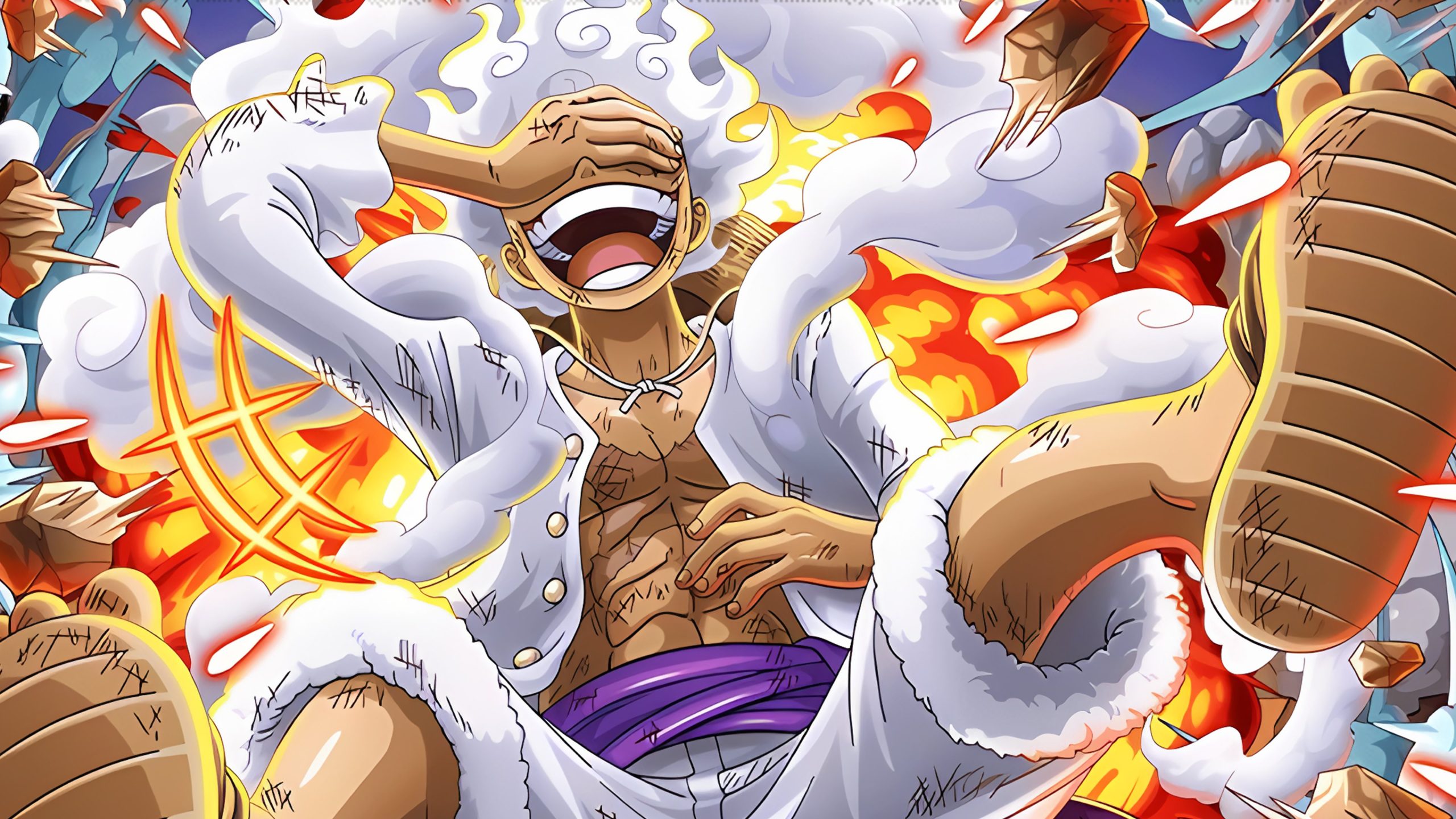
Whenever Eiichiro Oda approaches a triple-zero milestone, the tectonic plates of the One Piece universe don’t merely shift—they fracture. From the fateful departure from Loguetown in Chapter 100 to the myth-making spectacle of “Straw Hat Luffy” delivering a Red Roc to Kaido in Chapter 1000, Oda treats these centennial chapters as sacred narrative demarcations. Now, as the manga marches steadily toward the momentous Chapter 1200, the battlefield has moved from the hyper-futuristic ruins of Egghead Island to the primeval, myth-drenched canopy of Warland Elbaf. Yet beneath the jovial viking banquets and colossal tankards of ale lies a suffocating dread. The narrative trajectory suggests that Chapter 1200 won’t just be an introductory skirmish; it is primed to be the volcanic catalyst for the Final Saga’s greatest convergence, driven by the forgotten war machines of the Void Century sleeping beneath Elbaf’s soil and the apocalyptic liberation of Prince Loki.
The Centennial Paradigm: Why Chapter 1200 Demands a Cataclysmic Shift
To understand the impending gravity of Chapter 1200, one must analyze Oda’s operational rhythm across twenty-seven years of serialization. Oda does not waste centennial benchmarks on conversational filler. Chapter 500 unveiled Silvers Rayleigh; Chapter 1000 confirmed the dawn of the Worst Generation’s supremacy; Chapter 1100 ripped out our collective hearts with Bartholomew Kuma’s tragic pact with Saint Jaygarcia Saturn. Chapter 1200 sits at the critical thematic midpoint of the Elbaf Arc—the exact moment where introductory world-building traditionally gives way to existential, multi-factional warfare.
The cultural anticipation within the community is at a fever pitch. On forums from Reddit to Arlong Park, theorists are clocking the pacing with surgical precision. Egghead’s broadcast stripped away the World Government’s carefully manicured veneer of divine right, explicitly naming Joy Boy as the pirate avatar of an ancient, hyper-advanced civilization drowned by rising seas. If Egghead was the technological autopsy of the Void Century, Elbaf is poised to be its living archaeological dig site. Chapter 1200 cannot simply advance the plot—it must redefine the stakes of the global war.
The Subterranean Abyss: Treasure Tree Adam and the War Relics of Joy Boy
For decades, the lore of the grand trees of the Grand Line has dangled over fans like an unanswered riddle. We know of the Sunlight Tree Eve, whose bioluminescent roots provide oxygen and light to Fishman Island ten thousand meters beneath Mary Geoise. Standing as its botanical twin and spiritual inverse is the Treasure Tree Adam, the near-indestructible timber that birthed both the Thousand Sunny and Gol D. Roger’s Oro Jackson. Every breadcrumb Oda has dropped points to Elbaf as the ancestral home of Adam.
The Sub-Glacial Arsenal
The prevailing theory surging through the fandom posits that the roots of Treasure Tree Adam penetrate deep into the mantle of Elbaf, shielding a submerged, subterranean vault untouched by the cataclysmic flooding eight hundred years ago. Consider the mechanics of the ancient world: if the Iron Giant Emet was stored in the technological laboratory of the Future, where would Joy Boy conceal the heavy armaments of flesh and blood? Elbaf is not merely a warrior nation; it was the redoubt of Joy Boy’s closest vanguard.
The visual composition Oda has established for Elbaf presents a layered verticality: the upper branches holding celestial villages, the ground level inhabited by traditional clans, and the chained, desolate depths of the “Underworld.” Beneath those frozen prison caverns, Chapter 1200 may reveal the skeletal remains of pre-flood civilization—weapons forged not from gears and Mother Flame reactors, but cyclopean relics imbued with Ancient Giant lineage factors, subterranean naval dreadnoughts designed to survive a submerged planet, and perhaps the dormant sister-cores to the ancient energy sources that powered the Iron Giant.
Loki Unchained: The Patricidal God and the Ragnarök Protocol
At the center of Elbaf’s underworld sits its most magnetic enigma: Prince Loki, the “Cursed Prince.” Blindfolded, wrapped in colossal seastone bindings, and speaking with the razor-tongued insolence of a disenfranchised monarch, Loki subverts the archetypal nobility typically awarded to royal heirs in One Piece. By murdering his father, King Harald, to consume the kingdom’s fabled, legendary Devil Fruit, Loki willingly cast himself into damnation.
Mythological Inversion: From Nordic Schemer to Unshackled Divine Wrath
Oda’s mastery of mythological adaptation has never been more vibrant. In Norse myth, Loki is bound beneath the earth with the entrails of his own kin, a venomous serpent suspended above his head, waiting for the trumpet of Heimdall to break his bonds and initiate Ragnarök—the twilight of the gods. In One Piece, Loki’s chains are not merely punitive; they are stabilizing the world balance.
The theory for Chapter 1200 suggests that the fragile armistice keeping Loki bound will shatter. Whether precipitated by Luffy’s reckless curiosity, the interference of the Red Hair Pirates’ remnants, or an external assault, Loki’s liberation will unleash what can only be described as divine wrath. If his Devil Fruit is indeed tied to the primordial concepts of Fenrir, Jörmungandr, or a titan of chaotic earth-shaping, his unchaining signals the literal unmaking of Elbaf’s territorial sovereignty. Loki doesn’t wish to govern; he wishes to tear down the heavens—a nihilistic fury that mirrors Blackbeard’s ambitions, yet is driven by a deep, generational trauma tied to the Giants’ ancestral betrayal during the Void Century.
The Holy Knights Converge: The World Nobles’ Greatest Fear
While the Straw Hats navigate Elbaf’s moral ambiguities, the geopolitical chessboard outside is racing toward zero. With Saint Figarland Garling elevated to the Five Elders following Saturn’s abrupt, horrific execution, the command structure of the Holy Knights (God’s Knights) has aggressively mobilized. Elbaf has historically maintained an ironclad neutrality, protected by its insurmountable infantry of giants. But the World Government cannot afford neutrality in an era where the sea levels are actively rising.
If the relics beneath Elbaf are uncovered—or worse, if Loki aligns his destructive ideology with the weapons of the Void Century—the Holy Knights will be forced to intervene directly on the northern frontier. We have already seen silhouettes of Figarland’s elite operatives; Chapter 1200 provides the pristine thematic platform for the Holy Knights to make planet-fall on Elbaf, transforming an exploratory expedition into a multi-theater battleground between imperial fascists, ancient giants, liberation crusaders, and rogue gods.
Thematic Resonance: The Crucible of Liberation
What elevates this speculative chapter beyond standard shonen spectacle is the sheer thematic symmetry Oda is constructing. Luffy is the Sun God Nika—the liberator, the bringer of laughter, the warrior who breaks chains. Yet in Loki, Luffy faces a prisoner whose chains might actually be the only thing preventing global ruin. Can Nika liberate a soul consumed by hatred without inviting the apocalypse? How does the pirate who desires absolute freedom reconcile with a prince whose freedom guarantees mutual annihilation?
As the fandom braces for this monumental milestone, the clues are unmistakably aligned. Elbaf is not a pitstop; it is the threshold of the end-times. If Chapter 1200 delivers on this burgeoning build-up, the uncovering of Joy Boy’s ancient war relics and the roar of an unshackled Loki will be the clarion call signaling that the final war for the soul of the sea has officially begun.
What do you believe lies beneath the roots of the Treasure Tree Adam? Will Loki prove to be Luffy’s darkest mirror or an unexpected ally against the World Government? Sound off in the comments below with your craziest Chapter 1200 predictions!